

What if the biggest obstacle standing between you and your next big opportunity is you? On this episode of Epic Begins With 1 Step Forward, Zander Sprague talks with Dr. Albert Bramante, talent agent, psychology professor, and performance mindset coach, about fear, self-sabotage, perfectionism, and the stories that keep us stuck.
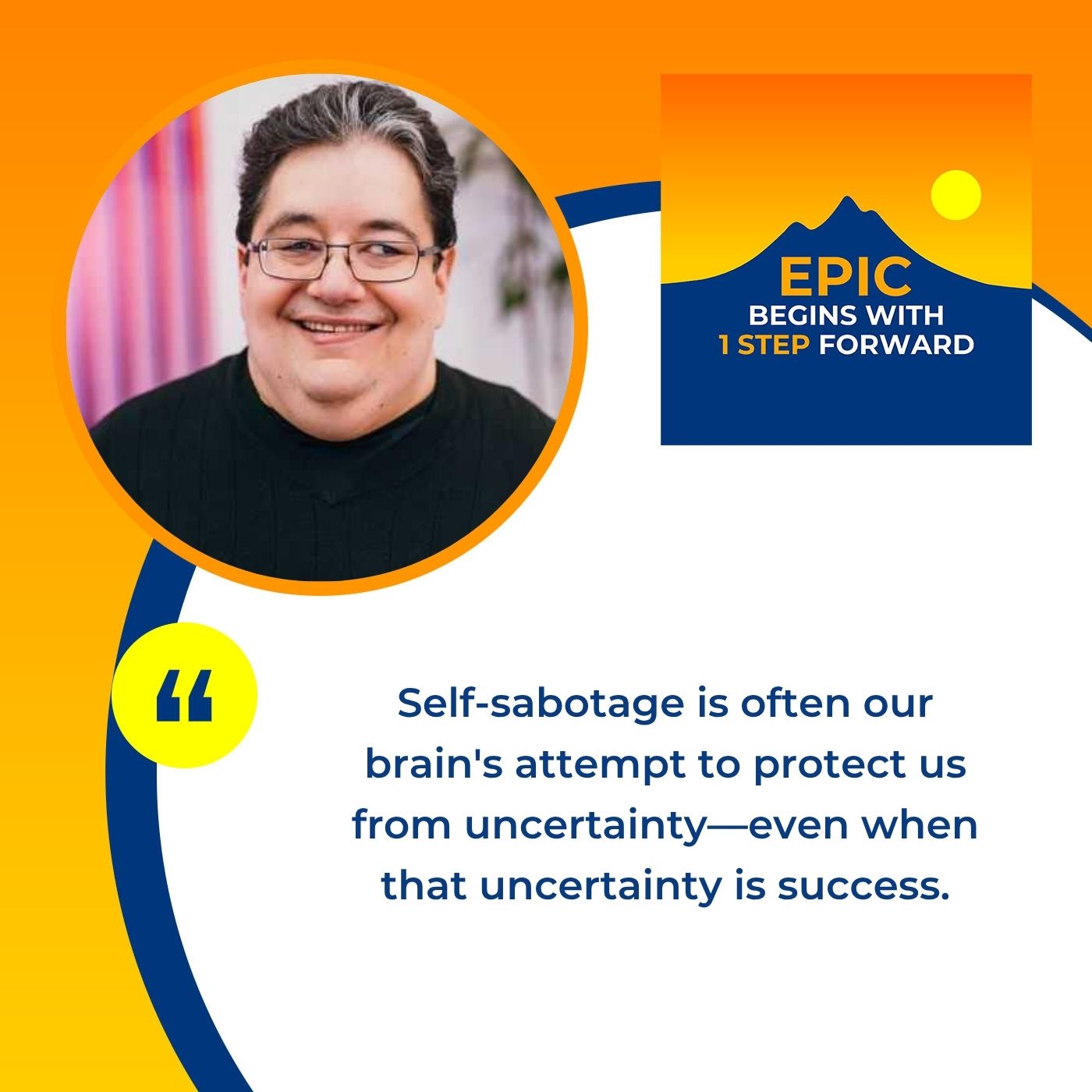
Albert shares his unexpected journey from psychology to the entertainment industry and explains why self-sabotage is often our brain’s attempt to protect us from uncertainty—even when that uncertainty is success.
They also explore the dangerous side of “not yet,” when waiting becomes an excuse for avoiding action. You’ll discover why setting a date matters, how setbacks can redirect your life, and why taking one concrete step can transform “someday” into something real.
Free E-book – https://dl.bookfunnel.com/afk096okro
Apply to be a Guest on My TV show – https://www.epicchoicemedia.com
#EPICBeginswith1StepForward #ZanderSprague #SelfSabotage #PerformanceMindset #OvercomingFear
—
Watch the episode here
Listen to the podcast here
Your Brain Is Trying To Protect You—But Is It Keeping You Stuck? With Dr. Albert Bramante
I’m so delighted that you’re joining me. I have a special guest, Albert Bramante.
Albert, tell us who you are and what you do.
First of all, thank you for having me here. I’m happy to be here. I am a talent agent. I’ve been representing actors for film, TV, theater, commercial print, and voiceover for 22 years. I also am a performance mindset coach, psychology professor, and practitioner. I work mainly in the areas of performance mindset. What that means is dealing with self-sabotage, imposter syndrome, and the growth mindset. All those lanes are my area of expertise and topics I’m passionate about and want to talk about.
Connecting Psychology With The Entertainment World
I’m also, among other things, a mental health provider. I appreciate the help that you’re giving. What led you to combine psychology and having your doctorate in that with being a talent agent?
It’s interesting because I never intended to be a talent agent or work in the entertainment industry. When I was growing up, I was so interested in the human mind and research. I was always a thinker. I am a very curious type of person. That led me to the behavioral sciences and the science of people. I was curious, so I did a lot of reading. There was still a part of me that was interested in the arts. In high school, I was in a drama club for three years. In college, I did a few electives in theater and acting.
Even though at that time I never considered it remotely something to do professionally, I liked being around this community. Looking back on it, I felt the most at home with the theater and acting community because I felt accepted, seen, and validated. That’s what led me to this population. I was interested at that time in being a clinical psychologist, which was my initial training. I was interested in being a clinical psychologist, PhD research professor, and all of that stuff.
Moving Beyond Clinical Labels To Action
I partially reached that goal. I have a PhD. I am a college professor. There were two things that deviated. One was going into the talent agency business. Two, I left clinical psychology. I left it for two reasons. Number one was for a practical reason. At that time, I was hired full-time as a college professor. I didn’t have time to devote 750 hours of practicum and a 2,000-hour APA internship, which is required for all PhD programs. The second reason is I became disillusioned a little bit with clinical psychology.
It does great work, but what I felt was that it was spending a lot of time labeling people, which I’m not a fan of, and also sometimes keeping people so cooked and baked into the problems. I would hear colleagues and professors that would say they were working with this same clinical patient for 8 to 10 years. Everything kept going on in my head. I’m like, “That’s too long.” I would think, “Something isn’t working.” I also don’t agree on the other hand where it’s like, “One session, and I will cure all your deep-seated drama.” I don’t buy into that either.
I am actively working. I have a small practice. Frankly, like you, I did put in the hours. In California, you need 3,000 hours of internship. I had 750 hours of practicum before I graduated. There’s a lot of time and effort that goes into it. I do enjoy the clinical side. I would agree there is that happy medium. Unfortunately, because we’re working with insurance, you have to have some kind of diagnosis.
I’m personally bothered by the fact that in the first meeting, I have to come up with something. I’m like, “First of all, I’ve spent so much time trying to get background. I don’t have any idea what might be the reason that’s bringing you in.” I can go in, change, and go, “Originally, I thought it was anxiety, non-specified. Now, as I talk to you, I am discovering there’s depression or some other issue.”
I also agree that eight years is a long time to work with someone. Twelve sessions is challenging because you’re getting into the meat of things. I honestly think sometimes six months is where you get it. My experience is that it takes a couple of weeks and a couple of sessions to get people to feel comfortable enough to start to share.
You need to establish rapport.
I’m happy that mental health is a little more accepted than stigmatized. That’s important. I’m a firm believer that most people at some point in their life need some help. You got stuck on something. It could be the death of someone, a breakup, or a loss of a job. It’s some life event where you’re like, “I need a little help.”
It doesn’t make you wrong. It’s the same way that sometimes you have to go to the dentist because you have a cavity. It does not make you a bad person. It’s simply what happens. You got your PhD, and somehow, you end up as a talent agent. To quote Sesame Street, “One of these things is not like the others.”
One of the themes of my life is that one thing doesn’t belong here, but I found a way to make it work. What happened was that when I received my Master’s degree, I did an internship at a New York talk show, working in an unconventional way. Most people only do internships at talk shows on the production end or as a PA. For me, I happened to be a little resourceful.
I don’t know if I can say I’m proud of this, but when I wasn’t working in grad school, I spent my summers being a talk show addict. This was in the early 2000s when talk shows were at their peak and on their rise. One of the shows I watched was Sally Jessy Raphael. You have to be almost of a certain era to remember that one.
Combining psychological insights with talent representation creates a powerful foundation for personal growth.
I do remember it, so I’m in that era.
I was watching this show one day. I was watching these boot camp shows where they would transform these people, which we could debate whether that’s true or not. I was watching this woman who was an expert on the show, and I was like, “I like her.” I went to Sally’s website, and there was a feature saying, “Ask this woman a question.” I didn’t think anything was going to happen.
I put in there, “I’m a grad student in family counseling. I like your work. I would love to work with you on the show. Are there any opportunities?” and hit send. I didn’t hear anything for two months. One day, I was going off to class. Right before my class began, I was checking my email, and I saw a response from her website. I thought it was spam, but I clicked it open anyway. It was from this lady. She was like, “Yes, I am. I’m looking for an intern for the spring.” I said, “Let me go for it,” and I did. I landed it.
In the talk show capacity, there was something called the aftercare, which was designed because of what happened with Jenny Jones in the ‘90s, where a guest was killed afterwards. They wanted to, for liability reasons, temper everybody before they went home and then find resources and follow them through. That’s where I worked. That was the department I worked in aftercare. I had nothing to do with the production of a show.
I got to see firsthand for three months what a New York City talk show was like. That was eye-opening. After that happened, I decided, “I’m never going to work in talk shows again,” but I kept in contact with my contacts. Here’s what happened. When I was young, I was under that naive assumption, which now I know is naive, that these talk show hosts cared about their guests. They don’t. It’s acting. It’s show business.
Here’s what happened. They get the script beforehand. The host reads it from the teleprompter. They get an earpiece in their ears, and the producers feed them the questions. It looks like the host came up with this on their own, but it wasn’t. They’ll get a briefing. The host will have an hour meeting. Sally would have an hour meeting before the show is recorded with the producers about what to go over.
Uncovering The Unscripted Reality Behind The Lens
The producers would then take every guest, separate them, and make sure there’s drama between them. They manufacture drama. Each segment had to have at least one chair being thrown, someone walking off crying. They would have wranglers in the audience that would put a card up like, “Everybody boo right now. Everyone clap now. Everyone sigh now.” It was all choreographed, the entire thing. One of my critical lessons about show business is the persona that you see on TV and the actual human being most of the time are complete 360-degree opposites.
Never confuse a staged public persona with authentic human experience.
Here’s what I’ll say. I do have my own locally broadcast talk show, which is very similar to this. I am talking to one person. I’m in a TV studio and stuff. I do not have a producer talking in my ear. The questions are not manufactured. I’m going over who the guest is. I think about it the same way I do on my show. I’m like, “What do I think I want to talk about?” I like having an organic conversation. It makes it a lot more real. I get what happened in the ‘90s. Look at Jerry Springer. All of that was over-the-top contrived. Geraldo Rivera and all of those.
It’s like, “This makes complete sense now.” I’m older and a little bit wiser. After the show ended, I kept in contact with my supervisor. This was the same year 9/11 had happened. Right after that, my former supervisor called me and said, “I’m assembling a team. We’re going down to work with some artists. We’re going to do some advocating and volunteer work for rescue workers and their families. I can use your help.”
At that time, I wasn’t working, so I said, “I’ll jump down.” New York was very close to me. I started working with actors. That brought back memories of high school and college. It was like, “Let me go back to acting now.” New York City is one of the acting places in the world in the United States, as well as New York and LA.
New York, Hollywood, and LA.
I decided, “Let me become an actor.” I got my headshots and did all of that. I didn’t like it as much as I thought I would. What I did like was the community aspect of it. I liked working with actors and being in love with actors. After about a year and a half, I was like, “This isn’t for me.” For me, I didn’t deal well with unpredictability. I liked the stability of a job, but I was like, “I wanted to stay in this business.”
I did some volunteer work. I worked at film festivals. I worked on film sets as a PA. I started recommending actors for little roles like independent films and shorts, and these actors I was recommending were getting hired. I thought to myself, “Maybe I could make this a business.” In 2004, I said, “I’m hanging out a shingle. I’m starting a talent management business.”
I moved over to an agency. It’s the same capacity, but a little bit of a different role. In 2007, I became a licensed talent agent and have been there ever since. In the year 2000, when I was in grad school, if you asked me this, I never would have guessed. I would have laughed at you and said I wasn’t working in show business.
I get you. When I came out of college, and I majored in History and Psychology, I was like, “I’m going to go be a counselor.” Then, I took a 22-year detour through the corporate world. I worked in high tech. At one point, I was a software developer. I was a quality assurance engineer. I spent most of my time doing technical instruction, which I was better suited for. If you told me in college I was going to do software development, I’d be like, “I know nothing of that. Why would I do that?”
I’m also, as are you, open to what is possible. I’m like, “This looks interesting. Let me check it out.” Sometimes, it works out. Sometimes, it doesn’t. For me, that’s part of that epic journey that we’re all on to be open to doing something. You look back and go, “I never would have guessed that I would end up here.” If you asked me in college whether I would write a book, I don’t like writing. I’m a talker, not a typer. Yet, I’ve written three books. I have a fourth book coming out. It blows my mind.
A sudden setback may actually be the exact breakthrough you need to realign your purpose.
I always dreamed of having my own TV show. When I was younger, I thought I would be the next Mr. Rogers. I’d have the Commander Zander Power Hour and be a children’s show. Now, I have a TV show. All of that’s because you think of something, and then you go, “Let me take one step towards this goal.” You were working in the industry, helping actors, and then you were like, “I might be able to make some money at this.” It’s not about the money per se, but it is certainly helpful if you’re like, “I like this. People will pay me to do it.” Isn’t that nice?
Embracing Detours On Your Professional Journey
I’ve always felt like you’ve got to love what you do. If you want to succeed, you have to love what you’re working at. Also, there were a couple of other things in my life that were happening. I started teaching at the college level, first starting off as an adjunct at the community college. I realized how much I love teaching. Teaching has always been in my blood because my mother was a teacher and my father was a football coach. Between the coaching and teaching, it was in my blood to teach. That is in my DNA to teach.
I then decided I was going to go back to add another thing to my plate. I always wanted to be a doctor. Not a medical doctor, but I said, “I’m going to become a doctor.” I decided I was going to go for my PhD. I was halfway there with my Master’s. It was always my goal to have a PhD. I enrolled in 2005 at Walden University. Walden is an online university.
At that time, as I was going through the program, online learning was in its bare infancy. It wasn’t exactly looked upon very positively by a lot of people who were already established PhDs. I dealt with a lot of contempt from other PhDs like, “You’re doing this online?” Now, it’s a lot different. If I were going to go back or if I started now, it probably would have been looked at a lot differently.
When it came time to start brainstorming dissertation topics, that was the one thing I dreaded. I was like, “What the heck am I going to write a 300-page book on?” As I was building my talent business, one of the issues I kept bumping into was these actors that were self-sabotaging. Why was this happening? It was happening on a large scale, not just with me, but with other people I was talking to.
When it came down to a brainstorming session for dissertation topics, I brought it out. I’m like, “What’s up with these actors?” The committee that was running this workshop turned to each other and said, “There’s your topic.” My dissertation was on self-defeating behavior in performing artists. I found a way to bring both of my passions together and unify them. That’s what I spent 8 to 9 years studying when I was writing and doing my dissertation. I was putting all of that together.
It took me 8 or 9 years. People who are reading may be like, “That’s a long time.” I got sidetracked. I got hired in the middle of this to teach full-time at the community college. When you work as a full-time academic, even though this was not a research institution but was teaching-focused, it still took up all of your time. There’s so much more in a teaching position than just teaching classes. You have to have office hours. You have to advise students. You have to be on committees. You have to do community service for college.
Reframing Setbacks As Pivotal Opportunities
It is a full-time job. That took up a lot of my time, so my dissertation for at least 5 of those 9 years went on the back burner. One of the things I talk a lot about is how the hardships that happened to us can be the best things in the long run for us. At the end of my fourth year, I was in a tenure-track position. I found out devastatingly that I wasn’t going to be granted tenure. They were doing budgetary cuts. There were thirteen of us college-wide who got the X. I was one of them. I was devastated and completely gutted. They say hindsight is always 20/20.
It’s so clear when you look back.
I was too comfortable here. I always assumed I was going to get tenure because I had great reviews, great evaluations, teaching awards, and accolades. I assumed tenure was going to be granted. It wasn’t. My rug was completely pulled out from under me. It turns out that was the best thing that happened to me. This was many years ago. I got to focus on my dissertation and complete it. Then, I went back to teaching part-time, which I still do. I will never go back into full-time academia anymore because of the commitment.
Someday is not a date on the calendar. Set a firm deadline to turn intentions into action.
A lot of people think that my life is full of drama because I work with actors. I can tell you there’s much more drama in higher ed politics than there is in actors. Actors are a walk in the park compared to the drama in politics with high school academia and politics between administration. I love teaching, and I love my students, but no more. I can’t do away with this. I like it because I can go in as an adjunct, teach my class, and leave. My only responsibility is to the students I work with.
Briefly, what did you discover were some of the causes of the self-sabotaging behavior in actors?
Recognizing Self-Sabotage As A Defense Mechanism
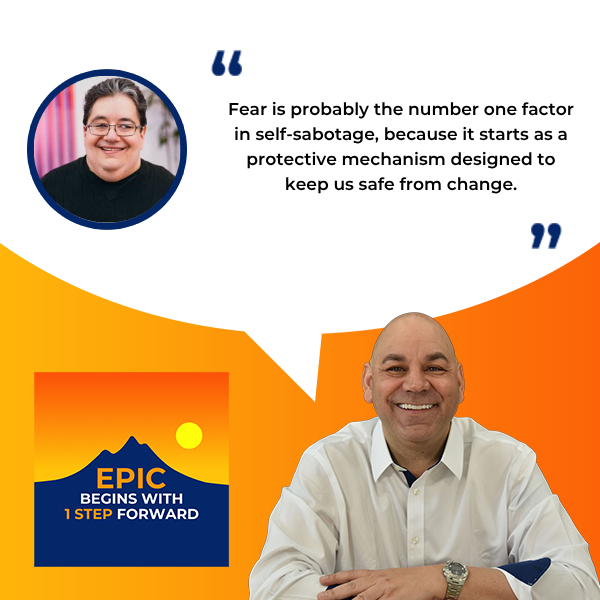
Fear is probably the number one factor because what I’ve learned with self-sabotage is that it’s a protective mechanism. The design is for protection. The outcome is a bit faulty, but it’s still a protective mechanism. Our brain is designed to keep us alive and avoid predators, in a sense. What I mean by that is thousands of years ago, or even hundreds of years ago, when we were living at the end of the day, we had so many different threats to us.
We had weather. We had famines, droughts, threats from animals or prey, and other tribes. We had to be constantly vigilant. Our brain has to be constantly active, searching for threats and retreating immediately. We’re in a much more evolved environment now. However, our brain still operates on a survival mechanism.
Anytime it sees any type of change or any type of little things that make us uncomfortable, it starts to signal, “Danger. Pull back.” We go into fight or flight mode, which is a great thing, but sometimes, it can go into overdrive. It can work against us because any type of change is scary. That change could even be a success. Another thing I learned in doing this work is there’s fear of success.
In my next book, which I call Epic Reset, I’m talking about how we have the patterns that we get into. We have that emotional reaction to something. You get in a loop. It’s a response to conditioned stimulus. It’s like, “This is happening, and here’s how I react.” In the book, I’m talking about that precious two-second window where you get to make another choice because that reaction isn’t helping you.
Self-sabotaging behavior, I will admit, I certainly have that. There’s stuff I know I need to do, or I need to make that phone call, but I’m a little leery that someone’s going to say no or that even someone’s going to say yes. Then, what do I do? It’s part of the reason I wanted you on. I’m like, “I get that. We can talk about self-sabotaging.” That is interesting. Our time is almost up, but I love to ask my guests this question. I love the concept of not yet. There are things that we say we’d like to do, but we haven’t done them yet for whatever reason. What are 1 or 2 of your not-yets?
That’s a very tricky thing to navigate because not yet could also be a lie that we’re trying to tell ourselves to not take action because we’re afraid to. The not-yet trap is perfectionism. We’re like, “I have to work on this. I am not yet ready to launch this because I need this.” When that’s done, we’re like, “I need that.” You start layering it, and eventually, that not yet becomes a lie. I wrote a blog post about this. It was called Not Ready is a Lie. For me, when I hear people say, “I’m not going to do this yet,” I often have to ask, “What does that mean?”
I’m going to counter for a second in the way I’m using it. For example, I know the editing process and proofreading take so many weeks. I believe four weeks should be enough. Someone goes, “Has the book come out?” I’m like, “Not yet.” It doesn’t mean that it’s not. I am actively working on it. For you, it’s like, “Are you done with your dissertation?” You’re like, “Not yet.” It’s not coming out now. That happens. That’s not avoidance. That’s like, “It’s taking me longer.”
That’s true, too. You want to put out quality. When I released my first book, I did two rounds of editing. I went to two different editors and went completely new. I didn’t set a time for them. I didn’t say four weeks. I didn’t say six weeks. I said whenever it was done. That could have been two weeks. Luckily, I had a very fast turnaround with my editors. I worked hard to get the changes to them. If you’re going to say, “Not yet,” my whole thing is like, “Let’s talk about a tentative date.”
You put something solid out there.
Eliminating The Perfectionism Trap Of Not Yet
Let’s not leave it open-ended. Put something solid. When people tell me that they’re going to do it with this goal, I’m like, “Let’s take the first step of this. When will this be done? Let’s get the calendar out when this gets done.” When you make a date, it becomes real. When somebody says, “I’ll try. I’ll get to it,” I’m like, “I know you’re not going to do that unless you set a time.” You could always revise and say, “I didn’t quite get this date, but at least I’m moving closer to that.”
I 100% agree. I’ve got a question. If people want to learn more about you, get a hold of you, or read your blog, how can they find you?
You can find me online at AlbertBramante.com. You can find me on LinkedIn, Instagram, and all the socials. I recommend checking my book out, Rise Above the Script. It’s on Amazon. I have an audiobook version of it. I’d love to connect.
I want to thank you so much for joining me. What a great conversation.
Thank you so much for having me here.
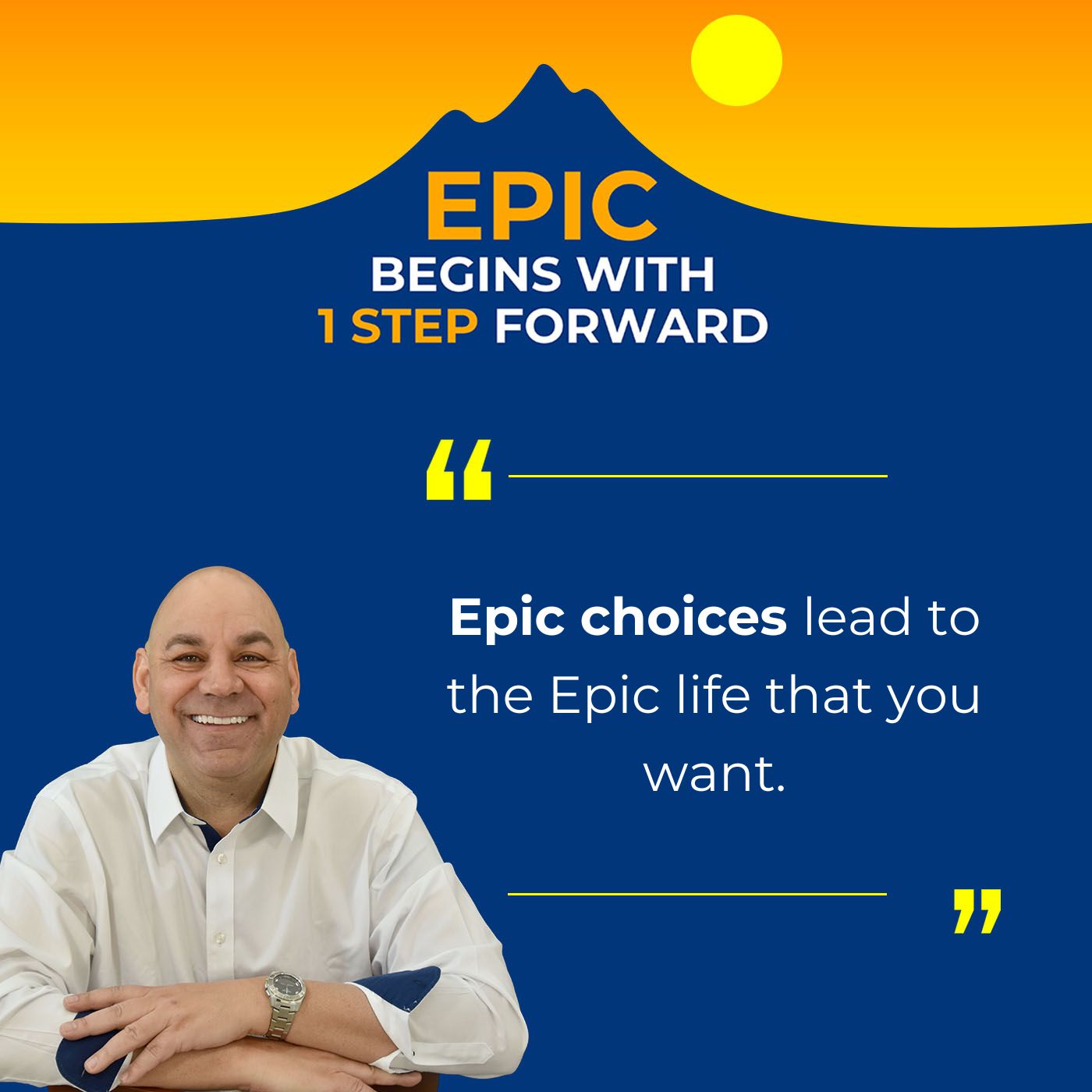
I want to remind everyone that if you’re ready to begin your epic journey, go to EpicBegins.com. If you want a little in-person help with your epic journey, I am planning an event. I am working out the details, but January 23rd, 2027 is when I’m going to have that. Be on the lookout for that on EpicBegins.com. As always, I want to remind you that epic choices lead to the epic life that you want.
Important Links
About Dr. Albert Bramante
 Albert Bramante, a seasoned talent agent with more than two decades of experience in the entertainment industry, holds a Ph.D. in Psychology from Walden University. Additionally, he is a certified Hypnotist and NLP Practitioner, bringing a unique blend of psychological insight and practical expertise to his work.
Driven by a passion for both the performing arts and the human psyche, he embarked on a mission to empower actors to overcome self-sabotage and unlock their full potential. Throughout his impressive career, Dr. Bramante has achieved remarkable success as a talent agent, securing roles for actors in a wide array of productions, including TV shows, films, commercials, Broadway, and Off-Broadway performances.