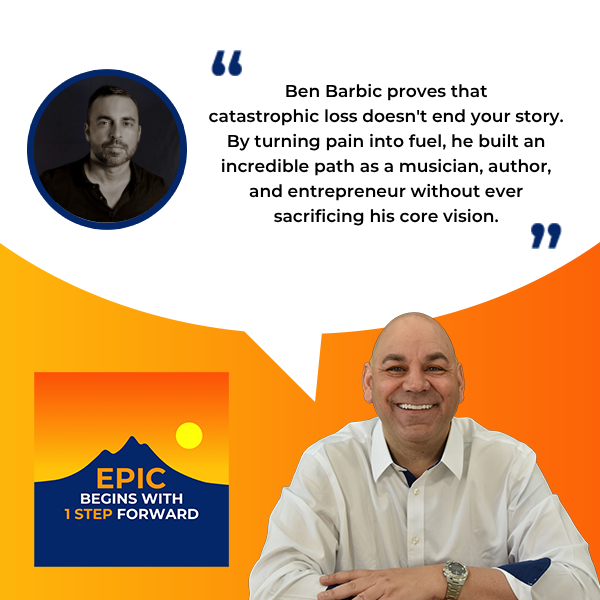
In this powerful episode of Epic Begins With 1 Step Forward, Zander sits down with musician, author, and entrepreneur Ben Barbic to talk about resilience, identity, and the choice to keep moving forward. Ben shares how losing his home to a wildfire, then again to an earthquake, shaped his belief that pain can become fuel. Music became a steadying force, while work, family, and creativity taught him that life doesn’t have to be “either/or”, it can be “and.” Together, they explore self-doubt, the inner critic, the courage to release creative work, and the importance of believing you are good enough. Ben also shares the story behind his memoir, Rise and Climb: Finding Purpose Through Pain, and why progress matters more than perfection.
Free E-book – https://dl.bookfunnel.com/afk096okro
Apply to be a Guest on My TV show – https://www.epicchoicemedia.com
#EPICBeginswith1StepForward, #ZanderSprague, #Resilience, #RiseAndClimb, #PersonalGrowth
—
Watch the episode here
Listen to the podcast here
He Lost Everything Twice—Then Built A Life Around Resilience With Ben Barbic
In this episode, I have Ben Barbic with me. Ben, tell us who you are and what you do.
I’m from San Jose, California. For a long time, I’ve been a musician. As of 2026, I’m a published author. I’m an entrepreneur. At the core of why I’m here, why I wrote the book, and why my music has done well is that I’m a person who’s curious about what I’m capable of. I like to wake up every day and say, “What can I do to make progress in the various aspects of my life?” I’m very passionate about that. I go through ups and downs and things like this as my life did, but at the core, that’s something that I want to share with people.
Honestly, it is the core of the show. I love to have guests on and talk about their epic journeys. Let’s face it. We all have more than one epic journey. Tell me a little about your book.
Turning Catastrophe Into Fuel
My book is a personal memoir. It traces back to my origins. When you’re looking at my life and how I developed as a person, to me, it’s critical that I go back to the beginning because I got some key points to how my philosophy of life was started from a fairly unusual few year. I’ll start at the very core beginning. My father was a professional motorcycle racer. We had a couple of motorcycle dealerships here in the Bay Area. It was called Yamaha San Jose for people from the Bay Area.
In the same year, we lost our house to a forest fire. During that time, my parents were struggling to deal with that. The manager of the store embezzled, so we lost the store. My whole life changed in that moment. The perspective of the world that I was in was then taken away. We were in a donated trailer surrounded by nothing but burnt trees and things like that.
It put something into my life that, first of all, things can be taken away from your control. During that time, I found music as an escape. While we were in the trailer, and we didn’t have running water, and we were struggling. The world got lost, and I found music as an escape for me. That was a seed that got planted right there. Fast forward two years, our house was destroyed again in an earthquake.
The early memories of me formulated a mentality of when something bad happens, you can find the fuel within it to continue. That’s what my life became. Those early seeds are important to preface because I struggled for a long time, but I had those seeds in there. At 28, I said, “Enough is enough. I know what I need to do.” I started implementing these inner things.
I couldn’t agree more, especially when we have what I call the epic unexpected, these major life events that you have no idea are going to happen, and yet they do. Those are the times where we discover how resilient we are. We are all a lot more resilient than we believe that we are. When you don’t have any other choice but to take steps forward, as you did and your parents did when you were living in that trailer. What are you going to do? Do you pull the blanket over your head and say, “This stink?” It does, but your life is still going on, whether you’re participating in it or not. That’s great. You said that you’re a musician. Clearly, music’s important to you. How did music help you through that tough time?
Creating An Anchor In The Chaos
When we have outlets to channel what we’re going through, I’m a little reserved on using it as an escape. I would use it more as a tool. When you have an outlet that you can go within and consistently go within, it provides a sense of stability. Music is a world you can enter, and it creates what you want it to be.
You can create a world of stability within the chaos of the outer world. I’ve always been fascinated by music in that lane. I’ve always used it as a direct artery to my soul through music. My music is always based on what I’m going through in an emotional journey of a journal, you will. There’s a core truth to it in the way that I utilize it as an artist.
As a musician, have you been able to tour? What’s the biggest crowd that you’ve got to play to yet?
For the crowd, maybe about 1,000. I haven’t played to gigantic crowds. I’ve always had to maintain sources of income. My son was born when I was 22, so I had to switch gears into making money. The whole time that I was continuing with music, I had to start a career at the same time. One of the things that I was very adamant about for myself was that I needed to be able to have a career that could sustain and bring in money to provide for my family, but I’m also not going to give up these other activities. I’m going to keep nurturing them every day.
Replacing Either Or With And
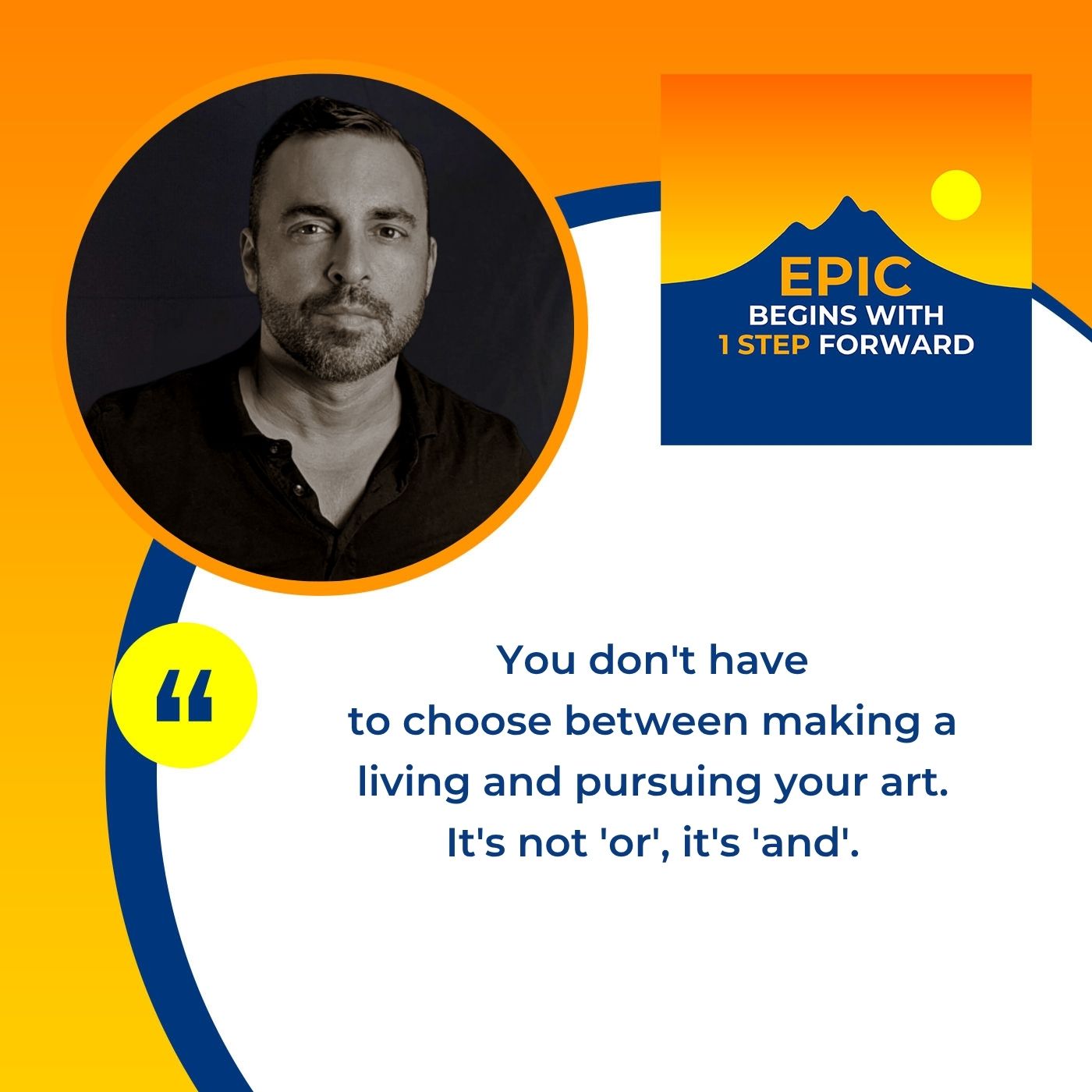
I have gotten to travel, go around the world, and record albums all over the place. It opened up this great opportunity that I didn’t have to ever let something go or give up on something that I believed in my core. They could keep stacking on each other. It wasn’t a pivot moment where it was like, “I got to go make money. I have to give up music.” It was the opposite.
It was like, “I got to go make money, so I’m going to be driven when I do have time to make music in the day. I’m going to make the time, and then I’m going to keep growing it.” That’s what I found very fortunate. Even as I’ve gotten older, music has continued to grow and thrive. I’m getting more plays, and the audience is bigger than ever before. That brings me a lot of personal satisfaction that this is a blueprint other people can do. You don’t have to choose.
When life strips everything away out of your control, you can choose to let adversity burn you or let it ignite your next chapter.
The important thing is the difference between two words. It’s not or. It’s and. We’re like, “I have to go get a job.” We have to have a job. We have bills to pay. We have a child to take care of. It’s not music or work. The other thing that I think is key, and I know it’s been true in my life, is some of the epic things I’ve done happen because I was like, “This is important enough to me that I will find the time.”
We all have 24 hours in the day. If you have your regular 40-plus hour work week, you still have lots of hours. You have to sleep and stuff, but if you schedule it and say, “My music is important. I’m going to be working on my music from 8:00 to 9:30 on Tuesday, Wednesday, and Thursday,” it gets done. Often, the things that I’ve done in my life happened because I was like, “This is important enough. I am putting the time in. I control my schedule. I’m the one who says, ‘I can do this.’”
I used to run. I don’t run as much now. When I did, I was getting up at 5:00 in the morning because nothing got in the way of that. If I said, “I’ll run after work,” I had a family. Stuff comes up and gets in the way. I love that. You’re right. It’s not an or. It’s an and. The name of your book is Rise & Climb, correct?
Yeah, Rise & Climb: Finding Purpose Through Pain.
How did you come up with that title?
Falling In Love With The Daily Climb
It’s the concepts that I live by, very simply. In a literal sense, I like to look at every day with the philosophy that I rise up, I get up, and then I climb. I’m enjoying the climb. I see your book behind you there. It’s a similar philosophy where I enjoy the climb in life. I enjoy the challenge. I enjoy the pursuit of things. The climb is the gloriousness of life to me in a lot of ways. It’s the curiosity. It’s the push forward. When you see things in front of you that are a challenge, you address them and then keep on going with the philosophy, “I’m going to keep going with this thing.”
You brought up a topic that I’m going to connect to a little bit. My book started when I was at the airport, going somewhere for music, and I started typing my life. Then, what happened was I started seeing the commonalities of things and the resilience that I had to overcome. I started to play into the principle that I would wake up at 4:00 for years. It took me a long time to write this book.
I would wake up at 4:00 for years and work on the book. Music is a little bit different because you can put the headphones on and go into your own world. With the book, it was like running. The silence of the morning was perfect for writing. It’s this perfect space. Europe and overseas are where you’re getting messages. It’s a great time to keep going.
To go back to the title of the book, I started seeing the commonalities of all the different obstacles that went on in my life. I learned that I gained fuel from them. Either that fuel was burning me, or I was using it, and it was igniting me. That’s real. That’s how I’ve always approached it. On the first couple of tries of the book where I got, “It’s good, but not that great,” I was like, “Rejection on that. Keep going. Go back to the book. Keep working on it. What am I missing? Did I cheat the reader?”
On a memoir especially, it’s something where I realized I’m cheating the reader if I’m not giving the whole story. Although it’s uncomfortable to keep going into the depths of some difficult times, that’s where the real fuel is, if I could provide that core story. That’s where I had to go. I had to allow myself to go down that road, get a literary agent, and get published. I was cheating them. I knew I was cheating them, but I didn’t want to go further. I had to throw that out and say, “If I’m going to go in on this thing, I got to go in on this thing.”
You don’t have to choose between financial responsibility and your creative passion. Stop saying ‘or’ and start building ‘and.’
Oftentimes, the most compelling stories are the ones where you allow yourself to delve into it and to share it. I certainly can write a motivational book, but what makes my books good is I’m talking about deeply personal things. I’m sharing that. Music is the same way. As a composer and a musician, you write a song that frankly hurts a little. Those are the songs that people connect to. If it’s like, “It was a sunny day, and I drove my car.” People are like, “That’s a poppy song.” They don’t connect to it. That’s great.
I have to say this, having written three books, and I’m working on my fourth one. I love to talk to authors about this. You were talking about how you wrote it, and then you were like, “That’s not right.” There is that process, but there does come a point where you’re good enough. I talked to some people, and the book doesn’t come out because they want it perfect. I’m like, “There isn’t perfect. You will never always find something.”
I’ve been fortunate to have some good editors who are like, “We’re good. Stop. You’re trying to fix stuff that frankly doesn’t need fixing. It’s fine the way it is.” It’s that perfect way to say something. If you read and go, “I get it,” that’s awesome. Did you go through this process during the whole proofreading? I probably read my books cover to cover 6 or 7 times. Proofreaders go through it. You’re reading it. You’re like, “Did we get it?” I’ve said this on the show before.
When my books came out, I didn’t want to open my book for about two months because I had honestly spent six weeks reading my whole entire book. With any book, if you read it repeatedly, like Harry Potter, six times, you get done. They’re like, “Let’s go read it again,” but you’re like, “I love the book, but let me walk away for a moment. I don’t want to see it.”
I find that in any art. Al Pacino said he never watched The Godfather. That’s what it is. I struggle with that with music. The first listen after I put out a song is cringey. It is torturous. When I open up my book, it’s interesting because sometimes, it’ll be so detailed in how I’m looking at it that I’m no longer reading like a normal human read.
I’m in some parallel universe the way I read it, so nothing is making sense. That’s part of it. To touch on the place of it’s good enough, that’s an important piece in any art. I see that with musicians all the time, too. This can pivot to something else, but good enough is important. Also, you’re good enough. That’s this other piece.
That’s a big one.
Silencing The Internal Heckler
That’s the piece that I changed my life on. I’ll be honest with you. When I realized that I wasn’t treating myself like I cared about myself and loved myself, that’s the thing. “It’s good enough. I’m good enough. You’re good enough,” is, to me, the vital piece that opens up the flood gates to progress.
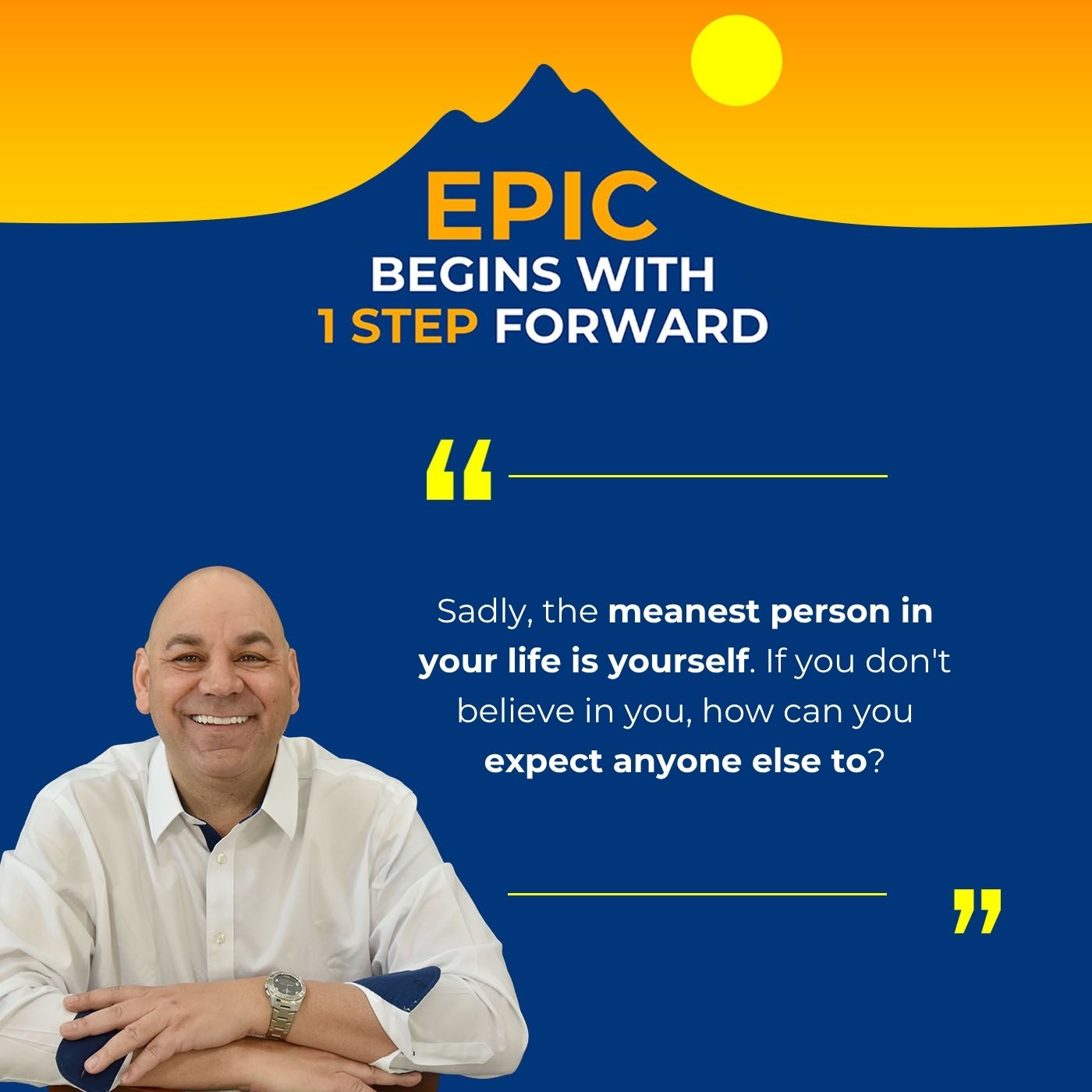
I say in my book, EPIC Begins, “Sadly, the meanest person in your life is yourself, so stop it.” The things that we all say to ourselves on a daily basis, like, “I’m not good enough. People aren’t going to like this. You’re not a writer. You’re not a songwriter. You’re not a musician,” or whatever it is, stop it. If your best friend said one of those things that you say to yourself, you’d be devastated. You’re like, “Why are you so mean?”
That’s right.
I tell people, “Stop it.” It goes back to you having to believe in yourself as an author, as a musician, as an entrepreneur, or whatever. If you don’t believe in you, how’s someone else going to?
That’s right. That realization, for me, was a rock bottom moment at 28. I looked in the mirror, and I said, “I don’t recognize this person. I don’t love this person. I’m so far off from where I feel I should be.” It was almost like taking a step back and thinking, “How would I talk to this person if it was my son or daughter?” The inner mind war that I was going through and not allowing myself any progress, like, “How did I get to that place? Why am I allowing that so deeply to my core?”
Saying, “Enough is enough of that,” and starting to listen to that voice, like somebody who’s talking in your ear that you can brush off, is what I would attribute it to. Somebody is heckling you, where you’re like, “They’re heckling me. That isn’t the voice I need to be listening to. It might be strong right now, but it’s not going to be the dominant voice in my life.”
I call that my committee. Those are the voices in your head that are super negative people. They’re telling you that you can’t do something, you’re not good enough, and people don’t like you. When I wrote my first book, I sat on it for five years. I told people I was coming out with a book, but I was lying to myself and to them because I wasn’t doing anything for that book to come out. I didn’t want to be the guy twenty years later going, “I’m coming out with a book.” It’s like the boy who cried wolf. I was like, “Stop it.”
I got brave, I put the book out, and an amazing thing happened. People liked it. I have to say, for the first six months, people would write to me or come up and go, “I read your book. I liked it. It was helpful,” but in my head, I’m like, “Really?” I would have believed it if they told me it wasn’t worth the paper it was printed on, more than a compliment. The psychologist in me says, “Statistically, I have enough positive feedback that I have created something good that people like.”
I was laughing when you were talking about when you hear your song or whatever. I do a lot of speaking. When I hear myself, it is cringe. You were talking about Al Pacino. Maggie Smith, who was a great actress, was on a gazillion things like Downton Abbey. She played Professor McGonagall on Harry Potter and stuff like that.
She’s like, “I haven’t seen any of it,” but you’re like, “You’re brilliant.” I get it. Being out and creating stuff, I’m like, “Do I want to listen back to myself?” You do get super critical, like, “You don’t sound good. You don’t sound articulate. Why did you say that that way?” Maybe you’re playing music, and you’re like, “That chord wasn’t played right.”
It all can come up. It could be anything, even watching back a podcast or an interview. It’s a double-edged sword, too, because if you’re not reviewing what you’ve done, you’re not able to take the notes on it. If Al Pacino watched The Godfather many years ago, he probably would’ve said, “That was pretty good.” He might’ve been able to dive something into it. It’s hard to overcome, but there’s some gold in it if you do.
I agree. You do have to go back, accepting that there’s part of it that is cringy and hard. You have to turn those voices off and go, “Let me listen for where there’s opportunity for improvement. It’s not perfection, but it is what I put out.”
I’m going to ask you a question on this before I get into this. Was there a moment while you were sitting on the first book where you were like, “Enough is enough.” Was there a specific moment, or was it in general, like, “Now I’m going to put it out?”
The harshest critic you’ll ever face is your own inner voice. Treat that negative thought like a heckler and keep pushing forward.
I did have that moment where I heard the words coming out of my big pie hole of, “I’m coming out with a book.” I’m like, “You’re not. You’re not doing anything. You’re sitting on this thing.” Part of that was because I had feedback throughout school that I was not a good writer. In complete honesty, the fact that I’m working on my fourth book blows my mind. I’m a talker, not a typer.
Uncovering Alternative Routes Forward
The other thing that I think is important is that there’s often not one road to get to your destination. Oftentimes, we lock in because we are psychologically creatures of habit. We’re like, “I know how to get here.” I used to drive down to Silicon Valley when I worked in the corporate world every day. I would be coming down 680. If there was something wrong with 680, I’d take 880. I know I’m being very specific for people who don’t live in the Bay Area.
I’m from the Bay Area.
I know you are, but I’m saying that for the rest of the people around the world. I didn’t entertain that there were more than those two ways to get to work. However, there was a time when I did allow myself, and it was more because I was forced to. I was trying to get home from Silicon Valley. I lived in Castro Valley up in the East Bay. There were two major truck accidents, one on 681 and one on 880, that had them shut down. I’m like, “How am I going to get home?”
Luckily, there was some form of GPS navigation that brought me through Fremont. I discovered a new way to get home. I was like, “That’s awesome.” In my writing, I found ways to be able to dictate, and then I have something to work with. It’s too hard for me to sit down and try to type it all out. Honestly, if you and I were texting and it’s going on too long, I’d be like, “Ben, I have to call you.”
I find spoken word is so much more efficient because it is a synchronous conversation. I talk to people all the time, especially younger people who are so used to doing everything over text. I’m like, “Let’s talk because my time is valuable.” A two-minute conversation can replace 30 minutes of texting back and forth.
To piggyback on that, I love voice notes. I love having conversations with people through voice notes. It’s me talking, and they get the voice, and then they send back their voice. It’s this exchange were uniquely, you could be present in them. It’s interesting. You can’t talk back to them, so they’re talking, you’re listening to them, and then you send it back.
That’s important. I’m going to sound like an old man here. The problem with all of the texting and stuff is so much of our communication is nonverbal. If I can see you, I can pick up clues to how you’re reacting to what I’m saying. If I can’t do that, then at least on the voice. If we’re doing voice notes, I can hear the intonation. For example, something that we all say all the time is, “Shut up,” but the way in which I say it tells you how I mean it.
On text, you can’t get it. If you’re telling me something surprising, and I’m like, “Shut up.” You go, “He’s not telling me to be quiet. It’s disbelief.” On text, you can’t do that unless you put this whole explanation. That completely negates saying, “Shut up,” because you took two lines to explain that you’re not telling them to be quiet. You can’t control how someone reads what you’ve typed out. We have the ability to communicate. Why aren’t we doing it? Why aren’t we talking? Talking is so much faster.
I’m with you. Recording the audiobook was a critical point for me. I don’t know if you’ve done all your audiobooks.
Release your expectations on how the world responds. Make the commitment to your craft and keep moving forward regardless of the outcome.
I’ve done my audiobooks.
Especially in the musical area, I was able to put recordings from my earliest days in there while I’m talking about them. I have all my music throughout it. You’re right. The tone of the voice and the ability to put it down on audiobook is not for everybody. Some people like to read it, but I enjoyed providing that and giving that option.
You’re adding to the nuances of it when you’re able to say your own words for people to listen to. You said one thing I’d love to go back to for a second because this might help a lot of people. I also, in high school, was never thought of as the person who would have written a book and gotten a publishing house.
I feel you.
When people from high school are like, “Ben is a published author,” they start to think, “How’s that guy doing that? He was this other thing.” What carries in that is there’s an underlying thing that I felt when I was getting close to putting it out, which is, “Did I progress to become a writer of a caliber that deserves this thing?” When you were telling your story, I was thinking about it internally. I was done with sitting on it in a way that I was like, “Now what?” I had a lane to one literary agent. I was going to release it on my own. I sent it to him thinking I wanted to hear his feedback.
You were fully expecting, “This is terrible.”
I was ready for it to be like back in high school. He was like, “I could work with this. I’ll work with you on this,” casually. To me, it was a life-changing moment. To him, it was a casual Thursday. That was where I was like, “Now we’re rolling. Now I feel that peace.” I want to make sure the audience knows that I was also stuck in that little piece of what to do with this. It wasn’t the longest duration, but it was like, “Now what? What’s the move here?” I like that we can share what we went through and to realize we’re not tied to whatever we put into English class in high school as the epitome of the quality we can write. I developed decades after that, but I’m stuck in that mentality.
I get that. We believe those things that we’re being told. It was like, “Ben, that’s okay. It could be better.” I’m a living example. I do believe that we can do so many more things in our life and with our life than we believe. It goes back to that resilience. We are a lot more resilient. You could write the book, and that literary agent or publisher could say, “No.” You could put the book out, and a modest number of people read it. It’s the same thing.
Look at the number of songs that huge bands have put out, like the Rolling Stones and others with these long careers. There are so many of their songs that you and I probably have never heard. When people put out whole albums back in the day, we’d know 1 or 2 songs because we heard them on the radio. We’d be like, “That’s a good song. Let me go buy it.” As artists, you’re like, “I put out 12 songs, and people only know 2 of them.” You have to accept, “I don’t know what people are going to like. I’m doing this because this is important to me.”
Committing To Relentless Forward Motion
You’re tying into this other key piece for me, which is I’ve made a commitment to be a musician and an author. It’s forward motion regardless. I put out my book, and no matter how it sells, I’m writing the next one. I’m continuing forward with it. You might be the same way, where this is something that brings value to me, and it has helped some people. If the number is 2 or 2 million, I’m going forward with it. If the book gets a mediocre response, I’m going to take that, grow with it, and go forward with it. Same with music. I’ll release a song, and it’ll do well, and everybody gets excited. The next one, I think, “This is going to be the song,” and crickets.
I feel you. On social media, when I put out a book, I think, “People are going to like this.” It does okay. It doesn’t do great. There’s what I would call a throwaway piece. It’s something where I’m in my car, sitting in traffic, I have a thought, I turn on my camera, and I record something. That’s the thing that people react to. How or why? I don’t know.
Sometimes, it’s a mystery, but that’s the magic of it, too. It’s also a fascinating thing when we don’t know. To me, I’ve got to be humbled and say, “It’s out. Wherever this goes, it’s going to go.”
I got to put it out there. However it does, it does. Release the expectations other than, “I’m releasing this. I’m putting this out into the world. We will see.” You and I clearly could talk for hours about all of this. I want to thank you so much for coming on. How can people find you? How can they find your music and your book?
You could go to Ben Barbic on Spotify and Apple Music. Wherever you listen to music, the music is available. The audiobook is available everywhere the audiobooks are. You can get the book anywhere that you go for books. It’s on Amazon and everywhere else that you would go. Barnes & Noble or wherever it is, it’s there. You could reach out to my website, RiseNClimb.com.
I want to thank you so much for coming on with me. What an epic conversation. Congratulations on your music and your book. I look forward to seeing what you create next.
Thank you. I appreciate it.
I want to remind everyone that if you’re ready to begin your epic journey, go to EpicBegins.com. If you want to start off your 2027 right, I’ve got a live event happening in Berkeley, California, on January 23rd. Go to Epic-Reset.com to find all the details and sign up. As always, I want to remind you that epic choices lead to the epic life that you want.
Important Links
- Ben Barbic
- Ben Barbic on Spotify
- Ben Barbic on Apple Music
- Rise & Climb: Finding Purpose Through Pain
- EPIC Begins
- EPIC 2027: One Day. One Plan. Your Best Year Yet.
About Ben Barbic
 Ben Barbic is a genre-defying creator, a chart-climbing recording artist, and the author of Rise & Climb: Finding Purpose Through Pain—a raw, transformational memoir for high performers, self-rebuilders, and motivated individuals. Based in San Jose, California, Ben combines decades of expertise in music, fitness, real estate, and personal growth into a singular force. His voice blends reggae and hip-hop. His message? You don’t have to choose one path—you build them all with vision and fire.
With 500+ books read, $250+ million in real estate sales, and a lifetime of daily discipline in the gym and on the mountain, Ben lives what he teaches. His creative home, Where Dreams Sail Studios, has produced records with reggae legends and rising stars alike, while his real estate brokerage continues to serve high-level clientele with strategy, trust, and heart.
Rise & Climb is out now, and the official Rise & Climb Soundtrack—an album scoring the memoir, song by song—drops October 15th. Ben’s music has been featured on global playlists and embraced by loyal listeners across continents.
Whether on stage, in the studio, climbing mountain trails, or mentoring others through hardship, Ben embodies what it means to rise with purpose and climb with power.