Free E-book – https://dl.bookfunnel.com/afk096okro
Apply to be a Guest on My TV show – https://www.epicchoicemedia.com
#EPICBeginswith1StepForward, #ZanderSprague, #AlanBodnar, #Neurophilosophy, #Habits
—
Watch the episode here
Listen to the podcast here
Your Brain Is On Autopilot. Here’s How To Take Back Control With Alan Bodnar
I am joined by Alan Bodnar. Alan, welcome. Tell us who you are and what you do.
Thanks for having me. I’m Alan Bodnar. I am an Author, Researcher, and a Neurophilosopher who wrote the book, The Self-Driving You.
I would like to know a little more about Neurophilosopher. I haven’t heard that title before.
It just helps to make more of that wow factor. I’ve studied a lot about the brain, so a brain philosopher, but neurophilosopher sounds better. That’s all there is to it.
Tell us a little about your background. Where are you from originally? How did you get to where you are? What has your epic journey been so far?
Waking Up From Automatic Thinking Patterns
That’s why I’m happy to be here because this whole Epic Begins with One Step Forward is a great message. My one step forward was when I decided to listen to audiobooks when I was around 30 years old. I’m in my 40s now. Around that time, I was just not happy with where I was in my life. I had a lot of internal pain, more like from childhood, but also not living up to my potential.
I wanted to get to the bottom of why am I? Where am I? Is it personal? Can I do more? That’s when I started listening to an audio book a week for over a decade. I applied that learning to my life as I tried to reverse engineer my own behavior and also wire success in my brain. That led to the book. That led to everything up to this point. That’s why I’m here.
That’s interesting. What audiobooks were you listening to?
Always nonfiction. Books on neuroscience, so hence the neurophilosopher. Hundreds of books on the brain. I couldn’t get enough of that because I felt that the more I better understood my brain, the better I could understand myself. That’s why there was just this unending hunger for that knowledge. Also, books on AI because I noticed correlations between AI and the brain because they’re both networks and then also mindfulness as well.
As a mental health provider, I spend time trying to figure out how and why. I’m a curious person. That’s why part of the reason I’m in mental health is I look at situations and relationships and go, “Why is that happening? What’s going on? What’s behind that?” Lately, I’ve been fascinated about the fact that most of us use like 10% of our brain and the geniuses are like 12%.
I’m in the 10% myself, but anyway, there’s 90% of your brain. It’s not just sitting there. It’s not a lump. It’s doing a whole lot of stuff and that connection. A lot of my clients were talking about anxiety and how millions of years of evolution, our brain is processing so many inputs about anxiety and stuff. Yet a lot has gone on before it comes to that 10% of our brain, that consciousness where we go, “Hold on. I’m feeling anxious.”
Fact of the matter, it’s probably been going for a longer period of time. You weren’t aware of it. That’s the neuroscience side of it. I get off, why is this happening? Why am I anxious? Why do I get scared here? What is it? You mentioned that you were 30 and like lots of 30-year-olds go, “I’m not living up to my potential.’ What did you think your potential was? What did you imagine it would be?
You don’t have to stay trapped in automatic thinking patterns. Small daily choices change everything. #Mindset
In my mind, the wiring up to that point in my life told me that I was living to my potential. That I wasn’t good enough, wasn’t smart, and wasn’t good looking. A lot of self-limiting beliefs and I agreed with them. There was still this voice that said I could do more and that I could do more than what my perceived potential was. That was the idea of like, “Let’s try not to personalize this. Go on this journey and learn and see if your learning is personal or if it’s a thing that if I apply myself, I prepare and I study and I do the work that is available to me and it is something I can achieve.”
That’s what it was. I would say that I didn’t know what my potential was. There was a voice saying I could do more and what I was doing at the time created a lot of pain. It was that pain that fueled me to try to not feel that pain anymore and to figure out what is on the other side of this, because I don’t like this. What if I try something else?
Funny how in life pain is often a huge motivator and the thing that moves us. Sometimes, it’s physical pain or psychological pain. It’s like, “I recognize I’m not happy with this. Why is that? What can I do to try and change it?” Let’s take something that lots of people around the world deal with, which is, “I need to change how I’m eating and how much I’m exercising because I don’t like how my body is getting. I gained weight. I feel sluggish. I’m tired. Whatever.”
It gets to a point where you’re like, “I got to make a change,” because we all go, “I need to do that.” It’s what’s behind the idea of epic, which is we’ve all done epic things in our life. There are things that we say, “Someday I’d like to go to Portugal or I’d like to do something like write a book or run a marathon. Whatever.” I’m all about, don’t wait. Start doing it now. As you discovered, you’ve been on a ten-year journey. You certainly didn’t know where it was going to lead you, but it didn’t stop you from going, “I got to start this. Let’s see what happens. Let’s see where I end up.”
Building Daily Momentum Through Time Boxing
That was the whole idea. The fuel was the pain because I wanted to be out of the life that all my decisions up to that point led me to. As I was learning more about myself, I was going out of my comfort zone and pushing myself to my limiting beliefs to see how far they could go. Your point on writing the book and having a thought of, “I want to do this thing.” It took me two years after having the first thought of writing a book to sit and write.
It was, “I’m going to write for me. I’m just going to do ten hours a week.” That’s how I was able to do my one step forward. With anything I started, it was, do just 5 hours a week or 10 hours a week, then I would build the cadence there and the habit. Years later of writing for 10-20 hours a week, then now you have an idea. You have a book. That’s what I did with audiobooks, and what I did with everything.
My own life experience is that these big journeys we’re on are steps forward. You’re constantly taking a step. In my book, I talk about what I call the pizza analogy, which is when you go to eat a pizza, you eat it one slice at a time. Unless, there’s an adolescent boy around, in which case you better grab a couple of pieces because by the time you get to the second piece, it’s going to be gone.
Deleting rough work isn’t failure. You’re failing forward and making room for your strongest ideas.
We could theoretically roll the whole pizza up and try and knead it all at once, but we probably wouldn’t be successful. In writing or whatever, people are like, “I’ve got to write a book,” and you think you have to spend all your time doing it. On so many levels, you won’t be successful. I spent seventeen years as a technical trainer. I taught people how to use complex softwares. I knew that basic learning theory said, “You can only take in information in about 30 to 45 minutes of time.” After that, I can teach it to you, but you won’t probably retain much of it because you’re just overwhelmed.
I would be taking breaks all the time and my students would be like, “Why are we breaking all the time?? I’m like, “It’s because you’re here to learn. I have given you the information, but you’re not going to retain it. Take a little break.” Writing is one of those things. Sit down, as you said, say, “I’m taking an hour to write.” Maybe you’re very prolific but maybe you only get a couple. You get a paragraph in. I will come back to it. I ran some marathons in my life. I know there were days the run went well and there were days it didn’t go well. That’s fine. I get to do it again.
Failing Forward On The Path To Clarity
Exactly. That’s what I liked about the time where it didn’t matter how much I got down. There were days where you sit for an hour and you’re deleting everything because that wasn’t writing. It was like typing. You end up with nothing, but it’s not nothing because you exhausted all those ideas. You’re failing forward. You’re coming up with new ideas. What appears to be nothing is something, then exactly with what you said. Some days, maybe I wouldn’t feel like writing that day. That’s why it was always in the week, it was ten hours. If I didn’t write for a day, I can make that up and write for two hours another day.
When I was doing my internship for my license, I was working with middle school and high schoolers. A lot of them had academic issues. They’d be like, “I’ve got to write a 5-page paper or a 10-page paper.” I’m like, “Chunk it up like pizza.” Sit down. It’s not that hard. If you’re like, “I need to write a page.” In ten days, you’ve written your whole thing. If you’re on a roll, you know this. There were days you sat down to write and you were just in the zone. You were writing. You’re like, “I gave myself an hour, but I don’t want to stop. I got good stuff going.”
You were talking about AI and stuff. I will not profess to know a lot about AI. I’m trying to learn about it because I’m like, “This could be helpful. This could help,” but it’s the big unknown like our brains. There are networks, but we don’t know exactly how they work. We can say, “We’ve mapped this part out,” but wouldn’t you agree that from all the research you’ve done, we still don’t know a lot about the brain and how it works?
They still don’t know how the brain works exactly. They know it’s a network, but they don’t know. Even with AI, like that’s why I use AI to explain the brain because they’re both networks. With AI, it’s an artificial network made of artificial nodes, but they resemble rough neurons in the brain. Basically, the way they work with both is you have these nodes or neurons and they’re in position, but their connections between each other are not fully defined.
That information flows through them and those connections get defined. That becomes the patterns that drive the software or drive us. As you mentioned, in AI, they build the network and they give it a goal in a way to measure success so it can tune and refine itself in a direction towards its goal. If the AI program was to give a spit out of its code, we would not understand it. That’s the challenge. That’s what’s so interesting about it.
Your brain’s automatic autopilot handles 90 percent of the driving. It’s time to step up as the conscious driver.
There’s so much. Again, I spent 22 years in the tech world. Most of it was doing training but at one point I was a programmer and stuff. I was cool. I got to learn a lot of stuff. I could tell you. I majored in history and psychology. How I ended up in high tech was simply because I said yes. I got asked, “Can you?” I said, “Yes.” Honestly, Alan, I’ve said this on the show before. I had jobs I had no business having. I got hired for jobs because I believed in myself and I’m like, “Sure, I can figure it out. I’m smart. I’m curious. I’ll figure it out.” One of the jobs I had, I worked on a Unix help desk.
For those who don’t know, Unix is at least when I was doing it back in the mid-‘90s, it was a command line. You had to write out everything you wanted to do. You didn’t have a lot of what we call GUIs, which we’re used to. It’s like, “I want to open up Microsoft Word,” so you click on it. Behind the scenes, it’s writing a line that says, “Computer, go here. Go to this program. Open that executable, and all of that.” That’s the way AI is. We ask a question, “Tell me about how much of the human brain we use.”
It spits out an answer but behind the scenes, there’s all this code that’s been flying around at an incredibly fast speed. I have to say, there’s times it’s amazing where I will ask Claude or ChatGPT a question. I’m like, “That would have taken me literally days to find that answer. In two minutes, I have some answers.” Is that right? That’s up to me to decide. That’s the thing. It’s not the be all and end all. The buck stops with me. I have to say, “Do I feel that information is correct enough?” How are you using AI?
In a similar way, like sometimes for fact checking and sometimes for if I write something. I may say something like “Check for accuracy.” My writing is done without it, but it can be a useful tool in other respects. It depends on what you’re doing, but with what you mentioned, it’s good as a starting point. I’ll use AI for providing leads for what podcast I can be on. As a marketing tool, you can also use it for writing, but it’s good just as you said, to take out a lot of the grunt work. We always have to be the supervisor and the one who is vetting it. If we just take what it spits out and without vetting it at all, then that’s not going to be serving us fully.
I’m certainly aware that I could create agents to do tasks but I have to say, I’m a little leery to go, “Go find podcast guests for me,” or something like that. Perhaps I’m just older and I want to make sure that if it’s me saying it. I know what’s being said. I don’t want it to go out and be churning out emails that I’m unaware of what it’s saying on my behalf.
Balancing Artificial Intelligence With Authentic Human Voice
That’s where I am. I represent myself, so I don’t want to misrepresent myself. I also spent years honing the craft of writing. I don’t like the way it is written. I’m a writer, so I like the way my voice sounds, especially with my message. I’ve crafted my message. It’s unique to me. I know what that sounds like. I know what I want that to sound like but it is useful in other regards. It’s finding a balance between how you can outsource some work and how you can stay true to yourself.
If you give AI enough information, you could say, “Here is my writing. I want you to learn what my voice sounds like so that if I’m asking you to help improve an email or help improve this chapter.” Not like I know as an author. I’ve written something and I’m like, “It needs some help.” It’s not bad. AI can spit something out where I’m like, “Now I have some clay to work with. I’ll go in and edit it.” That’s a better way to say that. I hadn’t thought of that. The same way that you have an editor when you write a book that says, “Alan, this is great, but we need to change how you’ve written this paragraph to make it clearer or more concise.”
Interrupting an old reactive habit brings control back to the front of your brain. Practice makes it permanent.
Exactly. With my book I did use it to say, “Delete words that are repetitive. That if it’s not there, then it won’t impact the book at all.” Telling it what you want to delete. It’s a useful tool. It depends on how we’re answering it because as artists, I want to be true to my voice and I want my voice, but outsourcing it where I can.
We only have so much time in our days. I know as a solopreneur, I have 25 things I have to be doing, but I can only do one thing at a time. If there’s a way that I can lighten the load a little, get some of that done. It’s great for research. I remember I asked ChatGPT to tell me about monetizing my YouTube channel. I was just curious.
Honestly, what would have taken days of going to different websites, I got an answer in like five minutes. I’m like, “Cool. Here’s how it could potentially look. That was useful information.” I’ve got to say, I put something out and I’m like, “That is awesome.” I get it to ask me more questions. I’m like, “I hadn’t thought of that. I do want that answer or don’t go that way. Go this way.” Anyway, tell me a little about your business and what you’re doing.
It’s about getting this idea of The Self-Driving You out there, selling books, speaking, doing podcasts, and continuing to build this message as a movement that explains more about the brain, how we can depersonalize the brain as more of a self-driving system, as you said, that does 90% of the driving, then how we can use consciousness more. Especially with mindfulness to bring about greater balance in our life and also wire the brain towards success. The mission is to continue to evolve the brand, move the brand and to make these ideas more publicly known.
Now, will you take a little time and explain The Self-Driving You? That’s interesting.
Understanding The Brain As A Two-System Vehicle
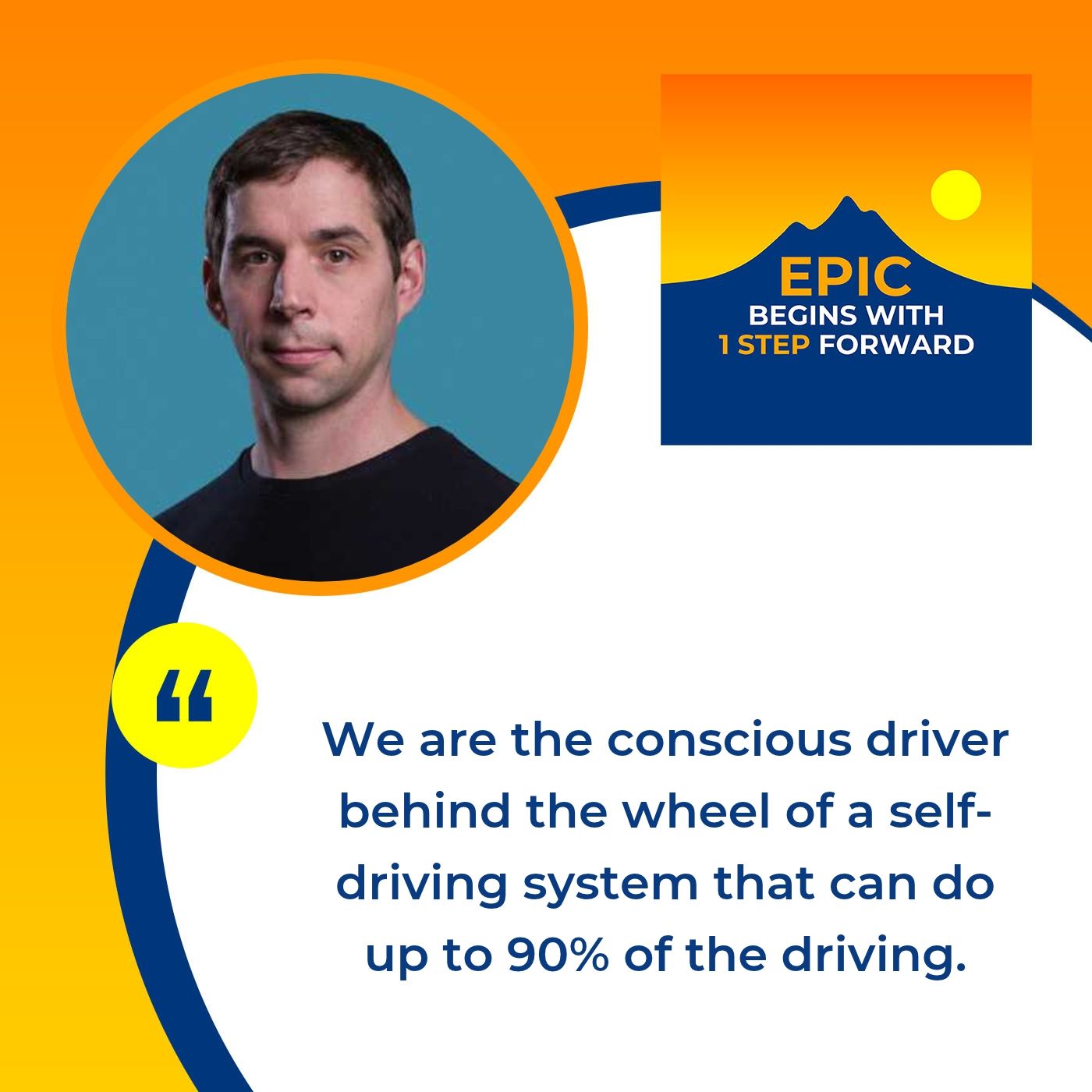
It all comes from the idea that the brain is two systems that process information and together they create the reality we experience. That’s the idea. That was popularized by Daniel Kahneman in his book, Thinking Fast and Slow. That’s this metaphor of, we are the conscious driver behind the wheel of a self-driving system that can do up to 90% of the driving.
That comes from system one, where system one is the self-driving system. What that means is the system one is always on. It’s automatic. It provides the first response to what we encounter. That includes emotions, habits, behaviors, opinions and beliefs. That’s always there providing instant responses.
We have system two, which works in conjunction with that or in addition to that. What makes that up is it’s called our executive control network. It’s the conscious self that we identify with as ourselves or I. What system two allows us to do, though, is monitor system one. Watch it, plan, deliberate, problem solve, and then also execute self-control. That is our conscious driver acting more like a supervisor of this system one, the automatic system.
That’s cool. I would say yes. That is probably what’s going on. There is so much. That happens without us knowing that self-driving part of all the information we take in, keeping our heart beating.
That’s the challenge. We were so accustomed to it and we’ve been in this human vehicle for so long that some of the patterns for system one are hardwired at birth. As you said, anxiety and some fears like the fear of loud noises and falling. They say you’re born with that, but then other fears are wired through experience. My old fear of public speaking and my old fear of being a leader in leadership are wired through our experience. They become the automatic responses that drive us.
We, as the conscious driver, can decide whether to go with it or not. I did for the first 30 years of my life. That’s the idea of learning how to wake up in a sense and use our conscious drive to challenge these responses because ultimately we are the ones who decide yes or no. We agree with it, so we let them go unchallenged and then our life doesn’t change.
Mastering the Intentional Two-Second Pause
A big part of the premise of a book I have coming out I’ve written. I’m editing, but I called it EPIC Reset. It’s this idea that we have things that are happening in our life that aren’t serving us well. Our reactions aren’t serving us well. There’s this two second window where it’s conditioned to respond to stimulus. There are things that we get that stimulus and we respond the same way, even though we’re like, “I don’t want to do that.”
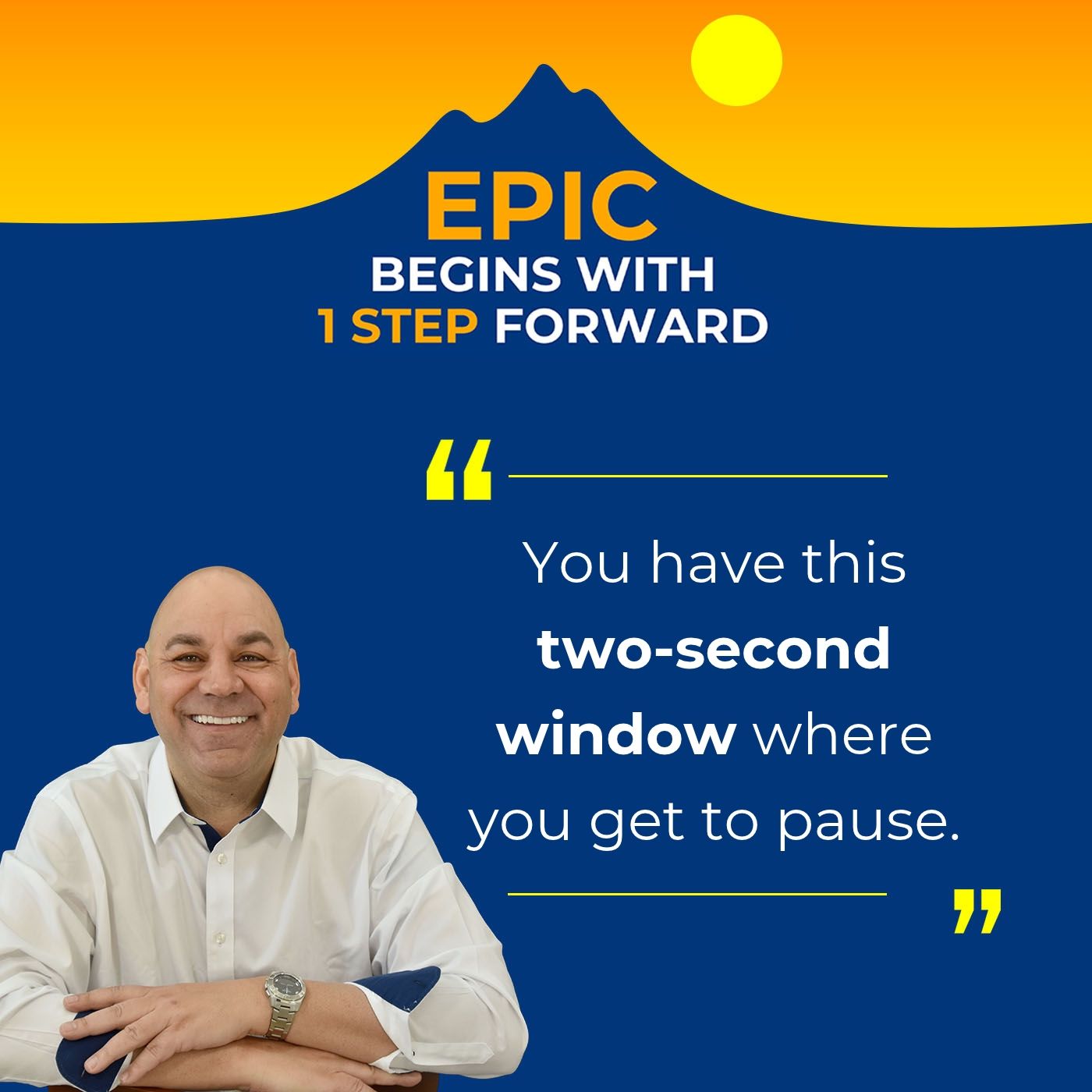
You have this two-second window where you get to pause. For the book I redefined EPIC as E is the emotion, what’s causing, and then the P is the pause. The I is the interrupt. Do something to interrupt. Bring it to the front of your brain. The C is a choice. Choice of what do I want to do now? One of the ones I’ve been talking about, because it’s true, is I’ll ask you, do you have any brothers or sisters?
Yes.
Would you say that there are some responses to stimuli from one or all of them that even though you don’t want to, you react the same way? They say something, do something, or whatever.
All families, yes.
It’s that way with siblings. Maybe you’re like, “This isn’t serving me well. Let me try and be mindful,” to bring your mindfulness in, “Hold on. There’s the stimulus. Let me pause for a second, and change my response, because it’s not serving me.” Siblings are great. I know my younger sister has all the dirt on me. I’ve got all the dirt on her and we push each other’s buttons. You can, and you do. We do have things that aren’t serving us well. You’re right, that’s the autopilot. Take it off. Bring it up front.
We’re saying the same thing. I’m exactly 100% in align. That’s the idea, is this pause. That’s becoming popular in culture. I’m hearing this from a number of different thinkers now where there’s this power in the pause and that’s exactly what it is. These automatic responses don’t serve us. Pause to try not to take it so personally and to view them from the outside. Is this accurate? What if I do something else? Also, as you said, interrupt.
Breaking Familial Triggers Through Mindful Awareness
Interrupt the pattern because then it brings it to the front of your brain where then you have a chance to go, “What choice am I going to make to react differently?” We’re all going to fail at it because like anything, it is a skill that we need to practice and learn. The more we do, the better it gets. This has been a fascinating conversation, Alan. How can people find you, find your book, or work with you?
I have my website, TheSelfDrivingYou.com. Then my book is available in all formats on Amazon.
Alan, I want to thank you so much for joining me. What a great conversation. Dare I say, epic. I want to remind everyone that if you’re ready to begin your epic journey, go to EpicBegins.com. As always, remember, epic choices lead to the epic life that you want.
Important Links
About Alan Bodnar
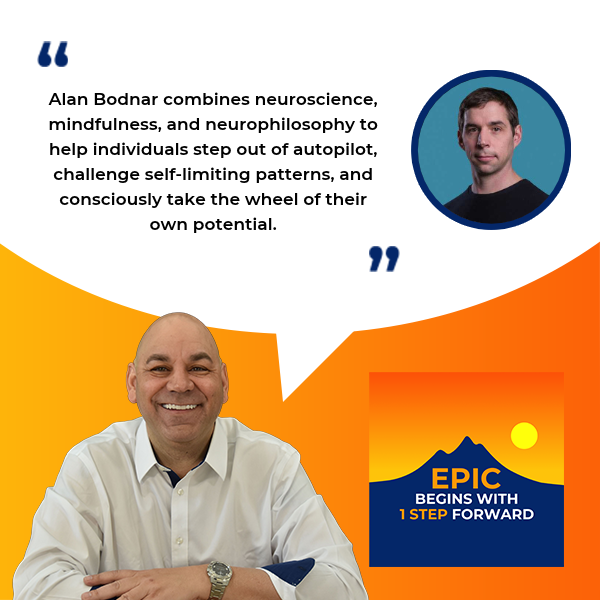
 Alan Bodnar is an emerging neurophilosopher, researcher, and founder of The Self-Driving You.
For the past decade, Alan has worked to translate complex science into a self-guided framework that allows people to get back in the driver’s seat of their mind and to take control of automatic responses.
Alan’s project started as an attempt to reverse-engineer his own wiring and test what works in real life. His work is focused on clear strategies, measurable practice, and evidence that holds up when the rubber meets the road.