Free E-book – https://dl.bookfunnel.com/afk096okro
Apply to be a Guest on My TV show – https://www.epicchoicemedia.com
#EPICBeginswith1StepForward, #ZanderSprague, #Marathon, #Ironman, #RacingAgainstTime
—
Watch the episode here
Listen to the podcast here
Marathons, Ironman, And The Power Of Starting Late With Jeffrey Weiss
I have a great guest. I have Jeffrey Weiss with me. Jeffrey, tell us who you are and what you do.
The Late-Start Athlete: Trading Willpower For Structure
Thank you so much. I appreciate your having me on. I do a bunch of different things, but the reason why we’re going to be chatting is about a book that I wrote about my fitness journey. It started with the first 10K race at age 48 and progressed to doing a couple of Ironman races in my late 50s and ultramarathons, including a 72-mile ultramarathon at age 61. It is about that journey, what accompanied it, what it meant to me, and how I went about it.
I do have to share that I, too, have been an endurance athlete. I ran halfs and fulls. I did a 50K ultra myself. What I will say about that is that it was a great experience. My running coach is like, “You should do a 50K because if you can run a marathon, it’s only 5 miles more.” That sounded logical six months before, but when I was running it, those last 5 miles were hard.
It’s cool. It’s amazing to have done an ultra. My hat’s off to anybody who does do those extra 5 miles because that is a wonderful accomplishment. The fact that it was hard probably made it mean all the more to you, which is great.
The difference between a full marathon and an ultra, aside from the distance, is that it’s a completely different breed of people. There aren’t that many people cheering you on. There are maybe your friends and family, but you’re out there by yourself. That’s a different experience. When I was doing one of my four marathons, and even the half, when you’re having some hard miles, people cheering you makes a big difference. It can boost you up and go, “I got this.”
In particular, in the big city marathons, when there are tons of people out there, it changes the whole mood. It changes the atmosphere. It gives you energy that you didn’t think you had. To your point in ultras, you can be out there in a forest or wherever, all by yourself. No aid stations. Nobody around. Certainly, no fans. Maybe not even a lot of other runners. It is a very different emotional experience, but an interesting one in its own way.
I got into endurance running about ten years before you did. I was 38 when I started to do this. It was an interesting experience. We all have things where we’re like, “I wish I’d been doing this when I was younger. Why do I wait so long?” What got you into signing up for your first 10K?
It was a couple of things. It had bothered me for a while, in the back of my mind, that I wasn’t being serious enough about exercise and fitness. I always told myself I’ll get more serious a little bit later when I have more time. My dad had passed away a year before that. That, combined with approaching the age of 50, made me realize all of a sudden, there’s no more pushing this off into the future. Later is now.
I saw an ad for a running class of all things. It was a two-month class that led to the goal to run the Veterans Day 10K in Washington, DC. I signed up for that, did that race, and found myself bitten by the bug, not necessarily to run long distances, but to do a couple more 10Ks. Slowly, I got the desire to try something harder.
In my experience, I signed up for a half-marathon to begin with because I’m like, “I think I can handle that.” I joined a team in training, which is the fundraising side of the Leukemia Lymphoma Society. It was great. I’m like, “I can run 3 miles, but how am I ever going to learn how to do this?” They handed me a schedule. I’m sure they did that in your running class. They hand you a training schedule. All of a sudden, it gets so much easier because there’s structure. They’re like, “Jeffrey, go out and run 3 miles today.” “I can do that,” and then you’re done. It’s not like you’re spending all day doing it.
The Accountability Factor: Why Every Athlete Needs A Coach
A lot of us guys are always in life looking for direction. I’m certainly very much in that camp. When I did my first marathon, I downloaded training plans from the internet. I’ve been working with a coach. I love it. I love being told what to do by somebody smarter than me and more knowledgeable about training techniques than I am. We have a conversation, and he sets a plan. All I have to do is follow it.
I love being told what to do by somebody smarter than me. When a coach sets a plan, it takes away the mental battle of willpower.
From a psychological standpoint, structure makes us feel comfortable. If we know what to expect, it’s not nearly as stressful. When you look at your schedule, if you do your long runs on Saturday or whatever, and it says, “Go run 12 miles.” It’s not that the 12 miles is easy, but you know what you need to do. You know that if you follow this, you will get to your goal. All too often, as adults, we’re like, “I don’t want structure,” but we grow up with structure, all the way up through high school. There’s nothing but structure. Go to this class at this time, then this, and this.
You don’t worry about that. You may worry about the tests that you have or the presentation you have, but you’re not worried about where you need to be and when you need to be there. Why would you know how to train for an Ironman? You wouldn’t. I do want to talk about that because that’s incredible that you’ve completed multiple Ironmans, but you can’t do that alone. You’ve got to have someone.
You’ve got to have somebody that gives you accountability, too. You know that somebody is going to be looking over the data and what you did or didn’t do. Not that you’re going to get yelled at, but it will be embarrassing if you were supposed to do a workout. You have to explain why. “I didn’t do it because.” It takes away a significant part of the willpower element because if I’m training on my own, “Do I want to run 10 miles today? Maybe, but then I’m out there. It’s a little bit hot. Maybe I’ll stop at eight or nine. Does it matter?” If a coach has told me ten, I’m not even going to think about stopping early because I know that that’s what I need to do. It’s great not to have that mental battle on a regular basis.
When I talk about my running, my regular audience is like, “He’s going to talk about marathoning again.” I will be honest. I ran my last marathon years ago. That was the 2014 Boston Marathon. I did not Boston qualify. I just want to be clear. This is not Boston-qualified, but I still got to run it. It was great. You’re talking about the training runs. I refer to sometimes having a grindy run. I equate it to riding a bicycle when you’re in between gears. It’s grindy.
When you’re running, you have those days when you can’t find your pace. You can’t find your breath. It’s the longest 10 miles of your life because you can’t find your groove, yet you go, “I’ve got to get through this again. I want to be able to tell the coach I did it.” It also makes you appreciate when you do have a good run. You’re like, “That’s a great run.”
Plus, especially after you’ve done one. You know that if you don’t put in the work, you’re going to pay for it on race day. You want to have a good experience. Even if you’re not out there trying to qualify for Boston, which also, this is not a Boston-qualifying body. You still want to have a good experience. You don’t want to be in agony and pain because you didn’t do the work, and your fitness isn’t where it should be. All of those things drive you ideally to the point where you say, “I’m going to do the preparation I’m supposed to do and trust that it’s going to help me get good results on race day.”
If you don’t put in the work, you’re going to pay for it on race day. You don’t want to be in agony because your fitness isn’t where it should be.
Big Hairy Audacious Goals: Using Business Logic For Fitness
I want to take some minutes here and talk about choosing to do an Ironman because that’s perhaps one of the penultimate endurance challenges that someone can take, aside from trying to either do the Barkley, Western States, or a 100-mile ultra marathon. How and why did you decide to try to do an Ironman?
It was a couple of things. I joined a startup back in 2012, having been a lawyer in private practice for 25 years. I was excited to be in the business world and read a few business books. One of which was Good to Great by Jim Collins. He talks about how the companies that distinguished themselves, separated themselves from their competitors, and became number one, had a number of qualities in common. One of which was that they had set becoming an industry leader as a big, hairy, audacious goal or BHAG.
He talks about how setting the right kind of BHAG orients people, focuses them, and drives everything that they do. It needs to be at the outer limits of what’s possible, not impossible, but not something that you can easily accomplish if you just do the work. Reading that, I thought, “That could work on the individual level. Setting an audacious goal could have all sorts of wonderful benefits for me as an individual.” My first one was to do this 56-mile ultra marathon, or to attempt it in South Africa, the Comrades Marathon.
That’s a brutal one.
I got cut after 51 miles at the last checkpoint before the stadium because they have five or six checkpoints you have to reach by a certain time. It was eleven hours of running 51 miles. I missed it by a minute and 44. Before I started that race, I decided, “Either I’ll finish or I won’t, either way, there’s a risk of letdown after I cross the finish line or after I don’t cross the finish line. I should set my next goal before that race so that I can shift my focus immediately to the next big thing.” I decided that a year later, I would do my first half Ironman. A year after that, I would do my first Ironman.
Managing The Letdown: Setting The Next Goal Early
In the end, I brought all of that forward by the year. I did the first half Ironman a few months after my attempt at Comrades. This time, it did have a happy ending. It was an amazing experience. By that point, I’d been training for 7 or 8 years. It never would have occurred to me earlier on that it was even within reach for me. I wasn’t sure that a half Ironman was even within reach for me, but I needed the experience of some longer races, some ultras, to start to believe that maybe I could push myself that far.
I get you about the goal. When I finished my first marathon, I was excited. Probably 30 minutes later, I was saying, “Now what?” This is great. I don’t want to take away from how awesome that lifelong bucket list goal is. I want to run a marathon, and now I’ve done it, but it’s anticlimactic. You cross the finish line. You’re so excited, but then you’re like, “I’m in this good shape. Now what?”
For some people, they’re like, “That was great. I don’t need to do it again.” For a lot of people, you and me included, it’s like, “Is there another race?” Having a race to train for made all the difference in the training. It gave a purpose to why I am out here running however many miles. I road bike now. I’ve done metric centuries and centuries. When I’m on my road bike on a 60-mile ride, I’m not doing it just for fun. I need to have a reason that I’m out there doing 60 miles.
In other words, a couple of things that you’ve touched on there that resonated with me. It is very common to be deflated after you achieve a lofty goal, which is where I got the idea. I had read somewhere to set the next goal before you start the race so that you won’t experience that letdown because you’ll immediately pivot mentally toward the next big thing. I do think having a race on the calendar, especially one that scares you a little bit, does focus your attention on how you work out.
It’s a cliché, but there’s so much truth in it. The joy is in the journey. That’s another reason why we experienced the letdown because we lived for months, maybe longer than months, with this audacious goal. We were getting ready for it, visualizing it, and anticipating it, and now it’s been taken away from us. To have another journey like that is a wonderful thing.
I was running first thing in the morning. Sometimes, I was running in the dark. Sometimes, it was raining. It was cold. It was hot. It is that vision quest that you’re on, where you are saying, “I am picturing myself crossing the finish line or having a good race.” When it’s over, it is the journey. The destination is great. You need to have it, but it’s not the end.
The Identity Shift: From “Bucket List” To Becoming A Runner
That’s it in a nutshell. It shouldn’t be the end. It’s also a bit about identity and how you think of yourself. You referred to the bucket list. There are a lot of folks out there who’ve done a single marathon. They did it as a bucket list item. They got themselves ready for that one race. They did it. They’re proud of it. They have the medal. That’s a wonderful thing. They’re on to other things.
I wanted to be a marathoner. It meant doing multiple ones of them. I wrote my first book back in 1998. Over time, I realized I want to be a writer, which means continuing to write and not just resting on my laurels that I was able to put a first book out there. That’s factored into things as well in terms of why I’ve continued to push myself to try new things.
Are you still doing Ironman? Are you semi-retired from that?
Setting an audacious goal orients people, focuses them, and drives everything they do. It needs to be at the outer limits of what’s possible.
I did my last half Ironman in 2023. I hope to do another one in the next year or two. I don’t know that I’ll do another full. I might. I haven’t decided, but the fulls were tough.
There’s no doubt. In my understanding, the rest of your life is around your training.
At the peak for me, it was about thirteen or so hours a week of training. Honestly, I can’t claim that as my excuse. I’m not that fast. Each time, I finished probably about an hour and twenty minutes before the cutoff. It’s not a lot of cushions. I’m a little bit older. I was 59 when I did the last one. I wouldn’t mind doing another one, but I would have to get serious about the bike. It’s what you’re doing. That’s my weakest leg.
For triathlon, that’s the most important leg, both because it’s the longest part of the race and because if you’re strong on the bike, you’ll be in better condition when you start your run. If I can reinvent myself as a cyclist, I might consider taking another one. My main immediate focus is the six original world major marathons, which are Tokyo, London, Berlin, New York, Chicago, and Boston. I’m halfway through that journey. I’ve done the three non-US ones and have the three US ones still ahead of me, which I hope to knock out in the next two years or so.
That would be great. I can’t speak to the other ones. What I can tell you about Boston. It was by far the best marathon I’ve run. I grew up outside of Boston. I grew up watching it. The ten-year-old me said, “I’d like to do that someday,” with no idea of how challenging running a marathon is. Boston is a challenging course. It is hilly. Mentally, the hardest part was from mile five on. I knew that whole course.
I had all kinds of nightmares where I got off the course. I had one where I had to run an extra 6 miles to get back. I’m trying to get through the crowd. I’m like, “No, I’m running the race.” I somehow got way off course, but I knew where to go. There were people every step of the way cheering me on. The support is great. It’s obviously a very historic race. The emotion of turning off Hereford Street onto Boylston was great.
My cousin had run Boston multiple times. His best piece of advice was, “As hard as it is, when you turn onto Boylston, do not put your kick in because you turn onto Boylston, and the 26-mile mark is still a little down there. You’re not even close.” You’re like, “There’s the finish line,” but it’s down there. Depending on how you’re doing, most of us do not have that long a kick. By kick, people, if you don’t know what I mean, it means you see the finish line, and you’re like, “I’m going to be on video finishing strong.” That little last bit of energy, you look good coming across the finish line.
It’s amazing how in marathons, it seems like the mile markers get farther apart. Once you hit mile twenty, it seems like they ought to be coming up sooner.
What I wish they would do is you didn’t get a mile mark until about mile five. It’s because, as much as you try not to do it, when you see mile marker one or two, you’re doing the math in your head, even though you’re like, “Don’t do the math. It doesn’t matter. You’re doing fine.” The other thing with Boston is you start, and you’re slightly downhill.
The first 5K is slightly downhill, which is bad because you’re amped up because you’re starting a race and you’re starting Boston. That was the fastest 5K I’ve ever run. I was trying to hold myself. “You’re going slightly downhill. It’s easy.” I’ve heard stories of people who were like, “In that first 5K, I killed myself.” It was great. I flew, but all of a sudden, I’m like, “I gave too much at the beginning.”
If you’re strong on the bike, you’ll be in better condition when you start your run.
I have to tip my hat to you for having had a vision as a ten-year-old, “This is something I would like to one day do,” something audacious like that, and to achieve it. Not too many of us have experienced it.
I did not Boston-qualify. I got lucky. My younger sister’s a massage therapist and did a post-marathon massage for Adidas, which is one of the major corporate sponsors. As a non-runner, she offhandedly says, “You’ve been running marathons. Would you ever want to run Boston?” I’m like, “Yes.” It was not a bucket list. That was a holy grail moment. I’m not too proud to say that when I crossed that finish line, I cried a lot because it meant so much for me to be able to say I was a Boston finisher. I’m slow.
I am, too. Honestly, that’s part of why I wrote the book. When I was getting started with racing, I got a lot of inspiration from folks like Rich Roll, David Goggins, and Dean Karnazes, reading their memoirs and their experiences. It made me think that some of this crazy stuff might be within reach. There were some great training tips in there, but it’s a lot of inspiration. Some of those guys can be hard to relate to because they’re so extraordinary.
The goal is to finish. The fact of the matter is, whether you’re the first over the line, close to the last, or the last, you are still a marathon finisher. You have still done something that less than 1% of the world has done.
Breaking Mental Limits: Surprising Yourself At Any Age
That’s it in a nutshell. Plus, my competition is me. I’m out there trying to achieve something that will make me proud. That often might be finishing. It might be finishing at a certain time. Now and then, I do try to race for a time, but whatever it is, I’m not racing against the person next to me. I certainly have no aspirations of achieving great things as a racer in terms of making it to a podium or anything of the sort, but that’s most of us. We can surprise ourselves with the things that we can do.
I had once told a friend years ago that I was as likely to run a marathon as I was to walk on the moon, but then I realized, after doing the 10K a few times and a half marathon, that a marathon could be within reach. I was continuing with that with ultras and then getting into triathlons. We all have the capability of surprising ourselves. Most of us tend to place limits on ourselves that aren’t warranted. It can be exciting to break through those.
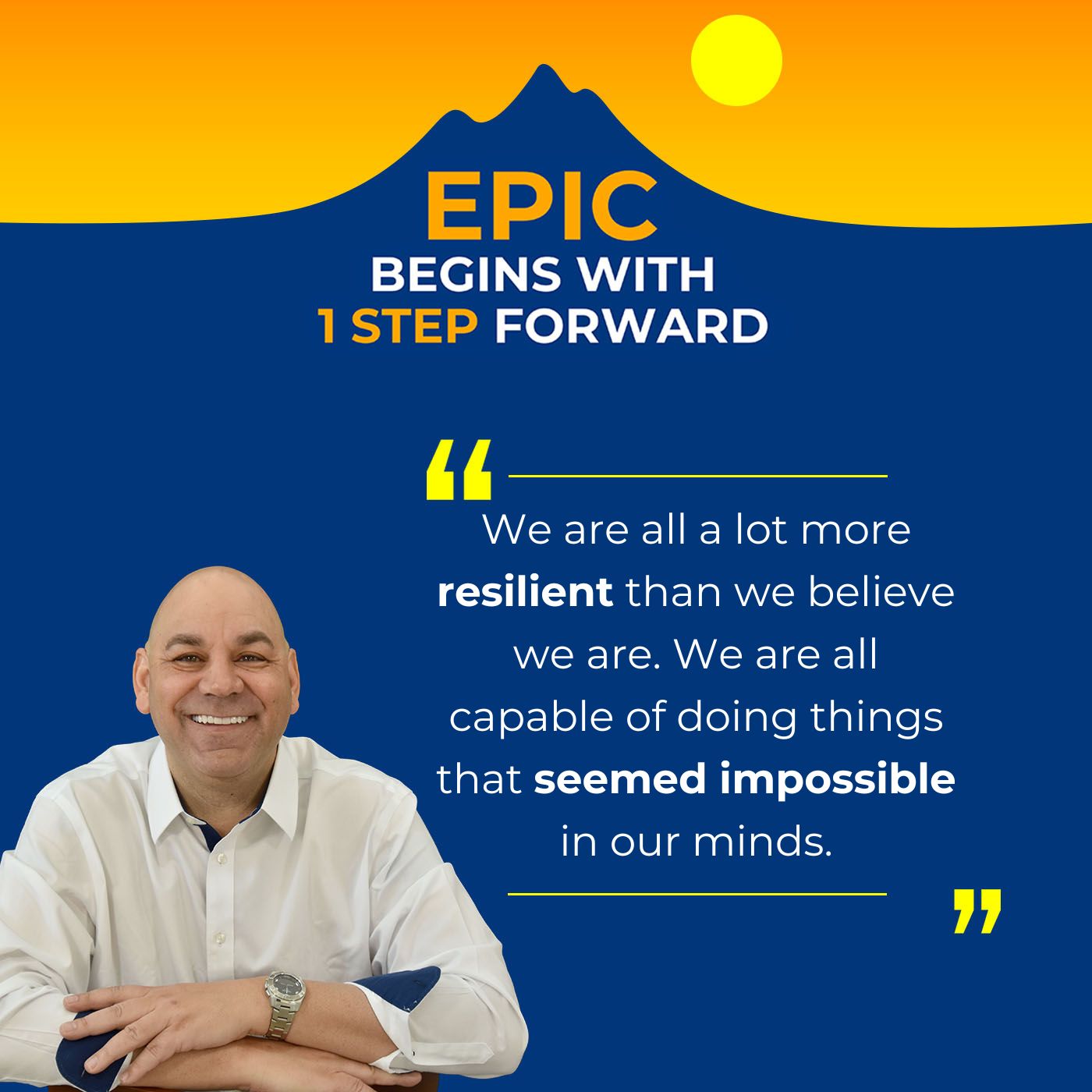
We are all a lot more resilient than we believe we are. We are all capable of doing things that seemed impossible in our minds. Honestly, that is half the fun. That is part of what makes the epic journeys so much fun. It’s epic because you’re like, “I have no idea how I’m going to do this.” You take that first step forward. You say, “I’m going to do this.” You also realize that no matter how hard you’ve trained, you get to race day. Things can happen, and you don’t finish. Although that could be crushing because you’re like, “Six months of training, and I didn’t achieve my goal,” you still showed up. You still did it. For you, comrades, that happens. Sometimes, you don’t.
Protected Failure And The “Not Yet” Philosophy
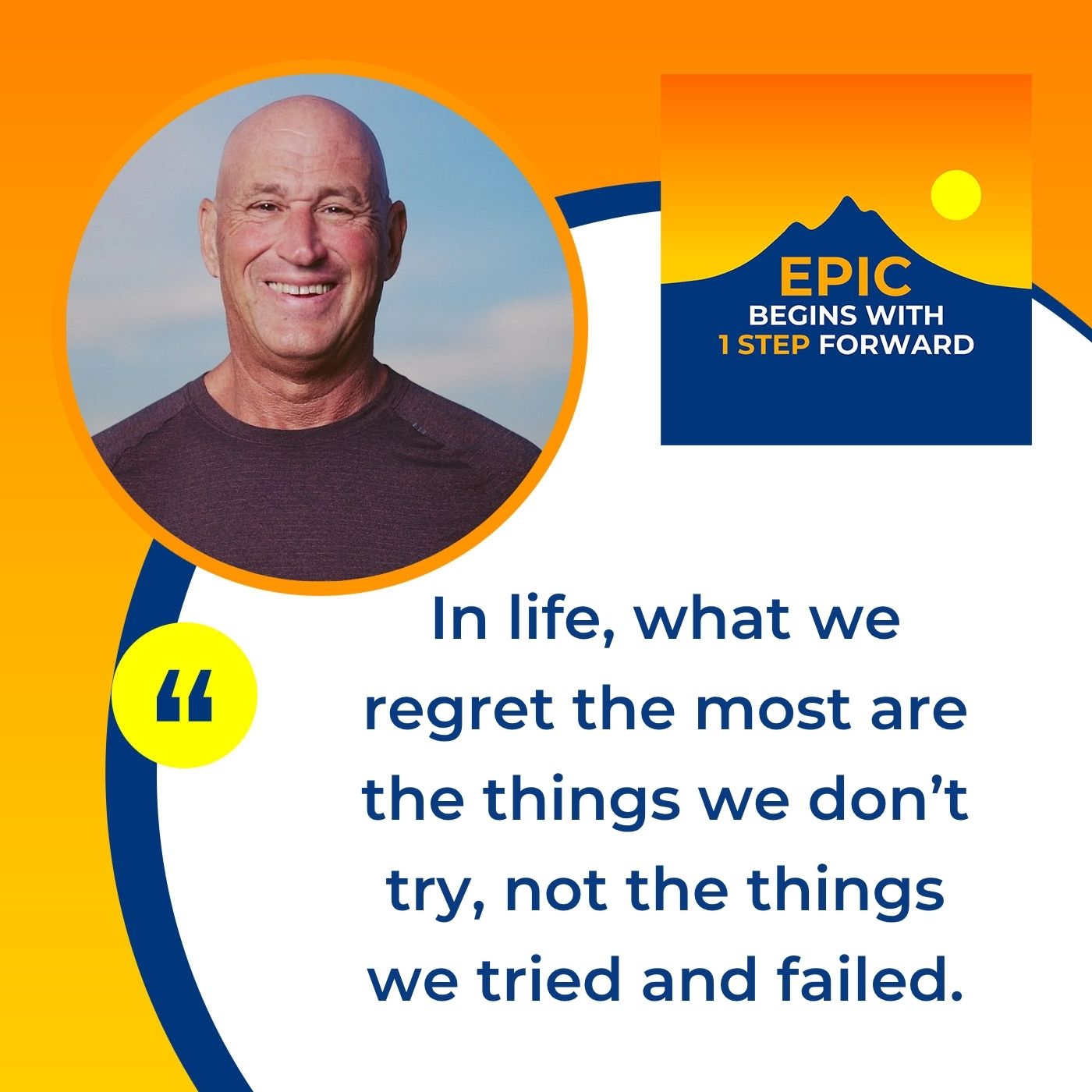
At the expo for that race, I bought four key chains. I have four kids. When I got back, I told them all to close their eyes and to put out their hands. I put a key chain in each of their hands. I said, “I went there, trained for the race, did the race, and got cut before the finish line, but I’m so happy I did it.” In life, what we regret the most are the things that we don’t try, not the things that we tried and failed. I’m a big believer in sports as a metaphor for life.
In the business world, a lot of people talk about the importance of failure, learning from failure, and recovering from failure. Failure in the business world can be a pretty awful outcome. You put yourself in a race situation that’s going to be challenging. You might fail. It’s a very protected environment. It’s low-cost. It is about your own self-esteem, emotions, and ego, so you can learn to be a little more humble. You can learn to put things in their proper context, try to learn some lessons, learn how you might do the race differently the next time, and keep moving forward. It’s a great metaphor for life.
One of the things I talk about in my book, and I’m fascinated by, is the two words, not yet. Not yet is so important for whatever. We all have epic goals. There are things that we say, “I’d like to do this.” Maybe you’re aware of it, but it’s just not the right time. It’s not yet. Have I done this? Not yet. Have I written my second book? Not yet. Whatever that is. Jeffrey, what are one or two of your not-yets?
I still have mountains that I want to climb in all of the different areas of my life, in the business world, as a writer, and as an athlete. I’m probably no longer looking to one-up myself as an athlete. I want to stay a marathoner for as long as I can. I want to take good care of my body. I want to be as active and fit as I can be for as long as possible. I’ll have to give that one some more thought. You’ve a bit stumped me there. It is a great question.
I don’t have a specific thing. I probably could have given you a specific goal years ago with Iron Man and with Midnight Express, the 72-mile race that I ran. At this point, I’ve climbed the highest mountain that I plan to climb, but I want to climb for a lot longer. Perhaps that’s my goal. It is to get to my 80s and to still be in the game, moving, playing with grandchildren, doing the things that I love doing, skiing, hiking, being active, and still having an active mind because I continue to read, write, and do things of that sort. Maybe that’s my not yet.
Maybe, your not yet is, “Am I done with running marathons? Not yet.”
I like that.
Clearly, you have some of the global majors to finish up. What is the name of your book? Where can people find it? If people wanted to contact you, how could they do that?
The book is called Racing Against Time. The best place to get it is on Amazon. It is available in paperback, Kindle, and audio versions. The best place to reach me is my author website, JeffreyWeissAuthor.com. I’m also on LinkedIn. I love to hear from people.
Jeffrey, this has been an awesome conversation. Dare I say epic. It’s so much fun to talk to someone who gets some of the endurance athleting and stuff like that. You’re clearly someone who’s somewhat like me, not the fastest one in the group, but still finishing them and still doing them.
Thank you so much. I feel the same way. It is great to talk with somebody who truly gets it. This is exciting stuff.
I want to remind everyone that if you’re ready to begin your epic journey, go to EpicBegins.com. As always, remember, epic choices lead to the epic life that you want.
Important Links
About Jeffrey Weiss
 Racing Against Time is the inspiring true story of Jeff Weiss’s incredible transformation in midlife. At 48 years old, out of shape and searching for new purpose, Weiss took on his first 10K—an event that would spark a profound personal evolution.
Within a decade, he pushed beyond perceived limits, becoming an Ironman and ultramarathoner, proving that age is no barrier to strength and ambition.
In an era when so many of us are focused on extending both lifespan and health span, this book serves as a powerful roadmap to living an empowered, fulfilling life at any age. Jeff is the author of two prior books.
He is also an accomplished entrepreneur, having served for 11 years as a C-suite executive in a start-up that recently sold for $3 billion – and sees a direct link between his successes in the fitness and business aspects of his life.