What happens when you achieve the success you spent years chasing—and discover it still isn’t enough?
On this episode of EPIC Begins With 1 Step Forward, Zander talks with executive coach and Life in Transition host Art Blanchford about achievement, burnout, purpose, and finding meaning beyond the next accomplishment.
Art shares his remarkable journey from running multibillion-dollar businesses and leading thousands of employees to confronting workaholism and completely rethinking what a successful life means.
Together, Zander and Art explore the “now what?” that can follow major achievements, why happiness can’t be postponed until the next destination, and the power of taking one step toward something that matters.
They also discuss endurance sports, the Appalachian Trail, embracing “not yet,” and a powerful lesson: sometimes finding clarity isn’t about searching harder—it’s about reducing the noise.
Free E-book – https://dl.bookfunnel.com/afk096okro
Apply to be a Guest on My TV show – https://www.epicchoicemedia.com
#EPICBeginswith1StepForward, #ZanderSprague, #LifeTransitions, #ExecutiveCoach, #ChasingSuccess
—
Watch the episode here
Listen to the podcast here
Stop Chasing The Next Achievement And Start Living With Art Blanchford
From Insecure Overachiever To Finding True Purpose
Welcome to the show. I’m so excited you’re joining me. I have a great guest, Art Blanchford. Art, tell us who you are and what you do.
Thank you, Zander. I really appreciate you having me on the podcast, and I love the title. It is true. Everything that is great starts with one step forward. Art Blanchford, I have a coaching company and a podcast. Life in Transition is the podcast. I help midlife men who are successful enough to know that success isn’t enough to find meaning. I lead the crossing retreats and group coaching events around that, as well as executive coaching.
Awesome. Now, let’s just get a little background, because you’ve got an interesting background. That’s part of the reason I had you on. Tell me a little about your prior professional career.
We can start there. If you want to go a little bit farther back, it’s also very interesting.
Look, go wherever you want, Art. Tell me where the epic is.
I’ll say it this way. I have so much epic, and I love my life, and it’s really a lot of fun. I was raised in a religious cult, which was pretty tough. I talk about that in episode number 7 or 9 of my show. Very poor and worked really hard, and that was what my HR chief said when I was working at my last corporate job, number two, a very big public company. He said, “You’re one of those insecure overachievers.” I learned in the call to please the man, and that served me very well.
I worked really hard to make my wife and my kids happy and do all the things I should do to provide for everybody. I was very successful. I lived in Germany. I lived in Detroit, lived in China, and ran multi-billion-dollar companies with 10,000 employees. It was wonderful and horrible because it was taking all of my energy, and it wasn’t what I really felt. The leadership part I was gifted at, but the rest of it, it wasn’t squeezing water from a rock.
I was really good at it, but it was not what I felt like it was calling me. Adopted two kids along the way, had one biologically, raising those, living in twenty homes on three continents. When COVID hit, my body stopped. I’d seen little hints. In hindsight, I could see it. I was already doing Ironman and meditating and doing crazy marathons and ultra marathons. My body shut down. For twelve weeks, I was in bed, and that caused me to reevaluate.
It’s too bad you weren’t busy there, Art. Running 10,000-person companies, running ultramarathons and Ironmans and stuff. Please, could you achieve something?
It’s funny you say that, Zander, but a lot of that was driven from an unhealthy place because I felt so insecure and felt like I always had to perform and always had to be doing. One of the great miracles of my life was finding Workaholics Anonymous Twelve-Step Recovery. In 2020, when I was lying in bed, not being able to move, my wife was like, “Maybe you should take this time to look up this little quiz about workaholics and see if you might qualify for this twelve-step.”
Clearly a wise woman.
Yes, absolutely.
He knew you better than you knew yourself.
Absolutely, which a lot of our spouses do. They do, and it’s been a difficult, beautiful journey for the next six years, where I’ve been finding out who I am, finding my really strong connection to guidance and God. Where does that want me to go? Following that and then helping others along that same journey. I just finished the crossing event at my home in New Mexico. It was a very small curated retreat for helping men connect with themselves, each other, nature, God, and clarity of purpose for the future so they can find meaning. It was amazing. The whole time I’m thinking, “This is the work that I’m meant to do.”
In order to have an extraordinary life, you have to stretch.
There are so many things. I want to talk about the cult. I’m interested in that. The endurance athleting, I used to do that. I’ve got that connection where I’m like, “Yes, I ran a 50K ultra.” I’ve run marathons. I did a duathlon, not a very short duathlon, let me be clear. I have not done an Ironman. I do not think this can do the 142.
It’s interesting, though, that you talk about it, and I love that epic begins with one step forward. When I was in my mid-40s, I could not swim, and I decided to do an Ironman. That seems crazy because you have to do an Ironman if you can.
That’s motivation, Art. Let me tell you. I want to do this, but I have no idea how to do it. Look, it’s honestly the story of my professional career, where I did jobs. I was in no way qualified for it, but because I believe in myself, I’m like, “I’ll figure it out.”
That’s so key because at some point in every extraordinary life, that individual said yes to something that they had no idea about. They said they could do something that they had never done before, or they lied about their experience, or they told the customers that it was ready when it wasn’t. We have to stretch. In order to have an extraordinary life, you have to stretch. That one time, when I started to do that, I thought, “I’ll learn how to swim.”
I went to a swim class, and the swim teacher gave up on me. She’s like, “No, you’re so bad. There’s nothing I do not know what to do with you.” I found another swim class, and that guy said, “It is awful. Listen, I can get you through an Ironman.” He worked with me, and then I found another coach eventually once I got a little bit better, and it took years to get there. It begins with a set. It begins with a single step.
It really does. There’s a famous saying that every marathon begins with one step forward. It’s true. I read a really great story about someone training for an Ironman. It was left, right, repeat. It resonated with me because I got it. Any of those endurance things start because you decide to do it, and then you do something crazy. Which is signing up for something, which, by the way, I think is key. It’s great to say, “I want to do something.” Have a destination, but understand that although you get to the destination, it’s not the end of the road.
Escaping The “Now What?” Trap Of High Achievement
I know when I finished my first full marathon, I did, like, two half marathons first, just to say, the way people usually do. Some people just jump in, but I got done with my first full marathon. It was truly something I dreamed about, all those early morning runs where I, like, vision-quested crossing the finish line, all of that. I got done, and I was ecstatic, and my family was there, and it was awesome. About ten minutes later, I asked myself this question, and I’m sure you asked yourself this question too, Art. Now what? I’m like, “It’s awesome. I completed this.” Now, what’s my next destination? What’s my next goal?
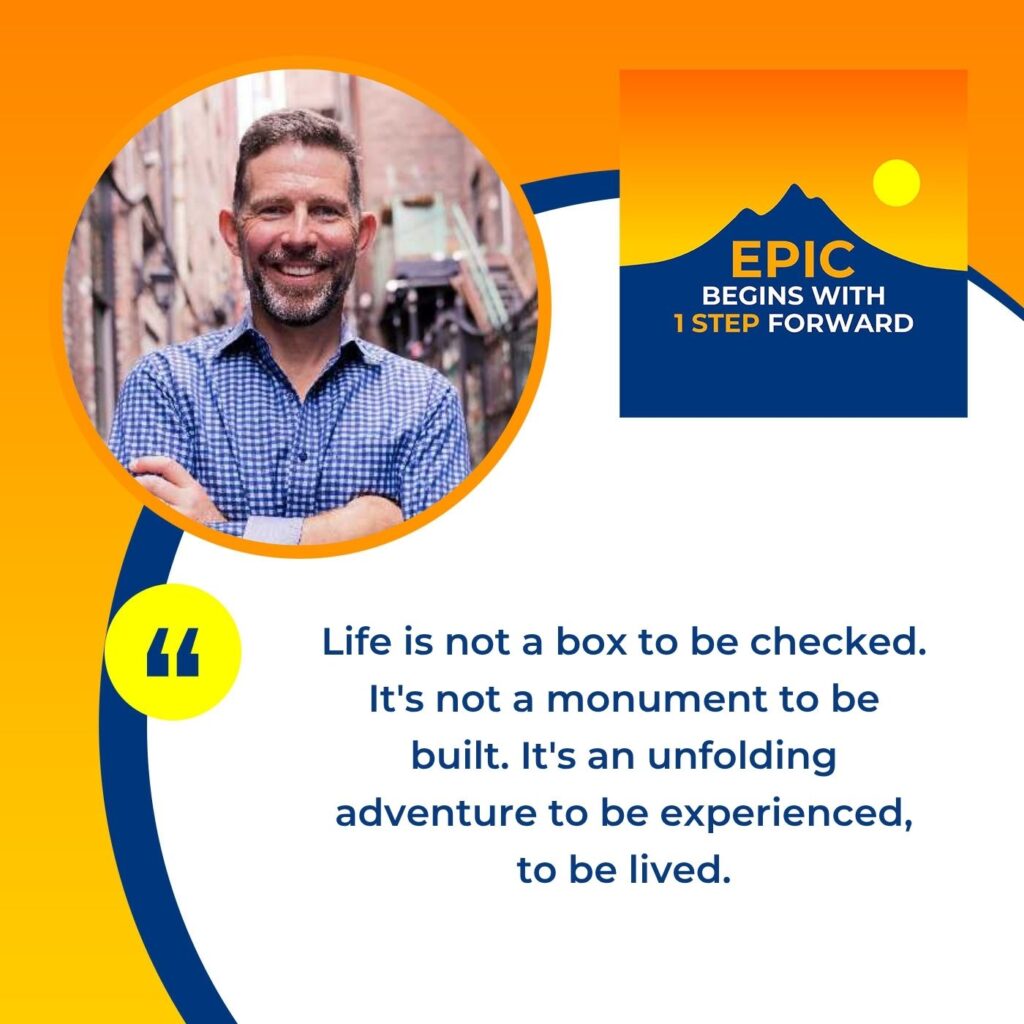
That’s something I deal with a lot with my clients, and it’s such an important thing because when we ask ourselves that, Zander, I’ve asked myself that question a lot. Now what? That also indicates that our relationship to the event wasn’t as healthy as it could be. Whatever the event is, whether it’s a marathon or a promotion, running a big company, getting married, or having a kid, any of it, there is no destination. We think about it in that way of like, “I know where I’m going, and I’m going to get there, and I’m going to check the box.” You ask yourself, “I checked the box, now what?” Life is not a box to be checked. It’s not a monument to be built. It’s an unfolding adventure to be experienced, to be lived.
A hundred percent, Art.
I do not get to that point. When I finish something epic now, I do not go, now what? I’m like, “That ride was awesome.” No matter how tough or crazy. At some point, they’ll be like, “I know I’ll find some other adventure, and there’ll be something else.” I went through a long phase, decades, where I had to have something scheduled before I did the one in front of me. I needed to have the answer to “Now what to keep my butt off the couch.”
For me, what it was is I was like, “I did this. Now let me go find another marathon to go run.”
That whole thing of “now what” that comes from this equation, the if-then equation for happiness that Srikumar Rao talks about, that we all tell ourselves, most of us, that if I get this, then I’ll be happy. If I do this, if I accomplish a marathon, I’m going to feel a certain way. If I get this promotion, I’m going to feel a certain way. The fact is, life is the process, the whole way. Happiness isn’t a destination. It’s the way.
I do agree with you.
Sorry, I came on a little too strong there.
No. Now, what’s actually, I view it as a positive thing, which is to say, you’re right, because the finishing of the marathon, whatever your epic destination is, there is a bit of a letdown because you’re like, this thing that I have been going to, and once you get it, it’s awesome. It’s a very fleeting thing. You’re like, “Now I’ve done this.” In my mental health counseling business, I love talking about the Gestalt closure theory, which is. I think we all have these circles in our lives, and sometimes my clients come to me because there is some circle that they’re stuck in.
We’ve got to help see if we can close it. Once we close it, they do not need me anymore. They go for it. I think I’ll use a marathon analogy. Your open circle is I’ve got this race. Now I’ve closed it. Now that you’ve closed it, you’re like, what else can I achieve? It’s not constantly chasing that, because I do get that. That saying that it’s the journey, not the destination. It really is. For me, that whole.
It’s much easier to go out and run 12 or 15 miles because I have a purpose for doing it. Not just because my friends who are triathletes and have done Ironmans and stuff say, look, I absolutely will not get up at four in the morning and go out and do a brick, which is a bike and a run. If I did not have something that I was working for, it’s just not something I’m going to do. Just because it’s fun. Some people do. Most people are like, “We need a purpose.”
Yes. A hundred percent.
Happiness isn’t a destination, it’s the way.
Whatever you’re doing. Look, there comes a point where the “now what” is, “I do not need to do this anymore.” I’ve done this enough. I did ten halves, four fulls, and a 50K Ultra. Awesome. I love it. I honestly do not feel that I want or need to go out and do that anymore. Sometimes that transition of saying, “Here’s this thing.” People are like, “You’ve done this. What are you running next?” You’re like, “I’m not running anymore.” Or “I’m just running.”
Embracing The Unfolding Adventure: Enjoying The Process Over The Destination
That’s okay. You’ve had that experience. You’ve had that journey. We mistake ourselves so much for thinking that achievement is what brings enjoyment. The enjoyment is being present for the journey. My wife and I are opening, it’s hers primarily, but I’m a twenty percent owner of a coastal tea cafe here in Fernandina Beach at the end of this month. It’s time now. I’m over there this morning, moving boxes and unpacking stuff and thinking, “I get to do this.” Whether the restaurant is successful or not, we can have these things.
That’s not the point, really.
It’s not the point. We have this experience that we’ve signed up for, that we chose to do. That’s really integrating into the community. It’s really great. I’m over there with the contractors and working on stuff. I really enjoy that. I’m enjoying the process. That’s the point. There’s a great book by Boyd Varty, his name. It’s called The Lion Tracker’s Guide to Life.
I actually know Boyd.
Do you? That’s great. You’ve read his books, then for sure.
I’ve read his books. I’ve actually been fortunate enough to go to Londolosi, which is where his family started, which, by the way, is unbelievable. If you’re going to go on safari, go to South Africa. It’s in South Africa. I met Boyd a few times. He’s a great guy.
Did you know that, based on this conversation, you know what quote I’m going to pull out of his book then? Do you have a sense?
I’m not quite sure which one you’re going to pull.
This is the one that, because I first read this, I was still like I had left my corporate gig, but I just couldn’t. I was still in my mind. I was running this corporate way. The quote that floors me is. “I do not know where I’m going, but I know how I’m going to get there.” Totally untypical of everything we’re taught in the West about picking the goal, having the compass, seeing that, and pulling yourself toward it. It makes so much sense to me now because the fact is, the fact is, none of us know where we’re going.
None of us know where we’re going. We have no idea how life is going to work out.
We have no idea how life is going to work out. We pick goals, we pick a marathon, we’ll go for it. Maybe we get it, maybe we do not, but the big picture, like two years ago, I would have laughed in your face, Zander, if you told me I’d be living in Fernandina Beach, Florida. Just two years ago, let alone ten years ago. The way that he says, “I do not know where I’m going. I’m tracking the lion, and I do not know where the lion is. I do not know where I’m going, but I know how I’m going to get there.”
One step at a time. One step forward, one track at a time. For me, I think about it as a process. I do not know where I’m going, but I know how I’m going to get there. I’m going to get there peacefully, lovingly, centered, compassionate, doing my meditation, doing my exercise, enjoying my sunrises and sunsets. We’ll see what comes. It’s just the opposite of when I was before this hard driving, going to make everything happen, which I absolutely started in life.
One of the things I talk about probably with my regular audiences, but I love these two words. Not yet. Not yet is so powerful for whatever our Epic journey is. Hammering on marathoning yet again, but it is writing a book. Writing a book has multiple parts that are challenging. The actual writing of the book. The editing process is equally challenging.
Never done.
There’s good enough. At some point, you publish. There comes a point where you’re like, “It is good enough.” People who are ultra-perfectionists should not write a book because they’ll never release it. More importantly, ” I have a book coming out. I’m running a marathon. I’m doing my retreat.” Whatever you’re doing.” Has the tea store opened? Not yet. It doesn’t mean it’s not. It’s just that today it’s not happening. “Have you run your marathon?” “Not yet.” Yet people get, “Yes, I’m running it on October 10th.” I get why you haven’t accomplished that. Some of our goals are more about self-improvement. Have you achieved your, if you want to lose weight, have you achieved your weight goal? Not yet. Why? It’s because it’s really hard.
I love that. It’s not, no, it’s not, I’m a loser. It’s “I’m in the process.”
I have to say that I got the concept of not yet giving credit to things that inspire us from Robert Fulghum, who wrote All I Really Need to Know I Learned in Kindergarten. He talks about it in his book, Sufi. The Sufi is like the concept of not yet. For me, I’m an eternal optimist. I don’t like it yet. I realize there are things I want to do. There are things that I dream of doing in my life. Even if I do not, it still does not yet allow it to keep going.
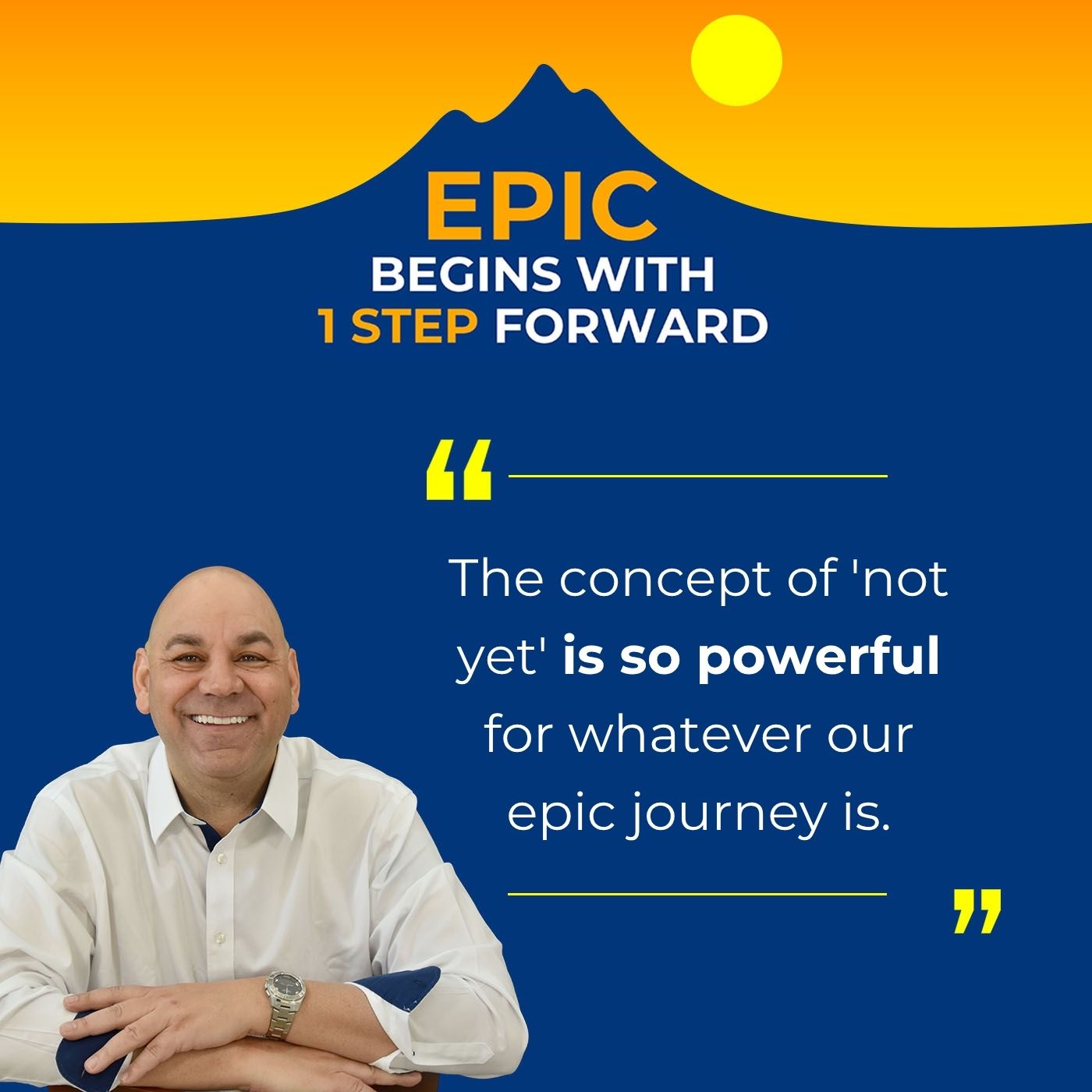
Active in my life, even if I’m not currently like i’m engaging in it right now, I’d like to do this thing. Even if I never achieve it, the fact that I’ve kept it as a possibility, and sometimes you have really good reasons why you cannot do something right now. You may have just started a family, so you’re like I cannot go out and train for an Ironman because I simply cannot take that much time away at this moment. I’m going to hold on to it. I am going to achieve it. I am just going to do it when the kids aren’t three.
Shifting From “I Want To, But” To “Not Yet”
One of the things I think about a lot with things like that is one is what you talk about. It starts with the first step. The second is about integration. If I think about that for myself, I did not know how to swim. I could take my young kids with me to swim class, or I could go join their swim lessons. I’m still making progress. Yes, I’ve not signed up for an Ironman yet. Yes, I’m not, but I’m moving in that direction and taking care of my kids at the same time. There are a lot of times when you think I’d like to do this, but. I’ll give you another. That, but it cancels everything out. That’s where it does.
I’d like to do this, but my wife won’t like it. I would like to do this, but I have three little kids. How can you integrate? I had this call to hike the Appalachian Trail while I was still working. I was like, “I really got this bug. It’s calling to me. I’m not sure why, but it’s really calling to me.” I did not take the first step on that for 5 or 6 years. I bought some books, I did some planning, but I did not actually get it on the trail for six years. Why? It’s because I had a picture in my mind of what that looked like. “I want to go hike the Appalachian Trail. I want to thru-hike that.
I want to thru-hike it in 5 or 6 months, but I do not have 5 or 6 months.” It sat there and tormented me. Even after I quit my job, I was like, “Honey, now I’ve got 5 or 6 months.” She’s like, “No, you do not. You got three teenage kids, and you’ve been traveling for twenty years, and now you need to be home, not going on the trail.” She was right. I just let it sit there and fester for a while. Last year I was really down. I was at my darkest point last year. The only thing that was pulling me and speaking to me was the Appalachian Trail. I said, “Honey, I really, I need to go do this.”
She’s like, “What if you just did two weeks?” I’m like, “Yes, to start, I’ll do it.” Now I learned that once I got to the trail and I went and did two weeks, started Maine by myself, the toughest part of the trail, the hundred-mile wilderness, was magical. It was so much clarity, so much peace, so much connection with nature and God, and everything else became clear at that point. Now I’m still doing it. I’m doing a multi-year thru-hike. There’s actually a name for it. They told me it’s a multi-year through-hike.
Lots of people do either the Appalachian Trail or the Pacific Coast Trail. They’re like, “Here’s what I can do.”
Instead of saying, “I’d like to do it, but,” “I’d like to do it, and this is how I’m going to do it.”
Not yet. Have I completed my hike? Not yet. I’m working on it.
It’s in process now. I’ve finished Maine, and I’ve done the hardest part, and I’m doing it in the way that makes sense to me, which is sequential, every white blaze, through hike, but just multi-year. The plan is to finish in 29, but who knows, right? The fact is, I’ve already gotten tremendous enjoyment and benefits because I quit with the but and just started with what I could do.
There is, and there is. Those are important words also. I’m not one thing. I am so many things. I’m a TV host. I’m a podcast host. I’m an author. I’m a licensed professional clinical counselor. I’m a dad, a son, a brother. All of these things, we do not just want, and I think sometimes that I have a corporate job, I can only do that. Why? Even though our jobs take up a lot of time, there’s still time if something’s important. A friend of mine, an incredibly successful lawyer, is also a prolific writer. What does he do? He gets up at four in the morning to write because that’s when he can do it. I know when I get up to exercise, I get up at five in the morning because nothing is getting in the way of that. If I go, “I’ll do it at 3:00,” you want to know what?
It never happens for me.
It doesn’t happen.
As much as I think it will, it just doesn’t.
I spent 22 years in the corporate world. I started running because I knew I needed exercise. Even though the corporation I was working at had a gym I could work out for free, and I was doing it to reduce my stress, I found my stress level was so high trying to get myself to the gym, to get the workout, to get back to my desk, to get to the meeting, that it was counterproductive. I did yoga, and I’m like, “This could be great. I needed to relax, but just where the yoga was, and I had to. I had to drive there, and there was traffic. It’s like I’m coming in to reduce my stress level, and I was like at a six. Now I walk in, I’m at an eight because it was traffic. I’m almost late. I’m in a room. I’m the only man there.
That’s changed, thank goodness, in the last 10 or 15 years. I’m like, I’m the only male in there.
If I’m completely honest, there were days where I’m like, “Just do not fart.” I hear you. We’re doing poses, and I’m a little spazzy. I’m like, we’re doing tree pose, and I’m like tipping over and knocking the person over next to me. I’m like, “I’m so sorry.” I fell asleep one time during Savasana. That was not good. Although I do think I achieved it properly. You’re supposed to be clearing your mind. Honestly, when they’re like, “Look through your third eye,” I have this question. “What if my third eye is myopic?” What if I cannot see clearly out of my third eye? You’re laughing because I am making fun of my own yoga practice.
Reducing The Noise: How Running And Nature Reveal Your Inner Signal
No, but it’s all of that, though, is about the process. You say yoga checks the box to reduce stress. Really not if it has all those other conditions like that. That’s one of the things I love about running for two reasons. I run outdoors because nature is so good for us, and it doesn’t matter where or when. It’s so good for us. You spend 3 or 4 days without a cell phone in the woods.
You’re completely reset. You’re completely calm. It’s really amazing. For me, running is simple, especially if you’re a traveling corporate executive or if you’re at home, whatever. You put on your shoes and head out, and it doesn’t matter what the weather is. Even if it’s cold as hell, you put on your YakTrax and a jacket and gloves and go.
That is true, and I did do that. The one challenge I can say about, and I traveled some, was it is great. People go, “Running, it’s a great way to see a new city.” That’s great, but I’m in a city, and I do not know where I am. Honestly, had gone out a few times in cities where English was not the first language.
Hundreds of those.
I had not written down the address of my hotel. Luckily, we have maps now.
Before GPS.
Where I’m like, I’m trying to figure out just a simple three-mile route that I can do. I’m like, if I get lost, I do not know how to get back to where home is. That’s the one thing. It’s true. Simple when you’re traveling. Throwing your shoes, you’re running, shirt, shorts, and you get to go run. That’s awesome. It was great for jet lag and all of that. I will say, I’ll put the but in. Challenging because you do not know where you’re going. In a run, that is where you’re like, “I’m trying to pay attention to landmarks. I’m supposed to go up here, turn around, and come back. There’s a cafe with a red and white awning. I’ll remember to look for that.”
You’re laughing because you know what I’m talking about. I’ve gotten lost, only badly lost once and it was in Tokyo. Now there’s GPS, and you pay attention, and one of the things I also love about running is it’s like a meditation for me too because I get to practice being in the present. If I do not know where I’m going, I almost never make it. When I’m in a new city, I never make a plan. Not never, but almost never make a plan. I just head out the door, and I’m going to go for five miles, or I’m going to go for three miles or two miles or whatever it is.
I just go, and I get to an intersection, and it forces me to be present. Which way feels better? Which way do I want to go at this intersection? To try to remember it as well, especially if I’m in a concrete jungle where there may not be GPS may not be working well. I got stuck that way in Japan once, but yeah, the number of times that I’ve had so much fun with that. What if I get lost? That’s still part of the adventure.
Again, you just need to be able to go, “I’m getting an Uber, a taxi. I have no idea, but now I’ve got to get back.”
Take your hotel key. At least that has the name of the hotel on it.
It does.
If you cannot remember where the address is, the taxi driver might be able to tell you exactly. That’s a really great way to get exercise and to be outside. Nature’s amazing.
Running, when I was doing it more, was absolutely, as you said, meditative. Honestly, it was the place where all of the things that I just did not have time in the moment to think about. Honestly, I would come back from a nice long run and all this weight, all this stuff I’ve been carrying around, I’m like, “I thought through all of that. I’ve got answers for that. I’ve got no clue on that, but I’m okay. I’m letting go of that one.”
Reduce the noise and you hear the signal that’s already been there the whole time.
The thing I realized this last year in July. I spent another three weeks on the Appalachian Trail, and what I realized there is that the signal is always there. The clarity, the intuition, the guidance, whatever you want to call it, the inner voice, it’s always there. We have so much noise in our lives that we cannot hear it. It’s not to try to hear it. It’s not to do these processes to try to hear it. It’s just to reduce the noise. When I go on the trail by myself for three weeks, guess what? The noise really comes down.
I can imagine.
There’s so much that I can sense at that point that I couldn’t sense before. Reduce the noise, and you hear the signal that’s already been there the whole time.
Art, this has been an awesome conversation. I’m sure you and I could go for hours talking about all of this. Our time is almost up. How can people get a hold of you? How can men who need to reconnect find you?
The easiest way is probably over my website. It’s just ArtBlanchford.com. You can also email me at Art@ArtBlanchford.com. You can DM me on the socials, which are also by that same name. I love to connect. I manage all that stuff myself and look forward to connecting. The crossing is the one that I would say that right now that’s been the most amazing and really helpful for folks.
Thank you so much. What a truly epic conversation.
Thank you very much, Zander. I really appreciate your energy and love what you’re doing. It’s true. Epic begins with one step forward.
It does. I want to remind everyone that if you’re ready to begin your epic journey, go to EpicBegins.com. If you want a little in-person help with your epic journey, I have an event coming up on January 23rd. I’m still working on my exact location, but it will be in the San Francisco Bay Area. Look out for that. There’ll be information on EpicBegins.com for that. As always, remember that epic choices lead to the epic life that you want.
Important Links
- Art Blanchford
- Art Blanchford on LinkedIn
- Art Blanchford on Instagram
- Art@ArtBlanchford.com
- Life in Transition Podcast
- Life in Transition Podcast on YouTube
- The Lion Tracker’s Guide to Life
- Epic Begins
About Art Blanchford
 Art Blanchford is an expert in midlife transition, helping men find meaning after achieving what they thought would make them happy. He is a devoted husband and father, spiritual seeker, avid adventurer and endurance athlete, executive coach, author, podcast host, speaker, and former senior global business executive who lived and ran businesses on three continents.