Emergency medicine veteran Dr. Maureen Gibbons joins Zander Sprague to talk about what happens when your calling becomes your whole identity, and what happens when you finally. After 15 years in the ER and 13 years at a Level 2 trauma center, Dr. Moe made the terrifying choice to execute her exit plan and step away, even though she still loved the chaos. She talks about her mission to help physicians and high-achievers build health, time, and income freedom through systems – not just habits. If you have ever felt stuck in a role that no longer fits, this one will hit home right now.
Free E-book – https://dl.bookfunnel.com/afk096okro
Apply to be a Guest on My TV show – https://www.epicchoicemedia.com
#EPICBeginswith1StepForward, #ZanderSprague #EmergencyMedicine #Burnout #StepAway
—
Watch the episode here
Listen to the podcast here
From Burnout To Bandwidth: The Doctor’s Exit Plan With Dr. Maureen Gibbons
This episode is going to be fun. I want to introduce Maureen Gibbons. Maureen, welcome. Tell us who you are and what you do.
Thank you, Zander. I am super excited to bring out my inner epic. I am an emergency medicine trained and an MD. I was on the ground for about fifteen years. I’ve been a coach in various factions for many years. I founded my own lifestyle medicine practice by accident. I ended up leaving emergency medicine and continuing to help other people. I honestly want them to stay in medicine. My goal is to get Physicians that I coach some bandwidth to stay because we know how much we need doctors. I also coach high achievers on health time and income freedom.
How Dr. Maureen Got Into Emergency Medicine
It sounds like you’re a little busy but that’s great. What originally brought you to medicine and specifically emergency medicine because that’s rather stressful I would imagine.
I’ve loved it. It’s just the way my brain works. I had a therapist once who told me, “We seek the teeth that fit the wound.” My brain is always in chaos. It’s a snow globe. I joke. I’m like, “You got to let it settle.” I loved it in medical school. In anything. My question to people even coaching is, where do you gravitate when you don’t have anywhere to be?
I was always hanging out in the ER. Before that, I was an athletic trainer. I waited on the side lines for somebody to get hurt. Now, in emergency medicine, I waited for someone to get hurt. The evolution of that in my coaching especially and my practice is creating systems. Habits are one thing, but systems are better. It is just a better way to again create those habits to create an epic life.
In my book, I talk about the importance of structure and how structure from a psychological standpoint brings us comfort. It’s so funny when I bring that up. People go, “I don’t like structure.” I’m like, “You do.” As I said, it makes us feel comfortable. There’s so many places that we have structure. The routine that we do when we go to bed, we tend to do stuff in the same exact order. Why? It helps us remember it. There’s structure. It’s relaxing. If you’re like, “I washed my face. I brushed my teeth.” Whatever you do that prepares you and tells your body, “We’re winding down.”
Whether we want to call it structure or systems. Absolutely. I’m not a doctor. I’d love to play one on TV. From what I see portrayed on TV, systems are important in the emergency room because that’s how that chaos is contained. I’m sure you have more than a few stories. When things all of a sudden go sideways, you thought you were dealing with this. All of a sudden, you’re like, “The person coded and now we got to deal with that.” How long were you in emergency medicine? Do you still have your foot in there or are you completely done with the emergency medicine?
Believe it or not, I’m done. Which is terrifying, especially because I love it. It’s a very weird place to be. I graduated from medical school many years ago.
How was that possible, Maureen?
I went back late. My husband and I went back. We didn’t start till I was 28. For it to be that long ago, it is terrifying to me. When I think of many years, holy crap. Between residency and being on the ground, I spent my last thirteen years in the same level two trauma center emergency department. That did a lot of amazing things. I loved it there. It also embedded itself into my identity in a way that I didn’t see until I left.
There’s no doubt. I know in my own life, there’s things that I’ve done. When I either had to stop like some injury or something or some change. All of a sudden, you realize that part of who you see yourself as was wrapped up in that. I can certainly understand as a doctor, especially an emergency doctor, that’s a big part of your identity. I help people. I save people. I’m the first line when people need help. When that ends, all of a sudden you’re like, “Who am I?”
I had done everything right because I was a triathlete on the outside, I’m a mom and a wife. I did a lot of other things. I was an author. I just published my second book. I had other things so I thought, “I’m fine. This is good.” It was not. I was forced out, don’t get me wrong, it was the best thing that ever happened to me. Otherwise, I never would have left because I didn’t know any other way to be but I didn’t fit anymore. I kept trying to fit a square peg round hole.
I had evolved differently. It just didn’t fit. If you’ve ever read From Strength To Strength by Arthur Brooks, I talked about this on so many podcasts because I was like, “Where was this book when I needed it?” It talks about being on the hustle curve and then the wisdom curve. That’s a bit more friendly way of speaking about it. If there’s a big gap between those two, that’s where that pain line comes in. When I left it was hard for me to understand that I’m still a doctor. I still have earned respect from myself mostly even though I’m not doing the same thing.
Any shift is hard. Change inherently is hard. I’m all about talking about EPIC in the show, the book, and the TV show. I’m highlighting EPIC. For me, EPIC stands for every pilgrimage including commitment, meaning whatever your EPIC goal is. For example, you’re like, “I want to go to medical school.” You started that epic journey, and you knew that you were on at least an eight-year journey and probably closer to ten. You have med school then you have four years of residency. If you have a specialty, you might have a couple more years of that.
If you happen to have any readers who are deciding that that is your EPIC journey, I always tell people, the young ones, “Would you still be a doctor?” Absolutely. Which is crazy in this health care climate because I’m one of the only ones out there who’ll say, “No. I want to keep people on medicine.” I was lucky enough that my residency was three years, but I had to go back to school. I had to retake the prerequisites. The last time I had taken Biology was a long time before that.
If there is a big gap between hustle and wisdom, you will experience pain.
Trust me, Maureen, I know. I went to graduate school at 45. I had a 22-year gap in between when I left college. All of a sudden, I’m like, “I need to go to graduate school.” I found myself quite quickly in graduate school. I know how to study. We all know how to study. Let’s face it. We spent the first twenty plus years of our life learning. That’s all we did. Our job was to be a student. There’s a difference between, “Let me take a little course and I have to do a little reading. I got to read every day. I get to figure out how to simulate all this information and then regurgitated out.”
I too maybe a little more so than you because I was reminded on a daily basis that I was old enough to be most of my cohorts’ parents or I was older than their parents. The funny thing is, because of my life experience, I found out right before my program was over that they were intimidated by me. I was clear about what I wanted to do and where I was going. I’m like, “I would hope so.” One does not go back to get their masters at 45, unless you’re clear that’s what you want to do and what you’re going to do with it.
I agree with that. Even only having six years in between my Masters because I have a Master’s in Athletic Training and I had six years in between. Even those years changed everything for me as far as my dedication and commitment to going to medical school. I never would have survived. I barely survived as it was. Medical school is not easy. I didn’t know how to learn very well. The funny part is, I didn’t realize until 2025 that my brain works differently than other people, than the middle of the bell curve. My brain doesn’t work well with flashcards or the normal study methods. I’m like, “That’s why I always had so much trouble.” Who knew?
I’ve been fascinated by medicine and stuff. At one point when I was younger, I’m like, “Maybe I’ll go be a doctor.” I realized like you that I was like, “I don’t think I would survive getting through medical school. Although my brain holds all kinds of trivial facts and stuff, I’m not particularly good at regurgitator learning, especially the same writing.” I joke sometimes on the show or with my friends, the best class I ever took in college was I had to give a two-hour lecture.
Everyone else hated it. I was like, “This is great.” I was a senior in college. I’m like, “Had I been able to take my exams as an oral exam? I knew this stuff. I just hate writing.” I wanted to get it over and my exam would not necessarily reflect. The grade wouldn’t reflect from my level of knowledge. I had friends of mine who go, “How did you only get a B plus on this? I studied with you when you know this stuff better than I do.” I’m like, “It’s all about the writing.” I get you. Sometimes recognizing how your brain works is how you learn best. You’re like, “Can I?” Especially medical school. You know better than me, but what I understand of it is it’s pretty regimented. It’s like, here’s the way we’ve done it. It’s the way we’re going to do it. You can’t go, “I’d like to take an oral exam.”
Finding A New Path Beyond Emergency Medicine
“I’d like to do this a little differently.” I also don’t like that part. In my entrepreneurship journey, I didn’t realize that I was a Serial entrepreneur until my dad said it a couple years ago. He’s like, “look back, will you please and watch what you were doing?” When I left my athletic training job to go to medical school, I was going to leave my kids uncovered at the high school that I worked at for past years. I loved my kids and I was like, “I can’t leave them uncovered.”
I formed a company that hired athletic trainers part time. I did the liability insurance and did things and made sure they were covered. I plunked them in these high schools and at one point I looked back on that paperwork. I was covering like twenty different high schools in Northwest Ohio. I was like, “I don’t remember it being that big.”
I wasn’t making a ton of money, but I was providing a service. When you see a problem, you want to solve it. When you’re in a very regimented environment, medicine or any emergency department, it just got to be that way. I like to look at systems and say, “Can we do it a different way?” Medicine is not the place to do that. Traditional medicine is not the place to say, “Can we do this a different way?”
Traditional medicine is not the place to do things in a different way.
There are things that have changed in medicine. Generally, it is a good thing. Maybe you as a doctor are like, “Heck no,” are electronic medical records.
I think it’s better. Not everybody does.
I get that. I used to do technical training. One of the things I did, I was hired by Kaiser Permanente in Northern California to go around and teach doctors, nurses, nurse practitioners. They rolled out EPEC, but it was pretty EPEC. It was like the beginning of some of their rollout of EPEC. I was rolling out some of the notes and the ERX or the electronic RX writing. I saw a distinct line, literally an age line where the doctors over 40 were incredibly resistant and were like, “I can write a script in like two seconds in this electronic medical record.” This is in the early 2000s. The doctors under 40 who grew up with the computers were like, “This is very cool.”
Although, I’m in that upper echelon of the age. I grew up with a computer. My dad was a computer dude. I learned how to program when I was seven. Very rudimentary, of course, but it was a big deal. I loved computers. I love doing my work on computers and I bring in typed papers to class back when no one had a computer.
Medicine is evolving but they do hold on to, “Here’s the way we’ve done it.” One of the things I’ve heard lots of debate about is trying to reform how residents like residents being on call for 24 or 36 hours. It’s like, “It’s the way we’ve all done it. I did it. You got to do it.” As a patient, I’ve always questioned, how good is that resident who’s been on for 24 hours? Are they going to possibly catch that little thing that could save my life but it’s obvious? Do you have some thoughts on that?
I do think that the new generation, so to speak. I don’t know how to say it. It’s a continuum. The new generation of physicians is no longer willing to accept a lifestyle that we used to. I was on a show interview and we’re talking about how surgeons are different from anesthetists, for example, that this gentleman had worked with. I love surgeons. This is near and dear to my heart, especially the trauma surgeons out there.
They’re my jam, and because my brain thinks in similar ways. It’s easier for me to work from an emotional standpoint. It’s easier for me to get my validation from work than home. I’m going to throw it out there. I’ll own it and it’s been a very difficult transition. I need to work at it, number one. The same as anything else. Number two, it can get better, but learning to be present. You have to be present in the moment when someone needs an airway. To speak to your point of the traditional medical training, I was a nocturnist.
I worked nights in the ER. If I ever go back, I will work nights. It’s who I am. It’s what I’ve chosen. You have to know when the world is crashing down, figuratively, ideally at 3:00 AM. You’ve got to know how to work tired. You’ve got to know how to work hard. You’ve got to know how to not miss something. There is value in the training, but I also think the malignancy of the training is a problem.
Focus On Doing What You Are Good At
I can see that. You referenced that medicine is changing but you don’t fit in anymore. Do you want to share about that?
Nothing’s off limits.
Now I’m interested.
The shoe was too small for me. Maybe that was only my department, but I don’t think so. It’s a more pervasive thinking. For example, the way I run my practice. When I help physicians, either take their practice hybrid, remote or form a new practice based on what they want to do to change patients’ lives. I painted myself into a corner because I used traditional medical concepts. Anyone who starts a business knows this. You’re going to screw up the first time or the second and the third, which is fine.
That is part of the journey there, Maureen.
You realize, “This isn’t a good way to do things.” When I hit about 100 patients in my practice, I needed help. I couldn’t take care of them all on my own. You think about this. You couldn’t. When you go to a doctor’s office, they’ve got front office, back-end billing, and insurance people. When you start your own side gig, so to speak, it’s just you. You’re doing all of those things. I don’t know how to do billing. I don’t know how to do the front desk.
I opened up a new ER in 2012 with five of my colleagues and we didn’t know how to do any of that and it failed. It’s a super good lesson not to do that again. When I was building this, I realized that I tried to use the traditional medical concepts. What did I hire first? I hired a nurse practitioner to help me thinking the care aspect was what I needed. Think about this like it. I don’t know why it didn’t make sense to me. I had no one to help me when someone walked in the door.
You’re already seeing a patient and your next patient comes in.
I don’t need a nurse practitioner, unless I want to go be the secretary. The Buy Back Your Time book is on the shelf. I do have tremendous respect for Dan Martell. It sits behind me so I remember, and if you’ve ever read The Big Leap by Gay Hendricks, my zone of genius is coaching. It’s not medicine. It’s a through line through every career I’ve done. I love education and inspiration. Can I do tactics? Absolutely, but I’m going to make those tactics clearer so you can do something with them.
I’m a big proponent of Strengthsfinder like where are your strengths. Any of these are great. If you understand where your power zones are, what are the things that intuitively come to you? Strengthsfinder says, “You should try and spend 75% of your day in your strength zone.” As a manager, you should understand what your team is good at and assign the tasks. If you’re a strategic thinker, put them in positions where they get to use their strategic thinking.
Don’t take the person who’s good at coaching or at presentations and go, “We’re going to put you behind a desk and have you do strategic thinking. By the way, because you’re an engineer or you know this, go make a presentation.” I’ve spent years as a technical instructor. I naturally have an ability to take in information and coaching or teaching teaches people how to do stuff. I understand the learning process of if I try to explain something to you and you don’t get it. It’s up to me as a teacher to rephrase it as many times as needed so that you then understand what I want.
I would do that all the time. I would master what I had to teach and I’d have stories. Not because the story was important, but because weeks from now, I want you to remember the story that helps you remember how to do that success., It’s all clear. I’m sure you went to a bazillion in and continuing education seminars in your medical career. You walk out of that and you’re like, “This is great.” Two weeks later, you might not remember it.
When I was working at Kaiser. I was trying to come up with stories or things that people would then clue in and go, “That’s that.” Hold on to that. I had a nurse practitioner who I happened to see on the campus I was on weeks out after. She’s like, “I remembered the stupid story you told but it saved me time because I remembered what I needed to do.”
It was a stupid story, but that wasn’t the point. The point from an educational standpoint was she remembered what she needed to do and that saved her from stopping what she was doing and going, “Hold on. Let me call a helpline. I don’t know how to do it.” Do what you’re good at. It’s so much more enjoyable. I’m doing stuff that I’m very good at. I loved talking, if you haven’t guessed. That’s where my strength is. Strength is presentation and being around people. Put me in a job where I don’t get to interact with people, I’m not going to be that good.
Toward the end of my emergency medicine career, I found I was better at taking care of the teams of people and making sure that they were okay after. I was good at saving lives, but where my heart was after a code and making sure the staff was okay. Does anybody need anything? Are we okay after that? Those are the things that aren’t addressed in the moment but even just taking 30 seconds and saying, “Is everybody okay? Who is in the bathroom crying? I used to say this all the time. That we see things that other people shouldn’t see.
There’s no doubt. I got asked a question because it does come up. Have you watched the Pitt?
I can’t yet. I’ve seen clips of it. I have a couple of accounts on Instagram that I follow.
Is it too traumatizing?
It opens up. I have a Pandora’s box and it has a lot of old souls in there that I’ve lost over the years or I have encountered over the years. Whenever someone else gets put in that box, I have to open the box. I’m not there yet.
I think they’re doing a good job, and again I don’t know.
From what I’ve seen, it’s pretty good.
They’re doing a good job of portraying exactly how a large emergency department is, but there is something that Noah Wyle brought in. Which is when they have times when a patient passes away. The team that’s there takes a moment. There’s a moment of silence. Everything stops and we must do this. I’m like, “That is very good. I wonder how much that’s happening.” You don’t know, but I’m just saying.
I’m getting close to wanting to watch it. I want to watch it. I do.
Let me tell you. It’s good but it can be intense. I can’t even begin to imagine the triggers and Pandora’s box.
It will make me want to go back, which is part of the problem because I can’t.
It’s okay to say, “My name is Dr. Maureen. I’m a recovering ER doctor.”
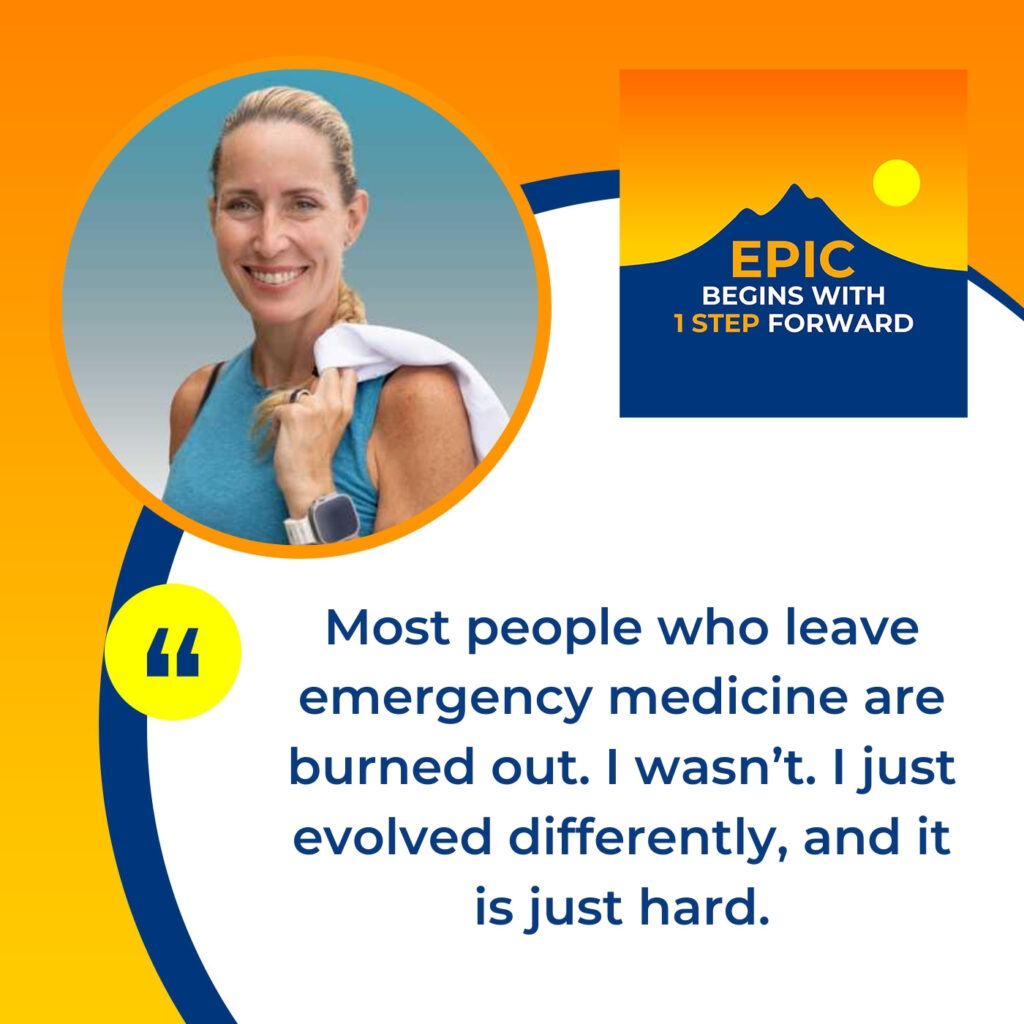
That’s how I was introduced on a show. It’s both good and bad because most people who leave emergency medicine are burned out. I wasn’t. I have evolved differently and it’s hard.
Dr. Maureen’s Not Yet In Life
One thing I love to ask my guests, in my book, I talked about not yet. The concept of not yet is so powerful in all of our lives and there’s things that you said. You were a triathlete. You’ve signed up for a race and someone goes, “Have you done the race?” Not yet. Why? It’s because it’s still months away. People get that like, “Not yet.” I wouldn’t ask you on your first day of medical school, “Are you done with medical school?” Why? It’s because we understand the track. Yet in our whole life, we all have those not yets. Those things that we go, “Someday I’d like to do this.” For you, what’s one or two of those not yets? Be it things or places or something that you’re like, “I dream of achieving this?”
I’d like to help a thousand physicians. Beyond burnout is the best way to say it because no other vernacular that I can find, and keep them on the ground in medicine, even part-time. One of the most impactful moments, one of my very good friends who is an upper-level boss came into relief me in the morning. We were just talking about cases and I talked about this in my book as well.
He said to me, “The only way for people to maintain longevity in emergency medicine is to go part time.” Which makes total sense, but the system doesn’t necessarily agree. One of the things that I would like to do is have impacted 1,000 physician lives in a way that they are able to continue to give back to medicine in a way that feeds their soul.
All too often, I have friends of mine who are doctors and they’re like, “This isn’t what I thought I was even remotely close to what I was going to do. I spend 50% of my time doing paperwork. I’m fighting insurance companies for something that my patient needs.” The insurance company goes, “No. We’re not going to cover that.” You’re like, “I don’t think so.” They’re like, “That’s not why I want to be on medicine.” I get that. That’s cool. A thousand physicians is awesome. Keep them in medicine. There’s a lot of time, money and effort that went in to get them there. It’s a shame when we lose them. Oftentimes, there’s a ton of institutional knowledge walking out the door.
Also, experience and desire to help people. As you said, a lot of times it breaks people. We lose physicians daily off the planet because they feel like that’s the only solution they have.
Every career has an expiration date. But not for doctors.
They think it’s some costs fallacy. Which is, “I put this much time and effort into this. I had to keep going down the path.” The fact of the matter is, people have jobs that they may have done 10 to 15 years ago, “I’ve done everything I can. There’s nothing more for me to do. Let me go do something else, or I had to side hustle and I found out that brings me joy. I like that. Let me go do that.” I get that.
Not everyone will stay in medicine. I get that. I have a few clients who would be like, “I want nothing to do with medicine. You’re not going to change my mind.” That’s where they’ve gotten too far. I honestly think the best time to catch people is 3 to 5 years out of residency, where they’ve got enough under their belt where they still like it. They’re still enjoying it and they can find different ways to give back to the patients and give back to the public. Use that knowledge and expertise. It’s sunk costs. Is it sunk cost because I went through emergency medicine residency and no longer practice emergency medicine after fifteen years? Yes and no.
You’re still doing some medicine but it’s like, “I’ve come this far and I’m a big proponent of choice.” If we remember that we do have choice, it is powerful. Sometimes the choices we have are crap and crappier, honestly. Even if the two choices you have are not ones that you want, and whatever your choice is not good for you, your life, your family or whatever. There is power in saying, “I didn’t just wait for something to happen.” I made a choice and said, “Here’s my choice. I wish I had a third one that was better.” I don’t. Here’s what I want to do. I’ve had many different careers.
I did a variety of things. I was holding on qualified to do. I’m not kidding. At one point, I was a software engineer. I majored in History and Psychology. How the heck did I end up there? It’s because I said yes, and I believe in myself. I worked hard to be mediocre and I stopped doing it because I want more than mediocrity in my life.
That speaks to your point as well about not yet. Your choice might be crap and crappier but you don’t have a third choice yet. It just hasn’t revealed itself yet. The only way it’s going to reveal itself is through action. What you said about doing all the careers, which was fantastic. I heard this said to me a few months ago and it blew my mind. Every career has an expiration date. Every job has an expiration date. I was like, “Not for doctors.”
You do not have to go down the traditional path of attending school, getting a job, and finally retiring. Your life and ability changes.
That’s somewhat of the fallacy. You went to medical school. My mom’s going through some medical things. She could have surgery and her surgeon is like, “I’m doing an MBA. I’ll be back but I have to go do this in-person part of my MBA program.” I had a moment. My mom’s going to be okay. The waiting isn’t going to affect her. It’s not dangerous to her life but I’m like, “You have this huge, wonderful career. Why can’t she go get her MBA?” My dad had a doctor who was getting his law degree. I don’t know why. Maybe it’s just someone who loves learning, like, “I missed the stress of medical school. Let me go to law school.”
I agree and I’ve known a couple of MD/JDs over the years. One was I worked with him very early in my career back when I did not take advice well. When you first get out of medical school, you’re like a teenager. “No, I know better.” You don’t.
You don’t even know what you don’t know.
Exactly. Looking back, he taught me a ton about understanding what you do and don’t know, first off and how to put yourself in the market. Again, we go through the traditional path of you go to school, get a job, retire, and then you die. I’m like, “What is this 1960?” It’s not like that anymore. It can’t be like that. Your life changes. My ability changes. My husband told me this years ago, “Emergency medicine is a young man’s game. They’re better at it than we are.” That hurts my ego for sure but he’s right. When I read Arthur Brooks’s book, I was like, “Now I get it. Alright, we’re there.”
Get In Touch With Dr. Maureen
Maureen, I want to thank you so much for being in such a great conversation. You and I could talk for hours about all of these things and wander all over the place. How can people get a hold of you? Where can they find your book?
The book is on Amazon. It’s Freedom to SHIFT and my last name is Gibbons. It’s the easiest way to find it. The best place to contact me, though, is to DM me on Instagram. If you DM me after reading this episode. DM me podcast and I’ll shoot you out a link to my vital metric review. It’s the very first step to taking a look at what’s on your calendar, what serves you and what’s not.
Thank you so much for being truly an epic conversation.
Thank you so much.
I want to remind everyone that if you’re ready to begin your epic journey, go to EpicBegins.com. As always, epic choices lead to the epic life that you want.
Important Links
- Maureen Gibbons on LinkedIn
- Maureen Gibbons on Instagram
- Maureen Gibbons on TikTok
- From Strength To Strength
- Kaiser Permanente
- Buy Back Your Time
- The Big Leap
- Freedom to SHIFT
About Dr. Maureen “Moe” Gibbons
 Dr. Maureen “Moe” Gibbons—known as Dr. Moe—is a physician, entrepreneur, and author of Freedom to SHIFT. She helps high achievers trade overload for health, time, and income freedom through practical lifestyle medicine and real-world systems.