Free E-book – https://dl.bookfunnel.com/afk096okro
Apply to be a Guest on My TV show – https://www.epicchoicemedia.com
#EPICBeginswith1StepForward, #ZanderSprague #OceanCrossing #Circumnavigation #TsunamiWarning
—
Watch the episode here
Listen to the podcast here
From Schoolteacher To Circumnavigator: Alison Gieschen’s Epic Leap
I have a special guest. I have Alison Gieschen joining me all the way from the Marquesas, which is in the South Pacific. Alison, welcome. Tell us who you are and what you do.
First of all, thank you for having me. I really appreciate this. I used to be a schoolteacher, horse farm owner, and just a general American citizen. My husband and I gave up everything, sold everything we owned. We moved aboard a 43-foot sailboat, and we are now full-time sailors circumnavigating the globe.
That is so exciting. What an epic adventure. So much to talk about. I’m sure there are more stories than I will get to, but just a question, because I’m a sailor and I’m curious, is it a monohull, a trimaran?
It is a monohull. We went back and forth about the best boat to do this, and we researched it and had a mentor who was an extremely knowledgeable person who sailed around the world many times, and he recommended this brand of boat. It took us 5 years because there are only 50 ever made, but we found her.
Can I ask what kind of boat it is?
It is a Taswell 43 cutter rig.
How long have you guys been circumnavigating the world?
We have been out since 2017.
Have you already completed one circumnavigation?
Unfortunately, no. We’ve been to around 49 countries and 4 continents. However, we were stopped for two years because of COVID. We had arrived in Ireland when COVID hit and we couldn’t go anywhere for two years. As a result, we had to miss the whole Baltic, which we were really looking forward to, but they just didn’t open up even after the two years, so we just had to continue.
Were you just living on the boat for two years, or did you leave the boat and go back to the US?
We did. We did go back a couple of times, and our kids came and visited us once, two of our children. We rented a car and drove all around the country of Ireland, and there was nobody at any of the really popular locations, so it was like having all of Ireland to ourselves. In a way, it was really cool.
Most Anticipated Things In An Epic Adventure
As with any epic adventure, especially with sailing, there is what I like to call the epic unexpected, those things that happen when you’re sailing that you could not have anticipated. Can you share with me, Alison, what are some of those things that have been those epic unexpecteds that you learned from?
I’d have to say the very first one, which was epic not in a good way, was our very first ocean crossing. We signed up with a rally, it’s called the Salty Dog Rally, and everybody crosses the ocean together. Actually, no, our first was the ARC Rally. They prepare you, they have a weather router, they check all of your safety equipment, you spend a week taking courses. We started off to cross everybody was excited and we couldn’t wait. It was going to be like a two-week passage to get to the Virgin Islands from Norfolk area.
Our engine started making a funny noise. There had just been a hurricane that went through, I think it was Irma, and we knew we were going to a place that was going to have lots of boat wreckages and no place to repair boats. My husband’s like, “Do we really want to start this ocean crossing, knowing there might be something wrong with our engine?” we diverted to Wilmington and we had the boat checked out. Nobody could find anything wrong with it.
Ten days later, the weather router was still working with us, and he said, “Go ahead. If you get across the Gulf Stream in the next 24 hours, you’ll be fine, but you got to leave in the next two hours.” we pulled up anchor, we were all provisioned, we headed off, got across the Gulf Stream just fine. When the sun came up the next morning, all of a sudden, we realized the waves were getting bigger and bigger and the wind was getting stronger, and we were trapped. Do you remember the movie The Perfect Storm?
Yes, very much so.
That’s exactly what happened to us. A storm was pushing in front of us, a storm was coming up behind us, and it compressed the waves. We had twenty-foot waves crashing on the deck of our boat. It ripped our dinghy off where it was strapped upside down to two handrails. It ripped the handrails out of the boat, put the dinghy through the lifeline, and now the dinghy is slamming against the boat and it was tied up to the mast and we were getting ready to lose our mast.
Dan had to go up in twenty-foot waves and cut that boat free. We lost our windsurfer, our scuba gear, a solar panel, a titanium whisker pole, all overboard. We turned around and five days later, we were back in the Wilmington area, twenty miles from where we started, with $14,000 worth of damage to our boat. That was our first ocean crossing.
You’re then like, “Yes. Let me sign up and do more of this, please.”
I did have a little PTSD after that. I was a little taken back by that experience.
I’m sure you were. Before you left, how much offshore sailing experience did you and your husband have, and who’s the mechanic? I haven’t done transoceanic passages. I’ve sailed for over, really, most of my life. I also know that even just doing a few hours sail, stuff goes wrong and you have to be able to fix it. When you’re out in the middle of the Atlantic, the Pacific, or wherever you are, it’s up to you to try and figure out how to fix it. Who’s the fix-it, or are you have you both learned a lot?
I would be zero on the fix-it department unless it happens in the galley and I’m great. My husband was a merchant marine. He was a naval engineer, a mechanical marine engineer. He is now known as the Boat MacGyver because he has stopped us from sinking at least two times, and I think once was with a safety pin. He’s amazing and he had crossed oceans on merchant ships, so he had been to all over the place on these merchant ships. Me, I had not been on the open seas. I had sailed in lakes and I raced in college in Charlotte.
To prepare me for going out into the ocean, when we were at we used to go to boat shows all up and actually all over the country to boat shows and listen to the seminars, the educational seminars. There was a man named John Kretschmer and he’s a delivery boat captain and he’s written five books on sailing. He was giving a talk on sailing in storms. I’m like, “Dan, I have to go listen to this,” because that was my biggest fear.
After his presentation, which totally blew me away because he was just so composed and had no fear and so much practicality in how he addressed being in storms and, “Yeah, you just do this,” I’m like, “Okay.” at the end he goes, “Now I do have a heavy weather training passage where we take you out and do a thousand miles in the trade winds and you can be out on the ocean and experience heavy weather sailing to prepare you.” I’m like raising my hand going, “Dan, that’s a need. I have to do this. Not a want, I have to do this.”
I signed up with John Kretschmer and we did a thousand-mile training passage from the Virgin Islands to the Grenadines, Grenada, and then back again. It was really heavy weather, so I got to get my confidence up. Dan got to go with me. He’s like, “You guys are going to be fine. You’re going to do just fantastic.” that was my only experience out on the ocean in heavy weather, but I thought that I had it handled, but apparently I did not.
Sailing and Murphy’s Law, boy, they’re holding hands as you’re on the boat because what can go wrong will go wrong, and inevitably it’s the one part that you just don’t have right now. You had it, you used it, but now you don’t have that part.
Can I just add that we have been in five countries now for at least three months or more waiting on boat parts?
Yes, and that is one of those things that I do know from watching like Sailing Nahoa and Delos and stuff where I’m watching, they’re documenting their circumnavigation. You’re right, they’re like, “Well, we’ve been here for two months because there is a part, and we are in this beautiful remote atoll and it’s going to take two months for us to get a part. If we were actually like in Australia, New Zealand, South Africa, the United States, somewhere in Europe, might take us two weeks.” I assume that you guys went through the Panama Canal in your boat.
We did. That was epic. It was incredible. My grandfather actually worked protecting the people in the Panama Canal because there was so much strife and turmoil going on. He was on a plane that was bringing supplies to the Panama Canal and he actually got shot in the chest. He was up on the roof and he had us up there with his gun and he got shot in the chest. However, he had a medal, as he had saved somebody else’s life, and the bullet hit the medal and saved his life.
What was it like? The Panama Canal, there you are in your 43-foot monohull boat, and there’s all kinds of incredibly large tankers and other cargo ships along with you.
We were in the lock with another ship, with a huge ship. We had a sailboat on each side of us and, actually, we were the outside boat. There was a large boat on the inside, another sailboat on the other side of them, and then a tanker behind us. We all went in together and you really can’t describe it. There’s some pretty good YouTube videos of going through the locks, and they’re really fun to watch because you get a feel of the immensity of the water that’s coming in and how you raise up and how you lower back down again.
Going through the locks gives you a feel of the immensity of the water as you rise and fall with the waves.
It is truly an engineering marvel and certainly saving a lot of time. I’m pretty sure you and your husband were not like, “Sure, let’s go down and sail around the tip of South America.”
We are going to do that when we get back. He really wants to go to Antarctica. That’s his bucket list item, probably number one.
Sailing To Europe And Crossing The Panama Canal
Can you share, because I’m curious and I’m sure the audience is, what’s been the route? It sounds like you were over in Ireland, so you clearly went across the Atlantic towards Europe, but you went through the Panama Canal, which indicates that you came back.
We started in the US and we went to the Caribbean. We went to Bermuda, the Azores, which when everybody asks, “What’s your favorite place you’ve been to?” it’s definitely the Azores. It’s a group of islands off of Portugal. We went to Ireland, then we went to Scotland and we did some of the Scottish isles, and then as soon as we could, we went along the coast of Europe to the Med. We went through the Med and touched most of the countries there. Stopped in Morocco and visited Africa.
We went to the Canary Islands. The Canary Islands we meant to cross, but our autopilot broke, so we had to stop in Cape Verde where we got stuck for three months waiting for a new autopilot. We crossed from there back to the ABCs. We did the ABCs and then we went to Colombia, and from Colombia, we went up and went through the Panama Canal. We were in that area for another five months. Again, we had to re-do our forestay and everything. We went to the Galapagos Islands. From the Galapagos to where we are right now.
What was it like doing the Atlantic versus Pacific passages?
The Atlantic was wonderful. Crossing back this way was awesome. I was at some point in the middle of the eighteen days, I said, “I don’t care if I ever reach shore. I could just be out here forever.” It was that beautiful. You just didn’t have a care in the world and it was absolutely incredible. Dolphins would come play in the bow in the sunset and we caught fish and we just loved life.
Was it just like a downwind run?
Yes, mostly downwind. Yeah, it was incredible. The Pacific was horrible. It was a nightmare. Mostly because I told you we had to replace our forestay in Panama. The guys didn’t put Loctite in all of the little sections holding the forestay together and all the screws fell out, and our jib got caught and ripped. We started having engine trouble. We went to the Galapagos on an emergency because you’re not allowed to land there unless you pay $4,000 for permits and have your bottom cleaned and all this stuff, but they have to let you in if it’s an emergency.
We had to do these emergency repairs, get everything put back together. Dan had to go up the mast, he had to actually cut every single screw because we couldn’t get the right size screw. He had to cut 40 screws the right size, go up the mast, get everything put back together. We were there for two weeks or so. We head back out, and we’re out for another ten days and the drum falls off. Now the guy didn’t put that on right either. Now our sail rips again.
We got caught up in a Chinese fishing fleet, which is a whole another story. They put out these 60-mile-long nets and they just catch everything they can. They kill the whales and the dolphins and the sea turtles, and they’re really very nasty groups. What happens is if they get nets caught up or whatever, they’ll just cut sections and throw them in the ocean and sailboats get these caught on their rudders. Of course, middle of the night, our boat screeches to a halt and 5 knots of current and 25 knots of wind and we’re like, “This isn’t good.”
Next morning, Dan put the GoPro under the boat and saw that there were marks all over the rudder where we had something tangled there. We turned the boat back into the wind, went to engage the autopilot, it didn’t work. It had broken our autopilot. We were 650 miles in 10-foot seas, 25 knots, and we have no autopilot and we had to hand-steer 650 miles to get to shore.
Now, that’s so much fun, Alison.
Yeah, no. I could only do it for 30 minutes at a time. It was so physically difficult because our steering also got loosened, the cables got loosened, and this boat wasn’t responding well. At one point, we actually hove to for an entire day and he went below like MacGyver and we got it somewhat tightened again.
That was going to be my question. With the nets, did you or Dan have to go overboard to try and clear the nets off of the rudder?
I wouldn’t let him. The conditions were just so bad. That’s why he took the GoPro, put it on a boat hook, put it under the water and we were able to see that the rudder was okay and that there was something on there because it was all scraped up, but it had freed itself. He had to take the entire pedestal off the boat, which we had never done.
We had a queen-sized bed in the back, we had to take the mattress off, all the boards, and crawl into the very aft of the boat with great big huge pliers and stuff. The boat’s doing this and we’re getting our knuckles cut and scraped. It took two of us to slightly tighten the steering enough that I could at least keep the boat on course, because every time I got a little bit off, the whole boat would broach over because of the waves hitting us.
You just have so much fun, Alison.
I just can’t even imagine. I have nightmares about it because it was just so wonderful. I could do 30 minutes, he could do 3 hours, and then every night, we hove to. We finally got there and I see the Marquesas, and it was my number one place on the planet out of everywhere. Before we left, Dan says, “Where’s your number one place?” I’m like, “French Polynesia, duh.” Finally, it comes into view and I’m sitting, I got my legs over the rail and I’m just looking at it, he goes, “There it is. Can you see it?” I’m like, “Yes. I feel nothing.” I had no emotion left. I was so wiped out, I felt nothing.
We pull into Hiva Oa, drop the anchor, and then the very next morning, there’s a knock on the boat. We have a bottle of champagne for when we get to epic places. I didn’t even want to drink it. I’m like, “Dan ” he’s like, “No, you’re drinking the champagne. You’re going to enjoy this moment.” the next moment, there’s a knock on the boat and there’s a guy in a boat saying, “You’ve got to leave the harbor.” we’re like, “What?” He goes, “There’s a tsunami coming.” there’s nothing like the icing on the cake, a tsunami after you’ve hand-steered 650 miles across the Pacific.
A tsunami is like icing on the cake after you hand-steer 650 miles across the Pacific.
Before we came on, I asked like where you’re going next. You will be making your way through the South Pacific, stopping at various places like the Cook Islands, an epic destination, if I must say. Rarotonga is beautiful. Aitutaki, which is a ring reef, spectacular, so beautiful, and then you’re New Zealand, Australia, and TBD.
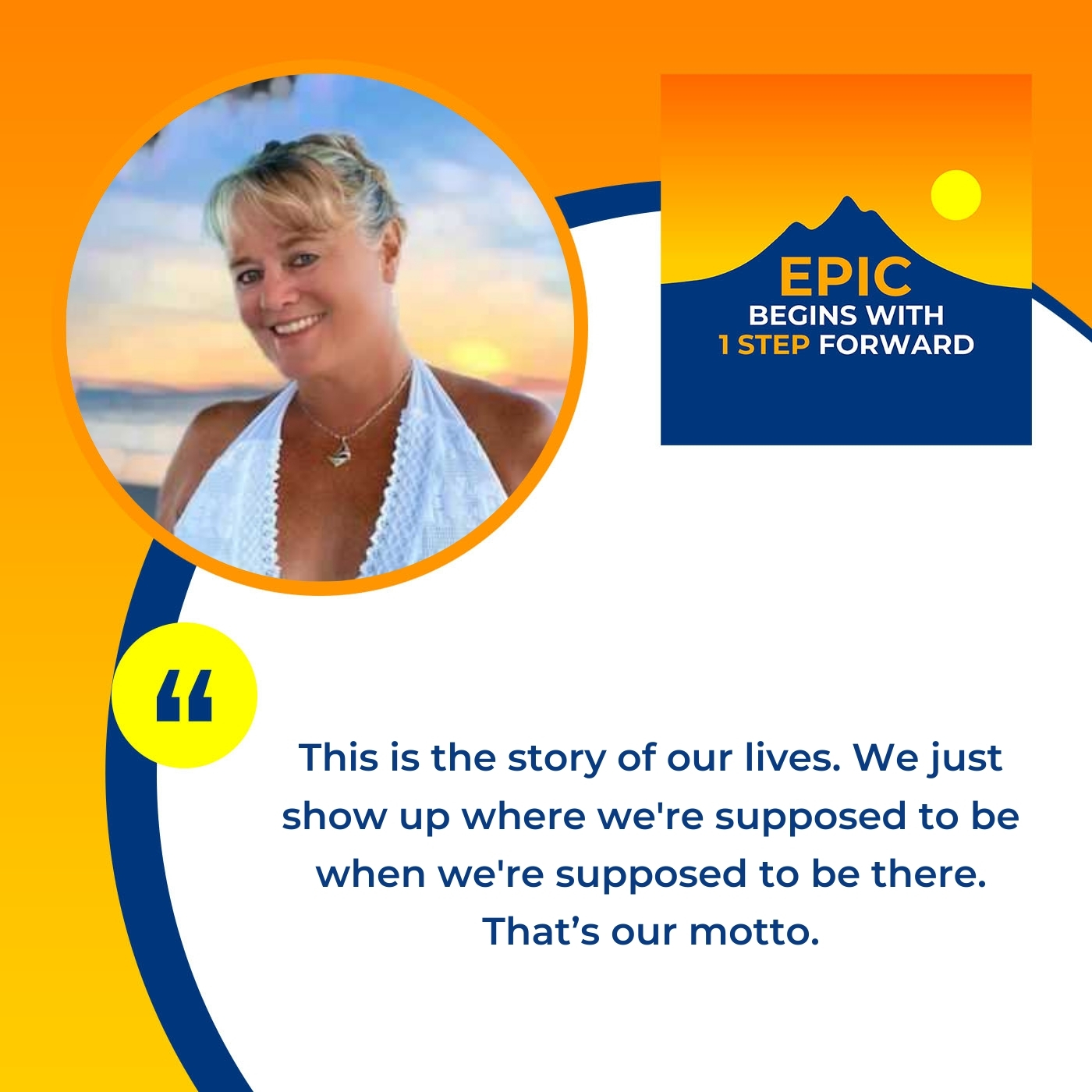
Definitely, yes. We really can’t plan ahead because we’ve never been anywhere when we thought we’d be there. It’s like the story of our lives. We just show up where we’re supposed to be when we’re supposed to be there, and that’s our motto.
How Sailing Around The World Can Change Your Life
What are 2 or 3 things that you’d like people to know about sailing around the world?
It really changes your entire perspective about life because when you’re living in a home on land, you have stability. You have a car, you can go to a grocery store. You have so many conveniences. You can have something delivered to your house the next day on Amazon. Along with that comes a lot of pressure and a lot of demands on your time and the structure in your life really drives you, drives your life. Here, there is no structure driving our life.
Sailing really changes your entire perspective on life.
It is totally freeing, and everything we own is on this 43 feet of boat. We can pack it in one bag. When you shed all of those worldly possessions, and the pressures of life, you can so focus on the beauty of the world around you and meeting these indigenous people and just enjoying things you’d never see or never experience in a normal lifetime. We’ve just really come to appreciate the simplicity and the level of enjoyment that we never knew existed.
Is it your intention to just keep sailing?
We have no intention. We literally might die next week. I’m not trying to be morbid or anything, but really we’ve just learned over the years that nothing we’ve planned has even come remotely close to happening. This is an adventure, and when it ends then we’ll figure out what to do. We plan on getting around the world, and then if we do, we’ll figure it out from there. Everybody’s like, “Well, are you going to sell your boat, move on land?” I’m like, “I don’t know. How can I possibly know, because I don’t even know ”
I don’t even know when I’m getting out of the Marquesas right now.
Exactly. Ask me what’s going to happen when we get around the world, because I can’t tell you and I can’t predict.
What Alison Misses From The Terrestrial Landlocked Life
What are 1 or 2 of the things that you just really miss from the terrestrial landlocked life?
I guess mostly my family. I have five grandchildren now. They call us “Boat Grandma” and “Boat Grandpa,” and thanks to Starlink, which has been an amazing game-changer, we did not have that, obviously, when we started out, I can facetime them. These little smiling faces look at me and I show them the islands that we’re on and the fish in the water. We try to go home once a year, don’t always get to do that. When we’re there, the time is absolutely precious.
I know a lot of people take for granted that when their grandchildren walk through their front door or they go visit a family member. For us, it’s just magical to be there. It’s given us a greater appreciation of time with family. That is the one thing that we do miss. Other than that, there’s not a whole lot that we say, “I wish we were back home because of this, or this.”
Any adventure like this, if you reflect back on the last few years, how have you grown and how have you changed?
In a lot of like a hundred ways, really. I’m not the same person I was when I left eight years ago. My writing has definitely taken off because before, I wrote a couple of books, but now I’m a prolific author because A, I have time to write, and B, even though I write fiction and nonfiction, I have chronicled our sailing journey the first two books and getting ready to write the third. Even my fiction weaves in things from that I experienced and knowledge I’ve gained and people I’ve met and places I’ve been. My fiction is very much driven by my real experiences.
Do you have a youtube channel or Instagram or some place that people can follow along and see what adventure the two of you are up to?
We have all of that. We have a Sailmates YouTube channel. Sailmates is our sailing brand, but Nautical Novelist is my author name. AlisonGieschen.com, I have all of my books. Sailmates.org is my sailing blog. I’m an avid photographer, so I take pictures and do the history of the places that we’ve been and pictures and stories from everywhere we’ve visited in the world. We have a YouTube channel with videos of different things we’ve encountered and fun experiences. We’re on Instagram, we’re on everything. Look for Sailmates or our name.
Eating At The Ocean And Encountering Chinese Fishing Boats
I, for one, will be going to youtube when we get done and go, “Let me let me go see some of the videos.” I have so many questions. What’s 1 or 2 of the foods that you’re like, “I just,” because again, sometimes you’re doing these really long passages and you can bring some fresh food, but depending on what’s going on, sometimes you run out. Now we’re into freeze-dried or whatever. In these past few years, what are 1 or 2 things that you’re like, “I just don’t want this?”
I really haven’t encountered something that I don’t want because, number one, we don’t feel like eating much when we’re doing passages. We might have one meal a day. There are so many new things that have come out with food and being able to preserve it and store it and keep it, that food is not a problem. Here in the Marquesas, getting good meat and stuff is really difficult unless you like goat, and I don’t really eat goat because they were my friends.
I think being on land is more of an issue because you feel like you should be able to go and find things that you like to eat and a lot of times, I walk in the grocery store and it’s either canned or it just you look in the freezer and go, “I have no idea what that is and I don’t really want to eat it because it’s $26 for a piece of meat this big.” I would say it’s more being in the islands and wanting to have food like you’re used to in the US or other countries and you just can’t find it.
Here’s the question for you. You talked about obviously when you’re out cruising, you can drop a line off the back, hope that you catch some fish. That’s always exciting. However, there are the fish that you catch and maybe you or Dan. You bring it in and then you’re like, “Yeah, that’s not that’s just not a good eater.” there are the fish that just are not necessarily particularly good for eating. What do you hope to catch?
There’s only been one fish that wasn’t good for eating and after we tried it once, we never made that mistake again. It looks like a tuna but it’s called a little tunny. Basically their nickname is cat food because that’s really the only thing you’d want to feed it to is your cat. Other than that, there has not been a fish. We love the mahis, we love the tunas, we love the Spanish mackerel.
We accidentally caught a six-foot-long sailfish and that was horrific because it took us two hours to get it beside the boat and we didn’t want to kill it and we weren’t going to eat it, and it just almost did us in trying to deal with this fish. It finally snapped the hook and went away, so everybody won. The fish are just amazing, and we have not caught anything that we have not enjoyed eating. Sometimes it’s too much, but that’s the only problem.
As you’re doing your transoceanics, most boats have a beacon signal that will show up on your radar, and I think it’s AIS, I think?
Yes.
Have you encountered some of the ghost fleets where like you’re sailing and all of a sudden, you’re like, “There’s boats, but we didn’t see them on the AIS,” because they don’t turn on their AIS?
That would be the Chinese fishing fleet, and they do not turn it on and they’re 200-foot boats and there was a pack of about 10 of them. They will not respond to you on the radio. They will not tell you that they see you and they’re going to avoid you. The only reason Dan actually got a little forewarning is because they are picked up on a global satellite. They don’t have their AIS on, but on No Foreign Land, which is a really cool sailing app, they did show up, but not on our radar, not on our equipment.
Dan was able to say, “There’s a fleet coming and they’re going this way and we’re going to be going right through them.” we actually had to turn our engine because I’m hailing them, I’m like, “You see us because we’re on collision courses.” They’re 200 feet long, we’re 43 feet long. They would not answer me, so we were under sail and we had to turn our engine on and just get out of there as fast as we could. They came so close that I took a picture with my phone of our radar and it actually looked like their boat was touching ours, like T-boning us. They were 200 feet from passing us, which is really close.
You’re in a big wide-open ocean, plenty of room, and they’re 200 feet away. That was scary.
It was very scary. I was not happy that day. We got through it, and then we ran into their net and they took off our autopilot, which caused horrific problems because we couldn’t get it replaced and it was just another major headache.
Alison’s Not Yet In Life
I want to finish up with this, because part of what I write about in my book are when on any epic adventure when we think of doing it, there’s two really important words. Not yet. I love these words because there’s so much optimism. I know that you guys have a lot of not yets, but what would you say is 1 or 2 as you look forward to where you’re going or where you’d like to go, those not yets?
I’m really looking forward to the diving, because we have a compressor on board and we scuba dive. To spending time, like uninterrupted time in diving paradise, and I feel like we’re going to get that up in the Thailand area because I’ve just been researching and it looks absolutely phenomenal. I want to have a stress-free, no-planned diving vacation on my own sailboat and see some of the most incredible sea life there is to see. We had some great diving in Curacao and Bonaire and that kind of stuff, but it was you have to get in your dinghy and we had to go out of a long channel and sometimes we’re out there in four-foot waves trying to get off our dinghy and go down and dive. I just want peaceful, wonderful diving experience.
Alison, I want to thank you so much for coming on. What an epic adventure that you’ve been on and that you continue to be on. I wish you all the luck. Calm seas, following winds, all of that, and hopefully, not too many mechanicals.
Thank you. That’s our dream.
Get In Touch With Alison
I’m sure. Anyway, thank you so much. Just once again, if people want to get a hold of you, follow you, how can they do that?
The easiest to remember is Sailmates.org and there’s links on that to our YouTube channel, to my author channel, to probably everything on that on my blog site.
Thank you so much. I want to remind everyone that if you’re ready to begin your epic journey, go to EpicBegins.com. As always, remember, epic choices lead to the epic life that you want.
Important Links
About Alison Gieschen
 Alison Gieschen is an award-winning author, lifelong sailor, and horsewoman whose life story is as epic as the novels she writes. A former schoolteacher and graduate of the University of North Carolina Charlotte, Alison spent 30 years running an internationally successful equestrian program on her family farm in New Jersey.
After raising three children with her husband Dan—whom she met during a sailboat race—they sold everything they owned to pursue their shared dream of circumnavigating the globe aboard their 43-foot sailboat. To date, Alison and Dan have traveled to 46 countries and recently crossed the Panama Canal, setting their course for the remote islands of French Polynesia. Her time at sea and her deep connection with both horses and people across cultures have inspired a powerful body of work spanning children’s literature, memoir, and adult fiction.
Her books include the Rising Star Award-winning novel Blue Ridge, the magical children’s stories The Legend of Altor and Julia’s Vaulting Dream, and the nonfiction sailing memoir Riding the Waves of Reality: Tales of Turmoil and Triumph—with a sequel on the way. Her latest release, The Seven, is a sweeping and soul-stirring novel that blends fantasy with deeply rooted real-world experience.
The story follows seven humans and seven horses in a tale that spans continents and cultures, asking one pivotal question: Can the hearts of a few determine the fate of all humanity? Alison is also preparing to release her newest children’s fantasy, Seanna: A Mermaid’s Tale—a story especially close to her heart. As someone who has always felt a magical connection to the sea and its mythical creatures, Alison brings the underwater world to life in this early reader chapter book. The story is being brought to even greater life through the artwork of seven-time international award-winning illustrator Barbara Owczarek, whose stunning illustrations add an extra layer of magic and wonder.
Through it all, Alison remains deeply connected to the world around her—from the sea life off her bow to the ancient cultures in the world’s most remote places. Her journey is far from over, and with every mile sailed, a new story is waiting to be told.