
In this fascinating episode of Epic Begins With One Step Forward, Zander reconnects with fellow LPCC Lisa Manca, a board-certified Dance/Movement Therapist helping clients heal through the wisdom of the body. Lisa breaks down what dance therapy really is—no, it’s not interpretive dance with your therapist—and explains how movement, mirroring, and somatic awareness unlock emotions that words often can’t reach. She shares stories from her wide-ranging career, from group work in psychiatric prison settings to the intimate breakthroughs that happen in one-on-one sessions. Together, they explore attachment, trauma healing, and why the body reveals what the mind tries to hide. If you’ve ever felt disconnected from yourself—or curious about creative approaches to therapy—this episode will move you in every sense of the word.
Apply to be a Guest on My TV show
#EPICBeginswith1StepForward #ZanderSprague #DanceTherapy #MovementPsychotherapy #BodyWisdom
—
Watch the episode here
Listen to the podcast here
Move To Heal: Lisa Manca On The Power Of Dance Therapy
Welcome back to another exciting episode of the show. I am so excited to welcome Lisa Manca.
Lisa, welcome. Tell us who you are and what you do.
Introduction & Professional Identity (LPCC In California)
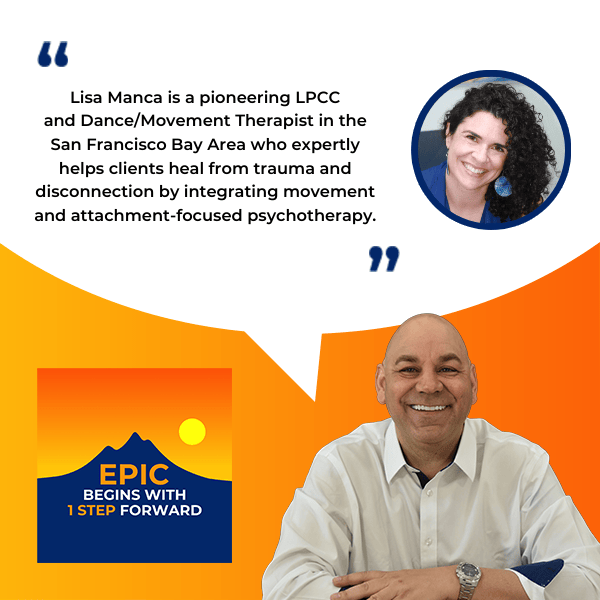
Thanks for having me. I am an LPCC and board-certified dance movement therapist. I will tell you all about that. I am located in the San Francisco area and work in private practice. I help people heal from trauma and from feeling disconnected from their bodies through the use of movement and attachment work.
The first thing that we need to talk about is the fact that I found another LPCC. For those of you who don’t understand, LPC and LPCC, or Licensed Professional Counselor and Licensed Professional Clinical Counselor, are very common around the United States. However, in California, we are brand new. The license was only recognized a couple of years ago. It’s cool that I met you. I know my number is in the 4000s. That tells you.
Mine is 270.
Look at you.
It was one of the originals. I was like, “I can have a license?” I rushed out, and they grandfathered some of us in, which was awesome. It was one of those things where it was like, “Everywhere else has LPCC? Why is it so hard for us to have them?”
There were things that I learned in graduate school that I was like, “Wow.” Part of the reason it took so long for LPCCs to be recognized by California is the licensed marriage and family therapist. It is a very strong organization. Seventy-five percent of the LMFTs are in California.
I was going to bust out that statistic. 75,000 and 50,000 of them are in California. One of the last was Nevada, and then us for LPCC.
We were the last state to recognize this.
It’s the most portable license. You can find more LPCCs or the equivalent, probably an LPC, everywhere. For some reason, we were like, “I don’t want that.” I didn’t want to do marriage and family therapy. I don’t know about you.
Honestly, this is a bad thing because I majored in history and psychology. I have lots of my friends who are LMFTs. It wasn’t until I got into graduate school that I was like, “They don’t just do marriage and family therapy.” I had a choice. My degree was set up where I could have two licenses, but I’m like, “First of all, why do I need two licenses to do the same thing?” More importantly, as a speaker and someone who’s out there, there’s so much confusion about marriage and family therapy. The name itself says that’s what you’re doing, and yet most LMFTs are not doing a lot of work with families and couples.
There’s a lot of individual counseling. It was a catchall. It’s the same with LCSW, which is the Licensed Clinical Social Worker. It was the catchall for if you wanted to do therapy. I’m very happy. I was happy to be one of the earlier LPCCs. It was exciting for us in California to have that license, especially for those of us who fall under the umbrella of creative arts therapists, like a dance therapist, a music therapist, or an art therapist. For us, we didn’t have a pathway to licensure. We weren’t under the LMFT. We would have to go through a whole new program to get licensed. That made no sense if you already completed two years of graduate school.
I was like, “I’m going for the LPCC because it more accurately describes who I am and what I do.” I’m not slamming LMFTs. Trust me, I’m not, but I was surprised by the statistic that most of them are in California, and it’s a lot rarer in the rest of the United States. There are a lot more LPCCs in the rest of the United States. I’m sure everyone else is bored that we spent five minutes talking about it.
They’re like, “What licensure? What is this about?”
Let’s talk a little about your work with dance therapy and stuff. How did you get into that?
The Nature Of Dance Therapy & Its Purpose
I loved psychology, and I loved dance. I was an undergrad. I wasn’t ready to go out in the real world. With psychology, I saw people going into HR with an undergrad degree. That wasn’t my bent. I wanted to help people. I put into Google dance therapy, because I figured, “There’s music therapy. There’s art therapy. There must be dance therapy.”
I found the American Dance Therapy Association. They have a list of approved graduate programs that you can go through to be a dance therapist. I applied to those programs not quite sure how dance therapy worked or what it was, but I was like, “This sounds like it’s for me.” That’s how I found it. I fell in love with it. I went into school not quite knowing what it was, but I was like, “I’m going to check it out.” It turned out to be such a good fit. That’s how I found the field.
That’s great. For those who don’t know, how does dance therapy function? How does that work?
To define dance therapy, it is the biocycle social use of movement. That’s for healing and for help with mental illness. They have a more precise definition on their website. It’s the idea that your body and your mind are connected. By helping change patterns of movement and changing how we move, we change how we feel and how we experience the world.
That’s good. When I first heard about that, I thought, “Huh.” I get therapy, and I get dance. I’m like, “Does that mean that the therapist and I are doing some interpretive dancing and I’m talking about my feelings and what traumas I’ve had?” It’s not quite that way, but you know how your mind sometimes works. We’re like, “I understand these concepts. I get dancing, and I get therapy. Am I ballroom dancing around a room with a therapist talking about my issues?”
I’m happy to explain.
I want you to. I’m not making fun of it.
The Role Of The Therapist In Dance Therapy
You don’t know, and that’s very real. That’s something I run into a lot. The other part of being a dance therapist is being able to advocate and define what you do. For the dance therapy piece, I need to be a dancer or have experience in training in dance because I’m observing movement. Another key piece is replicating movement in my body. I will be mirroring the movement back to you.
I move at the same time as my client a lot of times. It would be the equivalent of when you’re doing verbal therapy. You’re having to talk at the same time as your client is talking. It’s a skill. You have to keep moving because the other person will stop moving, and then your whole session goes away. It’s gone. That dance piece is important.
The mirroring is that if you take on someone’s body posture, you can get a little bit of a kinesthetic sense, like a bodily somatic sense, of how they’re feeling and what’s going on for them. You may get a snippet of what it might be like to live in their body and the feelings and emotions that come up. As a dancer, when I observe the movement, I can put it in my body and then be able to use those movement interventions. You had it pretty close. It’s not like interpretive dance, but it’s more improvisational than it is learning certain steps.
I got it.
As a dance therapist, the person comes in and tells me what they want to work on, and then I’m also observing what’s going on in the body, what’s happening, and what else they are telling me. Based on what they tell me and what I see, I’ll suggest things. I’ll put on music that might work. There’s usually a movement warmup. Warmup is key for dance service to analyze and see how that person is, because they could come in and say, “I’d like to work on opening up.” Meanwhile, they’re hunched over.
They’re all closed in.
I’m supposed to help them open completely to the world. I’m like, “That’s not realistic in session based on what I’m seeing.” Based on the movement warmup, we go towards a theme. That could be based on our initial verbal check-in or what I saw. From there, I can suggest interventions, like, “What if you try this? What if we explore moving this part of the body? What’s that like?” We are then talking about the emotions, feelings, sensations, and memories that come up when we move those parts. Since I have a psychotherapy background. It’s not just dance. There’s the piece of analyzing, talking about it, and helping people process that makes it therapeutic.
When you’re conducting this, are you in a dance studio?
I tend to use a dance studio. If my office were big enough, I could use that, and I have used that. I’ve been renting a dance studio to have enough space.
Application Of Dance Therapy In Challenging Settings
One would think you might want enough space so that you’re not feeling like, “I want to move around, but now there’s a wall here, so I’ll change my direction,” but that wasn’t where your body wanted to go.
We do need to have some space. That is one of the things that may limit dance therapy. I described it on an individual level, but I also worked in a prison setting and in inpatient psych. Those were more group therapy settings. For that, we generally have chairs. I’d often start the warmup seated because chairs can be pretty grounding, and also in a circle because we’re trying to build that connection. As we do in group therapy, we’re trying to help people build rapport within the group. Being in a circle versus a line, there are studies on that.
I run groups, too. The first thing that you want to do is try and get the people in the group to feel that it’s a safe space for them to share. I was doing it in a high school setting. You can imagine the self-concern that every single adolescent who was in my group had about, like, “I don’t want to say anything.” They’re so focused on their own bubble, and here I am, trying to get them.
I remember telling them, “The first 2 or 3 sessions here are going to be crunchy. I’m putting it out there. I want you to stick with it. This is good. You have to trust the process even though it feels uncomfortable.” I can imagine in a prison setting trying to do some movement therapy. That’s an even higher bar to try and get people to feel comfortable.
I’m sure you found this in the work, too. If you bring yourself in, you’re genuine in what you have to offer. Every therapist knows that the strength of the rapport is how good the result is going to be. Once I could get those men to trust me, we could do a whole lot. They want to know that you’re showing up every day and that you have their best interest at heart.
If you show up as your genuine self and offer what you truly have, the strength of the rapport determines the strength of the results. Once the clients trusted me, we could do so much.
I found that they were some of the most creative and interesting people. I did a dance therapy group. We did a prison newsletter because they didn’t have any outlet to write. We did a music writing group, like a songwriting group. The amount of creativity that was there, and that was stymied because of the environment. They also responded very well to any kind of creative arts because of that.
Can I ask where you were conducting?
Yeah. Salinas Valley Psychiatric Hospital. It is the Salinas Valley State Prison, but the city is Soledad.
I got it.
It’s in California.
Did you enjoy that?
I did. I burnt out because that’s not a system that’s meant for creative, sensitive, therapeutic types. The work with the clients wasn’t the challenging part. It was all the systems and how inhumane it felt at times to also get people to a place where they could talk about their feelings. Since it was a psychiatric hospital, we sent them back to wherever possibly made them ill. It’s like, “We got you stabilized, and we’re talking about your feelings. Now, let’s go back to that prison setting where you were sick to begin with.”
I always joke with my clients that the inherent part of therapy is that inevitably, we get to the good stuff 10 to 15 minutes before the end of the session. As we are digging into that, you’re like, “Now we’re touching it,” and then you’re like, “I’m sorry, but that’s time.” You can come back to it, but the fact of the matter is you’re not in that same moment and that same space.
I share with my clients that I’m equally as frustrated. When I’m working with someone, I’m like, “I am seeing something that’s important, but now I have to stop. I don’t have an opportunity to keep going.” I would assume in dance therapy, through the movement, all of a sudden, you recognize there’s some shift. There’s something that happened, but then you’re like, “I’m sorry. We can’t get into that as much.”
Sometimes, it’ll be useful to be like, “We identified that you move in this way. You always keep your chin tucked down. This is your movement pattern. This is how you experience the world with your chin tucked down and your eyes tucked down. What if you take that knowledge and, as an experiment, draw your chin up an inch when you remember and you’re walking outside? Can you report back a little bit about what happened?” Sometimes, it’ll be a way of doing that to prolong the benefits of whatever movement is in there. It’s similar to verbal therapy. I don’t like homework as a word because people have an adverse reaction to homework, but the idea of, “Can you try out that new way of moving we discovered in some small way?”
Therapeutic ‘Practice’ & Externalizing Change/Aha Moments
I refer to it as a practice.
Practice works, too. Practice is a good one.
Practice is like, “This is difficult. You’re going to have to practice this new way of reacting, thinking, or catching yourself when this situation comes up. If you have anxiety, pay attention to what you’re feeling and recognize it. What can you do?” The practice is what tools are they going to use to try and lessen that anxiety coming on? Practice seems to be good. I’m like, “That’s exactly what it is. You may not be successful this week, but keep practicing.”
I think DBT also calls it practice, too. DBT has a lot of those.
I know DBT, but I don’t.
That was another word they used. I recall it was practice. That is a good one across the board, because who knows what association people have with formal education as well?
Homework implies that it’s mandatory.
Correct.
Like you, I was like, “I need a different word or words, whatever’s going to work for my clients, to help them remember this.” Practice is when you’re evolving. I point out that some of the most trusted people around us, like a doctor, have a practice.
Meditation is a practice where you go over and over, and you’re not perfecting it.
Therapy has practice. Lawyers have a practice. I know some people don’t. For me, the whole idea of practice is that it’s not a set thing. They’re learning. You and I know as LPPCs that we have continuing education. The whole idea is that we went through graduate school and we got licensed doesn’t mean our learning stops. There are new things for us to learn. There’s stuff to refresh our memory. Maybe I did suicide prevention training a few years ago. My girlfriend’s a nurse. She’s got to do CPR training. Why? She doesn’t use it, but she still has to be current in it.
That’s the thing, too. Maybe people don’t realize this about therapists, too. If I feel rusty on a skill or something, we consult. We do all of these things to try and be better. We read. We do these things to be better for a client. That’s what I love about therapy. If you do it right, there’s a humbleness. There’s a humility to it where you are trying to learn more. You’re not expecting that you know everything about this client. Even though they have the same diagnosis, features, or movement of a client you’ve seen before, you’re still experiencing each individual as their own person.
Every client challenges you to come up on the fly with, “I know in the past, this has worked to help people with anxiety.” I certainly have clients who have some anxiety, and they’re like, “That didn’t work. That made it worse.” You’re like, “Let me figure out what’s going to work for you.” That is the exciting part. I do love those a-ha moments that sometimes people have of the things that we see. You’re like, “Look at that.” They understand that they’re all tight, and then they go, “I guess I do that.”
What I love about dance therapy is that there’s such flexibility in sessions. Maybe I’ll have an older adult who is trying to keep some of their mobility and wants to talk about the process of aging. I’ll have someone else who’s a therapist who’s working through their own stuff, but needed movement to do it. I’ll have someone else who has had a baby and wants to reconnect with their body. You can have all of these different variations.
What I love about dance therapy is the flexibility in each session. I might work with an older adult trying to maintain mobility while exploring the process of aging, and then see a therapist who needs movement to work through their own emotions.
I could have somebody else who has never connected to their body and is like, “I’d like to have more of an idea,” or, “I’d like to feel more comfortable moving.” There can be all these variations in every session. I was thinking about this as you were talking. In my individual sessions, they can be so different to get to that a-ha moment, right?
Before I became a therapist, I was doing personal coaching. I remember when I was going through training, there was like, “Think about your clients.” I always do. I was like, “I have this thing. I’m going to build you up to the a-ha moment.” I’m like, “Lisa, I observed this thing. I remember you said this a few times.” I’m building up to what I think is the a-ha moment up here. Inevitably, you get to the a-ha moment two steps below, which is great for you, but then I’m like, “I had two more things that were going to bring you to the a-ha.” It’s not about me, but I’m still like, “There’s still more information, but you’ve had your a-ha moment, so it doesn’t matter.”
Sometimes, we do all the foundational work, and then the a-ha moment happens outside of the session. I’ve had that where I’ve been like, “Listen to this podcast. Try this. Have you thought about your inner child?” and then it’s not clicking. Somebody is listening to that podcast I recommended, and they’re like, “I figured out I have an inner child.” I was like, “I’ve been talking about this for six months.” That happens, too. We have to take our ego out of it and be happy that the person got there, right?
You do.
There’s that tiny part, like, “Ugh.”
For all the humbleness, there is some ego. There is like, “I wanted to share the moment with you. I’m so excited for you.”
I remember having that and laughing. I was like, “You got there however you got there.”
I’ll make and make a broader parallel for people. As a parent, your whole job is to create and raise this being that is going to leave you. That’s the whole point. That’s not just humans. That’s every animal. The idea is that there are offspring. Our job is to help create beings that can go off and be on their own. I’ve got two daughters, 19 and 21.
You’re getting there.
I love my daughters so much. They’re becoming their own people, which means I’m doing my job. However, I’m sad. I want them to still want me. I want them to still need my help. I then look at myself, and I have a great relationship with my mom. I need my mom, but not in the same way. I haven’t, for quite a while, but it’s still that heartbreak.
It’s that heartbreak of, “I did a good enough job.” We have a good enough model of parenting because we’re always going to get something not quite perfect, or there might be a mismatch in attunement in places. That’s how things go. There’s the idea that they have to leave us. As with therapy, I don’t want my clients to stay forever. I like having them around for as long as we have things to work on, but when we come to a session, and then we stare at each other, and we don’t have anything to work on, it’s time for that person to go.
I tell my clients all the time, “There’s something that you’re stuck on. I’m here to help you figure out what you’re stuck on and hopefully be able to resolve some of that. Once we’ve done that, you don’t need me anymore, and that’s okay. I’m sad because I get to come into your life here and exit out of here.” I am wholly interested to know how everything’s going, but that’s not part of my job as a therapist, unless they decide to call and go, “I wanted to let you know.” That’s always great, but that doesn’t happen. You’re a little blip in someone’s life where you get to help them, and then you say, “I want to know how that’s working out. How is that person doing?”
Sometimes, they circle back around, too. It’ll be a couple of years, six months, or whatever. Sometimes, we do get that luxury. I’ll call it luxury.
It’s a luxury, though, to be able to come back into their life story, be able to catch up, and go, “Here you are.” I’ve certainly not had a lot, but I’ve had 1 or 2 clients who left, and then something else came up, and they were like, “I want to go back to Zander. He was helpful.” I’m always flattered by that. Sometimes, whatever has come up, I am not the right therapist for them.
The Importance Of Therapeutic Fit & Knowing When To Refer/End Therapy
There’s that humility again. Somebody comes to me and is like, “I have tripling OCD,” and I’m like, “I’m not your person, but I’ll get you to the right person.” Even in an initial phone call, if somebody calls me up and is like, “I’m looking for this,” if I know I’m not the right person, then it’s okay to move that person along to the next thing.
For my audience, if you are considering therapy, which Lisa and I will highly encourage because it is very helpful, understand that it is an incredibly intimate relationship that you have to build and that you have to have trust in. I may not be the right therapist for you. My style may not be what works for you. There is no ego in that if we start to work together, and I’m not the right person. I tell my clients, “I may not be the right person. You don’t know until you start.”
When I was doing my internship, I had a therapist do long-term. They said, “I’m coming in long-term. I don’t have anything, but I want to be able to talk about the stuff that I’m seeing. Help me process what my clients are experiencing.” There is an interview process. You have paid for that first session. See if this person’s style is right and if you feel comfortable. I’ve had therapists that I’m like, “Awesome person and knowledgeable, but not the right person for me.”
That’s okay. With dance therapy, I go a little bit of a step further. I do talk therapy as well, but sometimes, I’ll have people stick out a couple of sessions, especially if they’re not dancers or they’re new people.
With dance therapy, they may think they want to do it, but it may not be for them.
They could want a different dance therapist. That’s a possibility, too. Speaking to what you’re talking about, maybe they need a dance therapist who works in a more gentle manner. It is what it is. As older clinicians, not chronologically, but as where you are.
Experienced clinicians.
Experienced works. It’s a different way of dealing with what could be perceived as rejection. We’re not for everyone.
That’s important. I encourage my clients to go, “If I’m not the right fit for you, I will do what I can to help you find someone who is.” Maybe you get in, and all of a sudden, you’re like, “I don’t have enough experience to help you with OCD. I, too, have had training, but I’m not an expert in that. I’d rather have you spend your time with someone who can help you.”
It has been so awesome to talk about all things LPCC, therapy, and stuff like that. It’s so fantastic to learn more about what dance therapy is and the work that you do. I admire what you’re doing. I think it’s awesome. If someone is a local in the Bay Area and is like, “I need some dance therapy,” how could people get a hold of you?
My website is my first and last name. It’s LisaManca.com. I have done dance therapy online. FYI, it’s harder on me because I have to try and look at movement. Sometimes, you only get snippets on how Zoom and telehealth are. I’m open to that. I also have a great deal of experience. I did a lot of attachment work with Diane Poole Heller, and I’m trained in her method. If you also have something like dating anxiety or getting back into dating, or you have any relationship stuff you’d like to work on individually, that’s another thing that I’m open to.
That’s cool. I am so excited I could get you here on the show. This was truly an epic conversation.
Thank you for having me. I appreciate it.
You bet. I want to remind everyone that if you’re ready to begin your epic journey, go to EpicBegins.com. As always, epic choices lead to the epic life that you want.
Important Links
Important Links
 Lisa Manca is a licensed professional clinical counselor and board-certified dance therapist who helps anxious, supersmart individuals who feel numb after pain and tragedy reconnect to their bodies so that they can release their pain and feel good again.
With her guidance, clients explore how to feel emotions without running away or seeking distractions. She uses movement to help them access thoughts and feelings that might otherwise stay hidden.
Although currently in private practice, Lisa worked for five years as the Director of Activities at San Francisco’s Mental Health Rehabilitation Center. Before that, she worked for 2.5 years at a forensic psychiatric hospital on the grounds of a men’s prison in California. You find out more about Lisa and her practice at lisamanca.com.