In this inspiring episode of Epic Begins With One Step Forward, Zander sits down with Kimberly Haley-Coleman, founder of Globe Aware, an organization offering short-term adventure with purpose through “adventure in service” trips in 26 countries. Kimberly explains how their one-week, fully coordinated experiences combine meaningful hands-on service—like building homes, installing concrete floors for single moms, or assembling wheelchairs for landmine victims—with cultural immersion and unforgettable travel highlights. Together, they explore why showing up in person matters more than simply writing a check, how service transforms both the giver and the recipient, and what ethical volunteer travel should truly look like. From Costa Rica to Kenya to Zimbabwe wildlife counts under the full moon, this conversation will challenge you to rethink travel—and inspire you to make your next trip EPIC and impactful.
Free E-book – https://dl.bookfunnel.com/afk096okro
Apply to be a Guest on My TV show – https://www.epicchoicemedia.com
#EPICBeginswith1StepForward #ZanderSprague #VolunteerTravel #EthicalVolunteering #CulturalImmersionTravel
—
Watch the episode here
Listen to the podcast here
Volun-Vacation? Globe Aware’s Kimberly Haley-Coleman On Adventure With Purpose
I am so honored to be joined by Kimberly Haley-Coleman. Kimberly, tell us who you are and what you do.
Introduction To Globe Aware & Short-Term Service Adventures
Zander, thank you so much for having me. I’m so excited to be here. My organization enables people who are up and ready to do an adventure in service somewhere in the world. Really short-term, one-week, knock your socks off adventure, something meaningful where you give back. That’s what we do in a nutshell.
That sounds exciting. Safe to say, adventure working holiday.
That’s right. There are all sorts of terms out there, many of which I wouldn’t use, like volunteer vacation, voluntourism, things like that. We really feel that we’re separate from a lot of what we see out there. Yes, like a mini Peace Corps experience. That’s right.
Can you expand on that a little? What is volunvacation, whatever we want to call it?
How The Programs Work: Structure, Projects, & Local Coordinators
What would the volunvacation look like? Usually, they’re finding out about us from a podcast, social media, whatever, website or friends and then they go to our website and just like a cruise, they will pick the date and the location. We’re in 26 countries and they’re short-term and they sign up. They register and pay. It’s a tax-deductible expense.
From the moment they show up, it’s a shepherded experience. Our coordinator, our teams are usually 10 to 12 people and our coordinator picks everybody up, is with them the whole time. There are accommodations, the cultural and leisure excursions are built in but the primary focus is on service. The bulk of what we’re doing will be about helping somebody stand on their own two feet.
To your question, that could mean installing concrete floors in the homes of single moms or assembling and distributing wheelchairs to landmine victims in Cambodia or it might be building a wattle and daub style home in Kenya. They really vary, they’re all over the map and people really determine what they’re going to do by picking it out. They see ahead of time where they’re going to, what they’re going to be doing.
It’s all a very structured experience with other like-minded people. As you might imagine, the kinds of people that are drawn to do this thing are really also fabulous, great people, so it turns out to be a really great experience in terms of bonding and meeting new people that is very different than other ways you might meet people. It really does vary. They’re very hands-on and they are projects that are almost always designed to be finished in that week.
If, for some reason, something isn’t finished, the weather isn’t cooperating or the concrete didn’t cure fast enough or whatever, we have another group of volunteers coming to the same location a week or two later so everything is finished. It’s very easy for us to communicate and share this with social media so that people are able to stay connected to whatever project they’ve been on. That’s a bit more on what we do and how we do it.
I have to say, it’s really our coordinators, our staff, that are bringing the magic here because they are straddling the community, they’re from that community, they speak that language and English and they are working to make sure that is this project needed, is it actually going to help people stand on their own two feet and so they’re the ones who do all that. They’re the real magic there, the coordinators.
What is the name of this organization?
I can’t believe I left that out, Zander, thank you. We are called Globe Aware. We really are and we’re Globe Aware everywhere. We’re Globe Aware on Instagram, LinkedIn, Spotify and YouTube. Really, any direction you look with those words Globe Aware, that’s us. Globe Aware. We’re Canada-based as well. We’ve got Canadian and US charity status.
That is so cool. I got to ask, what have you done? What projects have you done?
I have done almost all of them. When I started this back in the year 2000, part of the big reason for me doing it is I just couldn’t find any place that would let me volunteer in a really significant short-term way. That was the big issue at the time. I feel like if you had 27 months to give the Peace Corps, you could do that or if you were a student or retired, you might be able to do an experience that isn’t so tightly structured.
You could get there and figure it out over time. That was where I felt like a really big gap was. There are a couple of exceptions but for the most part, I’m usually involved in when we’re setting up the projects and programs and making sure that whatever that is fits because the local community has their set of criteria in terms of what they want, what they need. We have to run it past is it safe, is it culturally interesting?
Is it going to be genuinely provide something to a needy community without causing dependence? We have our own list of criteria. There’s that’s where a lot of the work comes is is trying to bring those two sets of criteria together to find what’s going to be where the Zen diagrams, where they match. I’m usually involved in that.
What does one’s day look like? Let’s say they’re in Kenya building a mud and wattle structure. What would my day look like? Are we sleeping out under the stars? What does the accommodations look like?
The Volunteer Experience: Daily Life, Cultural Exchange, & Human Connection
There’s quite a spectrum. We’re in 26 countries. With one exception, we would we stay at what I would call mid-range accommodations. We have running water, flushing toilets, electricity, doors and all that stuff. It’s not the Ritz, and they tend to have more of a local feel. It tends to not look like a Western-style Motel 6 for example. When you’re in India, you’re in India. The look and feel. We try and find places that will really exude that culture. Our coordinator picks the volunteers up. Some of it depends on where it is. If you’re in Costa Rica and there hasn’t been a big-time change, then we’ll often jump into the orientation. We’ll have a few cultural exercises and go through what the work’s going to be and have a welcome dinner.
If you’re going to India, we will often start with getting everybody checked in and resting. Once we get going with the week, we begin and close our day with specific exercises that are designed to tease out those things in the culture that a tourist wouldn’t likely ever get from having visited. For example, in Costa Rica, we’ll start out on a Monday saying, “In Costa Rica, we do not use snail mail addresses to mail things to each other.”
We write out a paragraph and we discuss that, like how can that be, what does it look like, give me an example, you mean even Amazon, all that. In the evening, we’ll talk about what’s a kindness that each person observed today or what’s something you’re grateful for today. We try and have these experiences that gel the program together and solidify in your mind some of what’s happening.
We’re really putting volunteers in an environment where the architecture’s different, the food, the music, the way people dress and even their philosophy about life. When we’re working on a project site, our volunteers are often so focused on this relentless drive for productivity and the local culture often doesn’t have that first and foremost in their mind. If it rains, they will often stop and have a cup of coffee and think that the discussion you’re going to have at that point is just as important as building the bathroom.
These experiences, were trying to get that out of it too. What is it that’s driving this country and this culture, what’s important to the. What are the real beauties and the real challenges that you might not see if you’re just a tourist coming off of a big cruise ship and rushing through a community going to the souvenir shop and going to churches and museums? That’s all great but we want to provide something different and at a different scale.
Is it a work day an 8-hour day that obviously includes a lunch break and stuff or is it like 12-hour days?
It does vary but any warm location we want to get working quicker before it gets too hot. We’re often working by 8:00 and I’d say we put in a 5- to 8-hour day, depending on how fast we work. If anybody really just needs a break, that kind of thing. We aren’t slave drivers. We respond to how the group’s going and sometimes they’re working so fast that we’ll finish something sooner than we anticipated. We are working side-by-side with the local community as equals. That is, again, part of the experience. It’s that interaction between the volunteers and the local community. That’s just as important as any of the concrete that we’re moving around.
That interaction between the volunteers and the local community is just as important as any of the concrete we’re moving around.
These are one-week experiences, Sunday to Saturday, and that local community, they are also wanting to get to know us. Most of the communities where we are working, they don’t have passports, they don’t have the resources to get on a plane and go to North America. In a sense, we are also bringing part of North America to them and we are also ambassadors in that sense.
We are often really how a community views North Americans and so there’s a piece here that is meaningful travel in a way of harmonizing different countries and different cultures. We’re showing that we could just write a check and it would be more efficient to send wheelchairs without coming and showing up in person. However, that person-to-person effort is a huge value that’s hard to specifically monetize. What is it worth when you have somebody show up in person as opposed to write a check? That’s where the memories are made and that’s where opinions are created and where our mind space changes.
I can say philanthropy’s been part of my life. As I grew up, my parents instilled in me, there were things I was fortunate about, and there are others that their situation is different. Philanthropy volunteering is important. I have to say that as an adult, I don’t just write a check and say all right, “There you go.”
I actually like to know how this has impacted the program that I just supported. I’ll sit there and make a donation and follow up and go, “I’m just interested. How were those wheelchairs? Do you have any pictures of people getting their wheelchairs? What’s a story behind one of them? It does make a difference and it makes me more willing to support an organization that’s willing to not just take my money and say we got them wheelchairs.
Why Showing Up Matters More Than Writing A Check
It really changes that the person, the service. I think so many people focus understandably on who is the recipient of something without recognizing the shared experience that it’s something is happening on both ends. If you’re just writing a check, you are short-changing yourself in terms of what it does to your brain.
So many people understandably focus on who the recipient is, without recognizing the shared experience—that something is happening on both ends. If you’re just writing a check, you’re short-changing yourself in terms of what it does to your brain.
It’s also the impact.
It’s the impact, it’s all of it. It’s a rich experience. I recognize that in a world where we’ve got climate change happening, we have to recognize that there is a carbon footprint every time you get on an airplane. If we’re going to get on an airplane, we really feel you’ve got to maximize what’s happening then. I think you’re right that. For people who haven’t had a chance to really experience serving in this way, they don’t know what joy comes out of it too. It’s not just I’m doing this because it’s the right thing to do or that I was told to do this, but what it does for your heart.
It is really amazing how what seems to us to be a relatively standard or I’ll say minor contribution radically changes not only the person, the individual or family that’s a recipient but the whole community. To be a part of helping some community be better, like have something that they need and want that brings value and perhaps improves some of their living. Maybe it’s a community center or something and all of a sudden people have a place to gather.
Yes. In our case, in Guatemala, for example, we’re far off from where most tourists go and we’re in Mayan communities where there are a lot of single moms that are teenagers with young children without any access to health care. They are often living with a home they’ve made with whatever refuse they can find.
It might be corrugated metal, it can be cardboard, it can be whatever right on the open earth and they’re raising a child this way. Their ability to say clean a floor that a baby is crawling on is pretty limited and so the kinds of health issues that they face are pretty severe. When we’re going in and working on this project, you’re seeing all around how the standard of living that people are suffering through. How if you put a big concrete foundation and walls that are even just a little more substantial, now you’re able to bleach it, now you’re able to put a garden alongside it so that you’re able to eat more than just corn and potatoes but you can grow more.
Also, the pride that comes with that. There’s something that happens when you’re able to witness it and see it. When you’re pumping the water that you are mixing the concrete with and realizing that this is the same way that people are bathing and cooking, it means that the next time you go and brush your teeth at your hotel in the morning, you’re often turning your water off between brushing your teeth because of what you just saw.
You might have lectured your kids about this and why are you taking 45-minute showers, but somehow when your 12-year-old carries a bucket of water over to mix concrete, they didn’t need to be lectured anymore. They’re seeing the importance of water and what a gift it is to have running water so that again it’s the volunteer whose perspective is changed as much as having left a substantial difference for this single mom who’s got some serious obstacles in terms of raising kids.
Yet, they will often see that if you’re in most of our communities, the amount of screen time most of the locals have, it’s so minimal compared to what we have and the amount of time they have with their friends and family and faith is so much more than what we have. That’s a real beauty that you might not see if you’re just, again, getting off of a cruise ship going through and seeing the ruins of Tikal. You miss that, that’s a real beauty. Our real goal, our real mission is that our participants, our volunteers are able to have a better sense for that. The reality in terms of the challenges that a local community faces and the real beauties because they are also there.
Our real goal—our real mission—is for our participants and volunteers to gain a better understanding of the realities, including the challenges local communities face and the beauty that exists there as well.
I think what you all are doing is fabulous. A logical question I’m sure my audience has is, so Kimberly, what does it cost to do one of your vacation projects?
It does vary. Our Cuba and Bhutan programs are much more expensive than our others for all sorts of reasons, but they’re generally around $1,500-$1,600. They’re pretty reasonable but, again, you’re not staying at the Ritz but it pays for your food, your bottled water, your accommodations, the project materials, medical insurance, things like that and our coordination. That is a big piece because our coordination is why people can come into these experiences cold, without speaking the language, without knowing how to mix concrete or anything else.
They’re going in without any specific skills because we’re hiring the local staff to work alongside us. We’re also wanting to make sure we are not replacing paid jobs locally. For this to work the way we’ve always envisioned it where it’s win-win-win, we want the local community to always be happy when they see us.
“No, here they come back again and there’s another week where I don’t get paid.”
If you’re in Costa Rica, you’re going to be seeing a soccer game at some point and hopefully, you’re going to jump in with the kids and play alongside with them and see again more of the traditional pace, a typical pace of how people spend their time and what’s meaningful to them.
So many questions, Kimberly, so little time. Let’s see, what have been 1 or 2 of your favorite destinations?
Global Reach & Unique Programs
I’m always thinking so much either about where I’ve just come back from or where I’m about to go to. That tends to just weigh on my mind a lot. I’m also drawn to places that are the least like our own. I love India and the Philippines and Bhutan and Southeast Asia. We have a real renewed appreciation for a lot of these places. With COVID, for a couple of years, we didn’t get to do anywhere near what we normally would. The ability to go these far-flung places and get to see how people think and live differently has been such a joy.
I would say I’m always drawn to places like India, but all of our locations have something to offer. I should say we quite selfishly choose project locations that will have some natural draw aside from the service. For example, our project in Peru is in Cusco because we know everyone’s going to want to see Machu Picchu.
That makes sense, Kimberly, because again you’re not working 24/7 and who wants to go, “I went to an industrial park and spent my time in a warehouse.” Although that may be very helpful, probably not going to get people to come back versus going, “Not only did I build this thing but look at the pictures of the rainforest.”
“I did go to the rainforest and I did zipline and I did see volcanoes and I did see all of that. We know that. We wouldn’t be around for this many years if we didn’t know that there’s got to be a way to do all of it. To contribute significantly, meaningfully, still see all the things. We’re hoping that it will light that fire and inspire people.
Generally, that is what happens. Usually, people come to us not having served before. They’re a little afraid, they’re worried about the risks involved. Once they’ve gone, usually they will start in Latin America if they’re North American and they’ll see how they were able to jump in without any real advance preparation.
They get bolder and they find themselves going further, to the African continent and further to Southeast Asia because that is what happens. They realize this is doable and being the best or fast or strong, any of this is absolutely immaterial and they realize that just by participating they’re going to make a big impact and so they’re willing to go further and further. The progression we usually see is people will start closer to home and then expand their world pretty quickly thereafter.
Just because of my own prurient curiosity, I love Africa. I’ve been fortunate to travel there. Where are you in Africa?
Have you gone to South Africa?
I love South Africa. You and I could do an hour on South Africa.
Just on Cape Town, there’s just so much to see. I love Europe. I would never miss a trip to Western Europe but I’m amazed that there’s some fear that they have about going certain places. If they just go, you could swim with penguins and go to wineries and up to Table Mountain and to see what you can see and yet also still see the amount of need in this place. People who are trying so hard and would just a little bit of help how much difference they can make. See all of that in one thing.
Our projects and programs in Africa are in Kenya, South Africa, Malawi, Tanzania and Zimbabwe. That one’s interesting. It’s the only one we have like this where it’s once a year. You fly in and out of Victoria Falls. That’s another place in South Africa for people. Zimbabwe’s just jaw-dropping. You’re going to be focused more in animals probably and waterfalls if you go there but what we do, that once-a-year thing, is a game count. It’s a census that the local wildlife organizations put on once a year. They have some sense of the migration of animals and what’s happening.
The way they do it, there are 300 of us, almost all are Zimbabwean and then our volunteers and we have 2 or 3 people assigned per watering spot. Whether it might be a river, it might be a seep hole, it could be any number of a thing with the thought that once during any 24-hour period, every animal will go for water. We sit there for 24 hours in the driest month of the year, which is usually October, November because there’s the least amount of vegetation, under a full moon so that we’ve got full visibility. For 24 hours, we count all the animals.
The lions, the zebras, the ostriches, the elephants and then we meet all the Zimbabweans doing it too. That one’s only once a year but it is really extraordinary and special. Even if you’ve done safaris, you haven’t done this and had elephants come up to your car at night with their babies. Anyway, it is really magical. We’re doing wildlife protection programs as well, although I would say 85% of our projects are more focused on human beings.
I have to say that sounds fabulous. I’ve been to Victoria Falls a few times. It is spectacularly beautiful and getting to see the wild animals, honestly, the reason I’m going, I want to see I want to see the animals. Cape Town is great, Table Mountain is great. I assume that you’ve been down to the Cape of Good Hope.
Yes. The penguins at Boulders Beach and the ostriches there.
I got to ask you of your opinion. I went to the Cape of Good Hope the first time and I was all excited and you know how sometimes you have those experiences where you weren’t aware that you had a preconceived idea of what the experience would be like but you get there and figure out that you did. I got there and I’m like, “I’m going to see the end of the African continent.” I guess I somehow thought there would be somehow like klieg lights and maybe a tent and James Earl Jones would go, “The end of the African continent.”
I get there and I go out there and technically, the Indian Ocean’s to my left and the Atlantic is to the right and here they’re meeting and it was underwhelming. I don’t want to say it wasn’t beautiful but honestly, I could have been on any standing on any rocky outcrop. Did you have that experience where you’re all excited but then you’re like, “Okay?”
I know what you’re saying and there’s just a sign there that says Cape and then and sometimes there’s a line of 40 people you’re waiting on just to get the picture with the sign that says Cape of Good Hope. It’s all the stuff around it that really gets me excited. Seeing wild ostriches there. A lot of people don’t see the wild ostriches because I guess they don’t know to look for them and they can blend in with the landscape there.
On the way, stopping and getting on the beach with the penguins, Boulder Beach, a lot of people go to the deck where you pay without knowing that if you go to the right and enter from the back side, you get on the beach with them. Some of it is the day you go, who you go with, how you do it, all of those things. I would never turn down a trip to South Africa for any reason either.
I will have to say Zimbabwe and Zambia, Botswana, you have an opportunity to see animals more in their natural habitat. Unlike in Kruger, Hwange doesn’t have any barriers between the countries so that the animals are migrating in a much more natural way and so people who’ve just gone and seen if they go up to Hoedspruit in South Africa, if they’re on a road Kruger behind twenty other cars because a lion stopped up above, it’s different than going to Hwange and being where the animals are.
I’ve done the safaris up at like Londolozi and stuff which is a private game reserve on the edge of Kruger and being, as I like to joke, dangerously close to animals that can kill me, they’re not going to. I want to let everyone know they aren’t but I have been like five feet away from a pride of lions and even though I’m like yes I know I’m safe as long as I stay in the Land Rover and don’t be like, “Hold on. Let me get out and pet them and stuff.”
It’s still amazing at how close you get to them. Without sounding like it’s stupid, but you probably had this experience. Elephants are really big animals. If, like you say, you’re on the water you’re doing the census count, if you’re on the ground and an elephant comes up it is a large, even if it’s a baby, it is still a large animal. I happened to come out one time and going into the parking lot and there’s a bull elephant. I felt so tiny. I felt like it could have just stepped on me like I was a grape.
I will say there’s no way to eliminate all risk and when you are with animals in those environment, while there are a lot of precautions and things done for safety, we have babies come up. You’re in a vehicle. If a baby comes up to your car, her mom’s going to come too and mom’s serious. If she wants to knock your car over, you let her. Everybody’s just quiet and doesn’t make any noise and lets mom come over. That is and hippos. People don’t realize, hippos on a street at night, that’s not funny.
Hippos kill the most number of people of any animal in the world.
That is something that our volunteers often have never heard. While there is this majesty of being around wildlife in an element like this, a lot of the communities where we work that don’t have the resources that our volunteers might don’t recognize some of the wildlife-human conflict that exists. For example, lions that maim and kill humans if they’re having to walk too far to a watering hole to pump water or elephants ruining gardens that people have planted to depend on.
There are both things happening, this majesty and appreciation for the wonderful wildlife and yet, looking at how does the local community manages and addresses that big, huge budding up of humanity and wildlife where they might be competing for resources. It’s an interesting way of looking at how life can be. The African continent to me, yeah, I agree. There’s just so much to see and know.
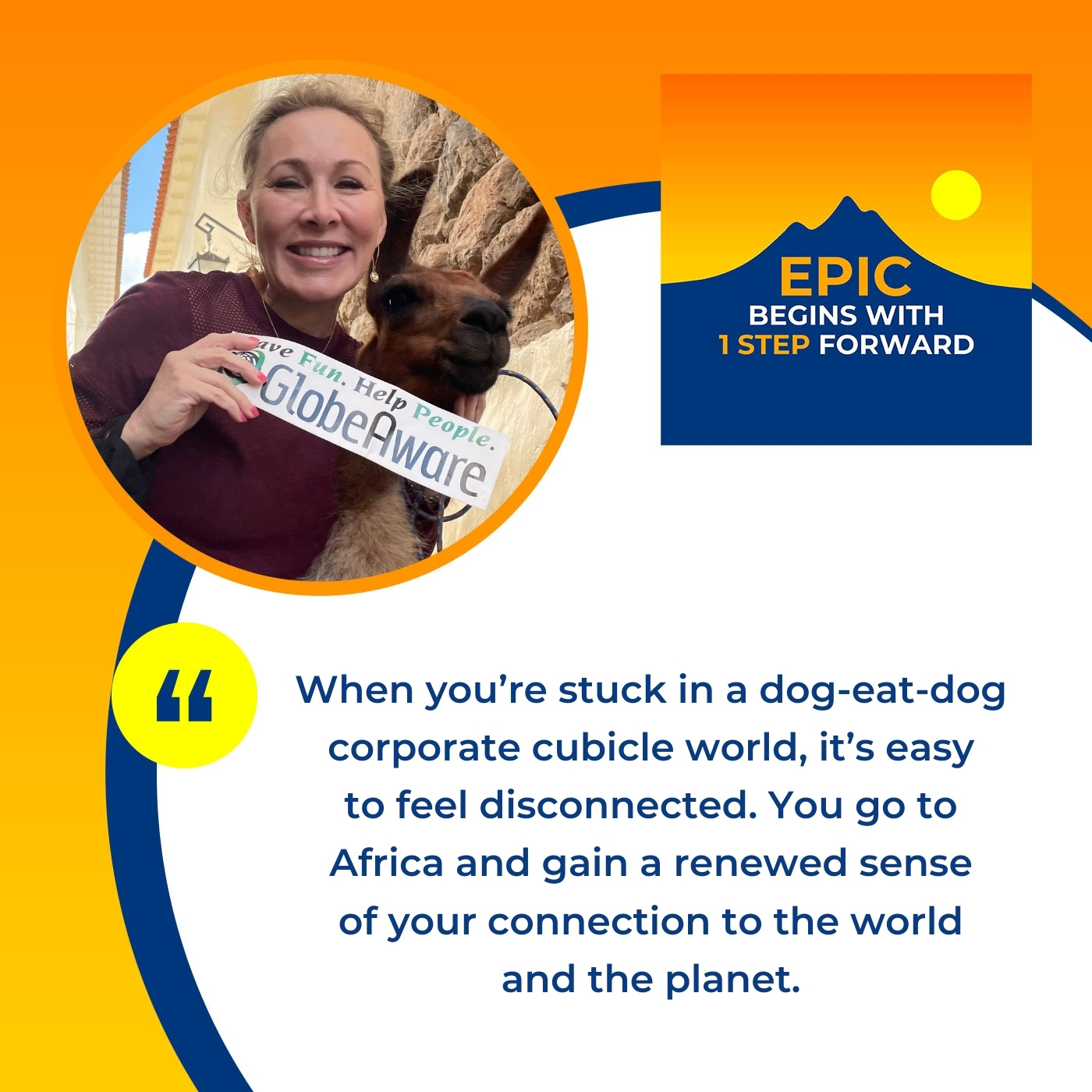
It’s like going home, isn’t it? I don’t know. When I go there, it’s like part of me feels like I’m somehow home. I don’t know how else to describe it. Africa definitely is in my heart. That’s all.
I agree. Somehow, that connection to life and reconnecting to our place in the universe, I feel like you can do it there for so many reasons. It’s easy if you’re stuck in a dog-eat-dog cubicle corporate world to feel disconnected from that. You go to Africa and you get a renewed sense of your connection to the world, to the planet.
Kimberly, I’m sure you and I could talk at least for another hour about how awesome South Africa is and Zimbabwe and stuff. I want to thank you so much. How can people find you, come and do a vacation, a volunvacation, whatever you want to call it?
We are so easy to find. The biggest mistake people might make is that they might think we’re Global Aware, but we’re Globe Aware, so three syllables. If they Google that or we have a podcast where we tell people about our programs and how to prepare for traveling to various places. We have a YouTube channel, certainly a website, Instagram, Facebook all that. Any direction you look with those words Globe Aware with that handle, you’ll find us. Our phone number is on the website too. It’s 877-LUV-GLOBE. LUV-GLOBE is our 1-800 number. It’s easier to remember. Anyway, thank you for asking because we’re everywhere.
I want to thank you so much for coming on. Truly an epic conversation. I want to remind everyone that if you’re ready to begin your epic journey, go to EpicBegins.com. As always, remember, epic choices lead to the epic life that you want.
Important Links
- Kimberly Haley-Coleman on LinkedIn
- Globe Aware
- Globe Aware on Instagram
- Globe Aware on LinkedIn
- Globe Aware on Spotify
- Globe Aware on YouTube
- Globe Aware on Facebook
About Kimberly Haley-Coleman
 Kimberly Haley-Coleman is the founder and Executive Director of Globe Aware, a US & Canada based nonprofit that leads and mobilizes volunteers for short-term service projects in over 25 countries (since the year 2000).
With a background in international business development and finance, she previously held leadership roles at global firms including CNBC.com, Space Services International, and Investtools. Kimberly holds an MBA in International Business, an MA in Art History, and a BA from Emory University.
A multiple patent holder, SMU Guest Lecturer, and recipient of the Texas Business Hall of Fame Award and long-time Hall of Fame member, Chairman of the Executive Board for the International Volunteer Programs Association (IVPA) and actively engaged with organizations like the Building Bridges Coalition and United Nations ESOC Consultative Status Committee and variety of other nonprofit boards focused on international service, community development, and environmental improvement.