In this energizing episode of Epic Begins With 1 Step Forward, Zander sits down with keynote speaker, author, and performer Greg Bennick, whose career began with a simple mistake that turned into a life-changing path. What started as a missed coin-collecting class led Greg to discover juggling—and ultimately a lifelong passion for engaging audiences around the world. Greg shares insights from his book Reclaim the Moment, diving into why meaning matters, how fear of success can quietly hold us back, and why taking that first step is everything. Blending humor, storytelling, and powerful perspective, this conversation challenges you to rethink how you approach your goals and your time. It’s a reminder that epic journeys often begin with unexpected moments—and grow through consistent, intentional action.
Free E-book – https://dl.bookfunnel.com/afk096okro
Apply to be a Guest on My TV show – https://www.epicchoicemedia.com
#EPICBeginswith1StepForward, #ZanderSprague #FearOfSuccess #ConsistencyIsKey #ReclaimTheMoment
—
Watch the episode here
Listen to the podcast here
Fear Of Success Is Real—And It Might Be Holding You Back With Greg Bennick
I have a good one for you. I’ve got Greg Bennick with me. Greg, tell us who you are and what you do.
Greg’s Introduction And Book Release
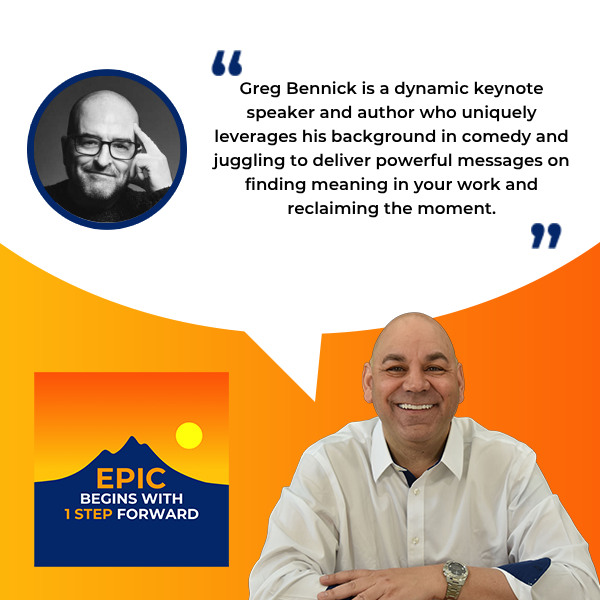
I’m just excited to be on a show about epic people. It makes me feel even more epic than I might already be, but my name is Greg Bennick and I’m a Keynote Speaker. I remind people that they matter and that the work they do is meaningful and I bring people together, especially teams. I’ve been a comedy entertainer since I was thirteen years old and I wrote a book called Reclaim the Moment: 7 Strategies to Build a Better Now. I make my way around the country and around the world doing keynote presentations and speaking about the ideas in the book and I’m excited to be here and talk about some epic things.
Absolutely. First of all, congratulations on the book. I know how much effort goes into a book and it’s always rewarding when you put all that effort in and then you’re like, “There it is.”
You know what’s interesting, there was two levels of reward. In case anyone’s ever been interested in writing a book, the work is overwhelming and it goes on for months and months, sometimes years.
Beyond a doubt.
The reward of seeing the book in print when I unboxed the books was the first reward. The second came a week ago and the book’s been out for a year and a half. When the book came out, I was going to do this whole promotional campaign and I mentioned the book quite a few times, but I let it rest and I think psychologically it was like, “It’s out, it’s released, let it go for now.” I was talking to somebody who said, “You know what, make every day for the rest of your life a book launch day,” and I said, “Okay, I’ll consider that.”
I had to do a keynote in Michigan and in preparation for the keynote to satisfy specifically what the client wanted, which was ideas from the book, I revisited my own book. In doing so, I went, “This book is great. I love this book.” All of a sudden, it was like this second revitalized moment or energized moment of realizing the epicness of this book and now I’m excited to promote it and get it out into the world. I’m just doing things my own way, my own tempo, my own grammar.
Absolutely. Look Greg, let me tell you, I’ve come out with three books, I’m working on my fourth right now and I’ve said this on the show before, but I think this is true. When my books came out, I actually didn’t want to open the book for about three months because what they don’t tell you is the writing the book is challenging, the editing process is I think twice as hard.
I had read like my Epic book 6 times in 2 months because you do edits, your proofreaders go through, you say, “Correct this,” then you have to go back and make sure that everything got corrected. You’re reading it all the way through to make sure that it sounds the way you want, that you didn’t miss something. As with anything, if you read the same book 6 times in 2 months, you’re like, “I need to walk away from this for just a moment because I know what I said.”
The other thing that happens is inevitably, all this huge team I had, we missed a period or a comma or something that afterwards, as you said, when you go back and go, “This is really good, I like this” and all of a sudden, you go, “We missed that” and then you’re like, “How did we miss it? Why?” It’s because you all know what it should say. Psychologically, if something’s missing and there’s an “a” missing or a “the” or something, you know what it’s supposed to say. Your brain just puts it in there.
That’s right. I’ll tell you this, when I finished my book, I had done most of the development and editing myself. When it came time to do the editing, the copy editing, and I wasn’t sure how many mistakes there would be. My publisher assigned an editor to the project who found zero mistakes and I thought, “You know what, I didn’t pay that much attention in high school. I’m not convinced I wrote a book with zero mistakes.”
Thankfully, my copy editor, is also my partner, Stephanie Anderson Whitmer. She’s an amazing editor. She looked at the book and she found 435 mistakes. It’s pretty amazing that I had her look at the book and she’s extraordinary as a book editor, but she looked at it and found 435 mistakes. If it wasn’t for her, I would have put out something that was filled with the wrong commas and the wrong em dashes and the wrong grammar and all of it, so it’s a lot of work.
Absolutely. Give us just a little background on how Greg got to be where he is.
The Happy Accident Of Juggling Instead Of Coin Collecting
Sure. My life is a series of happy accidents. I was not supposed to be where I am. I don’t know if I was ever supposed to be a speaker or a performer or a communicator of ideas, other than that my mom is a pretty brilliant communicator and was a speaker for years. I guess in a way, it’s genetic. I came upon performance and the stage quite by accident. I wanted to be a coin collector and a coin dealer. While I’m still interested in coins, I signed up for a mini course that I created at my junior high school when I was twelve years old.
We had mini courses after school on Wednesdays for an hour. You could take gymnastics or art or what have you. I wanted there to be a coin collecting class. I pitched the school on there being a coin collecting class. They challenged me that if I found someone to teach it, they would add it to the roster of classes. I did. I signed up for this coin collecting class and sent in the permission slip to the school that the school secretary would then navigate all the permission slips and assign classes to students.
She accidentally signed another student up for the coin collecting class and signed me up for a juggling class. I was devastated, but I walked into the juggling class the first day and there was a young boy in there juggling three baseballs and I looked at him and it was like a light went on in a dark room. I said to myself, as soon as I saw him juggling, “That’s what I want to do for the rest of my life.” It was immediate.
I was on stage for the first time when I was thirteen years old, performing professionally, and never looked back. I combined juggling and magic, mentalism effects, with my keynote speaking still to this day in order to engage an audience. I always tell people, “If the last person you had in had a powerpoint about the effects of risk taking or I come out on stage and juggle a machete and talk about the effects of risk taking, which person are you going to have back next year?” I never intended to be where I am or doing what I’ve done my entire life. It was a happy accident, thanks to that school secretary.
I was on stage for the first time at thirteen, performing professionally, and I’ve never looked back. I combined juggling, magic, and mentalism with keynote speaking to this day to engage audiences.
Look at that, that is an epic story there Greg. You mentioned at the beginning that you did some comedy from a young age.
I integrated comedy with the juggling, with the magic, using audience volunteers in ways that were fun and made them look like heroes. I still do that to this day, meaning that my keynotes are engaging, but they’re engaging in a way which is fun or funny for the audience but not at anyone’s expense. I’m always try to communicate ideas and make it fun at the same time. It’s just been a lifelong quest.
Definitely. I too am a speaker, I’ve been for many years and stuff like that. I spent seventeen years as a technical instructor. I taught people how to use software.
Which software?
A whole bunch of different softwares. I worked for different startups and stuff like that. I worked for big corporations and stuff, but I seem to have a knack for understanding some technical stuff even though I don’t have a technical background. I majored in History and Psychology and yet I spent 22 years on the tech side. I had jobs that I should never have had. I got hired to work on the Unix help desk on the fixed income trading floor at Fidelity Investments and I didn’t know what Unix was.
The story for me, I sit there and go, it’s funny, they asked me, and for those who don’t know, Unix is like an operating system. It’s very powerful, but at least in the mid-‘90s when I was doing this, it was all command line, which meant you had to put in the whole entire line of c:/cd, like you had to tell it exactly what you wanted. There was no icons for you to hit.
There was no easy user interface.
I was asked in the interview if I knew what Unix was and I didn’t, but I knew what a eunuch was so I said it was, “Two emasculated men from Rome.”
They hired you?
I did, I got hired. My point of the story is you talked about happy accidents and stuff like that. First of all, working on a help desk implies that I know this well enough to help someone else. The point is, I believe that I can do anything and I’m not afraid to fail. I think that’s an important message for people, which is, if you have an opportunity and it looks interesting, even if you’re like, “I do not have the skills,” so what? Are you able to learn? I was able to learn, the first six months I was there, it was like firehose learning. I was there with UNIX For Dummies trying to figure out how to do my job, but I did.
Overcoming Fear Of Success And Failure
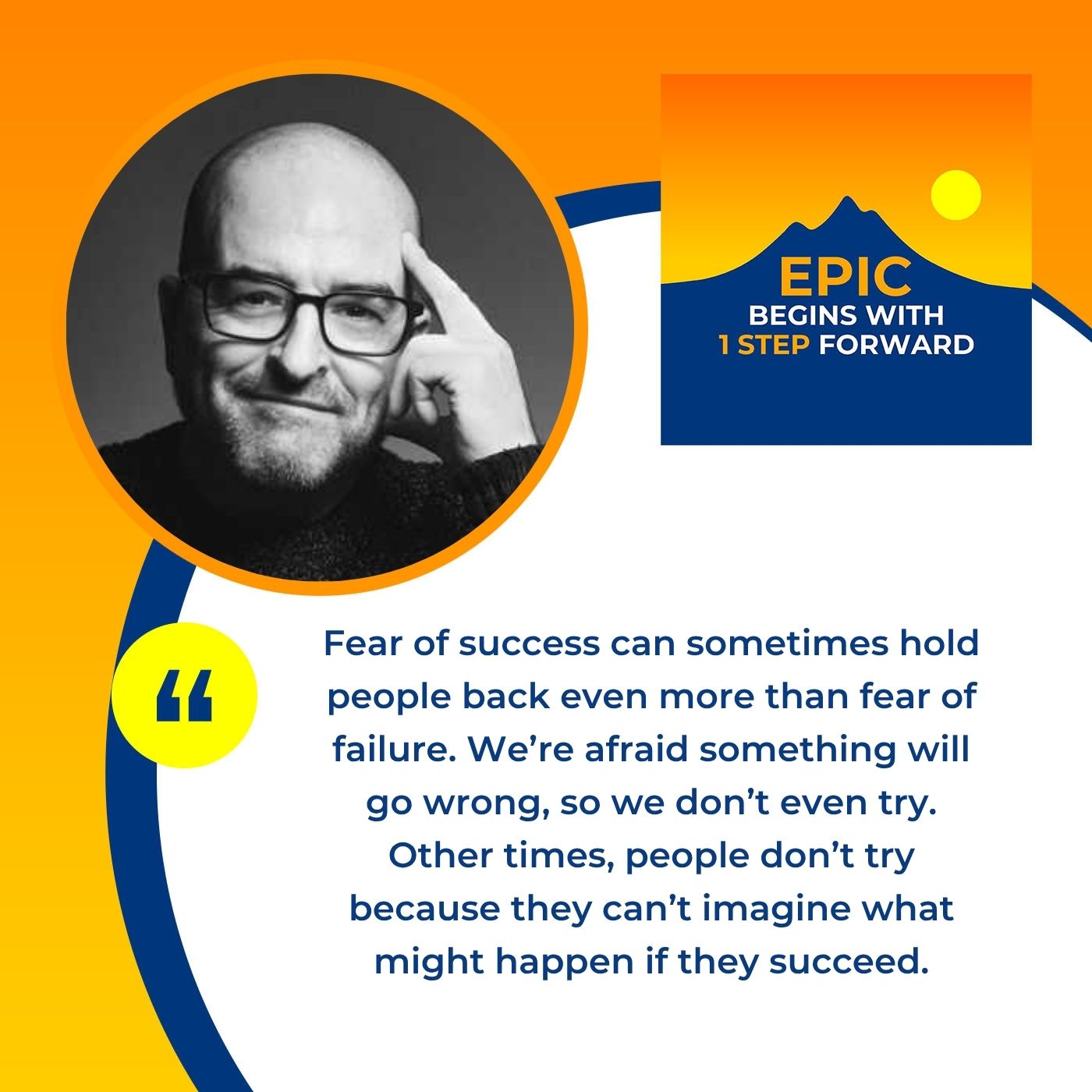
It’s essential. There’s a chapter in my book about how fear of success sometimes holds people back even more so than fear of failure. Fear of failure’s obvious. We’re afraid that something’s going to go wrong so we don’t even try. Sometimes people don’t try because they can’t imagine what would happen if they succeed.
Meaning, let’s say I want to learn how to play guitar. What happens if it actually goes well? Well, then what do I do with all these other activities I’ve been doing my whole life? What if I try to connect with somebody? Well, what happens if they say yes? Then what do I do with my solitude and isolation now that I’m connecting with this new person? Fear of success, and I always talk about, “Leap into the dark,” like we have to take a step and leap into the dark and see where it leads us.
Yeah, let me put it this way, because when I work with people about their epic dreams, those things that we say “Someday, I’d like to write a book, run a marathon, whatever. I’ll do that tomorrow, I’ll do that,” and it never happens. Tomorrow never happens. I’m like, no, just start doing it now. My own life is just a series of examples of things that I’m like, “I’ve always dreamed of doing” and I’m like, “Why don’t I go do it?”
What happens is people go, “I don’t have all the answers, I don’t know exactly what to do.” the psychologist in me said let me put it into terms that are very understandable. In my book, I call it the pizza analogy, which is you eat a pizza one slice at a time. Unless of course there’s an adolescent boy around, in which case you eat as fast as you can because if you dawdle, there will be no pizza because that adolescent boy will have eaten it all.
There’s a great book called Bird by Bird which is along these lines too where the author talks about being a young person and their parent coming to them on the night before a report on birds was due. The student had waited until the last possible minute and said, “I have no idea how I’m going to get through this report.” And the father says “you do it bird by bird.” That’s exactly it, just one slice of pizza at a time, one bird at a time, one stone lifted at a time. That’s what you have to do.
You can’t expect to be a virtuoso now. I’m a speaker coach for TEDxPerth, Australia. When speakers come to me to be coached and they’re thinking, “What’s my big idea and how am I going to get on stage and what do I do with my hands once I’m on stage and how am I going to memorize this?” Hold on one second, let’s start from the beginning and step by step.
Again, my whole book, Epic Begins With 1 Step Forward, it is that one step. The thing that I break down is I sit there and I ask people. Greg, I’ll ask you this question, I already know the answer, but I’m still going to ask you, which is do you have all the answers to all the questions that you’re going to get now?
I don’t even have all the questions yet so as you can imagine, no.
Exactly. Did that stop you from getting up this morning? No. I look at that and go, you don’t have all the answers. None of us do. Yet we still move forward. Yes, the fear of success, also the fear of failure. You want to know what? The only thing you fail 100% at are the things that you do not try. We’re going to fail. In fact, oftentimes, when we fail, there’s lots of learning there, “That’s not how to do this.” As a motivational speaker, there’s things that you you’ve tried in your speech and then you go, “I’ve tried that in two speeches and that just didn’t go over the way I think it should. I think I’ll change it.”
I did some stand-up comedy back in back in the day. I learned when I did a comedy writing class they’re like “try a joke, if it doesn’t get a laugh the first time, do it again,” like do some experiment because it could just be the audience. When I was doing that, I was doing like open mic nights. They didn’t know me yet so I was usually at the end of the night, at which point the people who were still there were either had had quite a few of the cocktails or were just comedically burned out. They’d sat through like fifteen other comics. Some of who were really great and I could come up and have just a really great set, but people just didn’t laugh because they were just done.
That’s right, that makes perfect sense and sometimes it is the audience. Oftentimes it’s not, oftentimes it’s experimentation and being fresh and being immediate and in the moment. It is true that if you use the same line with the same inflection on 15 different audiences, 1 is going to laugh uproariously, 8 audiences might have a lukewarm response, 1 might have zero response, 1 might have a funny but not overwhelming. It’s very interesting the way audiences and crowds behave. That said, it’s also a function of preparation, practice, rehearsal and performance that makes a difference too.
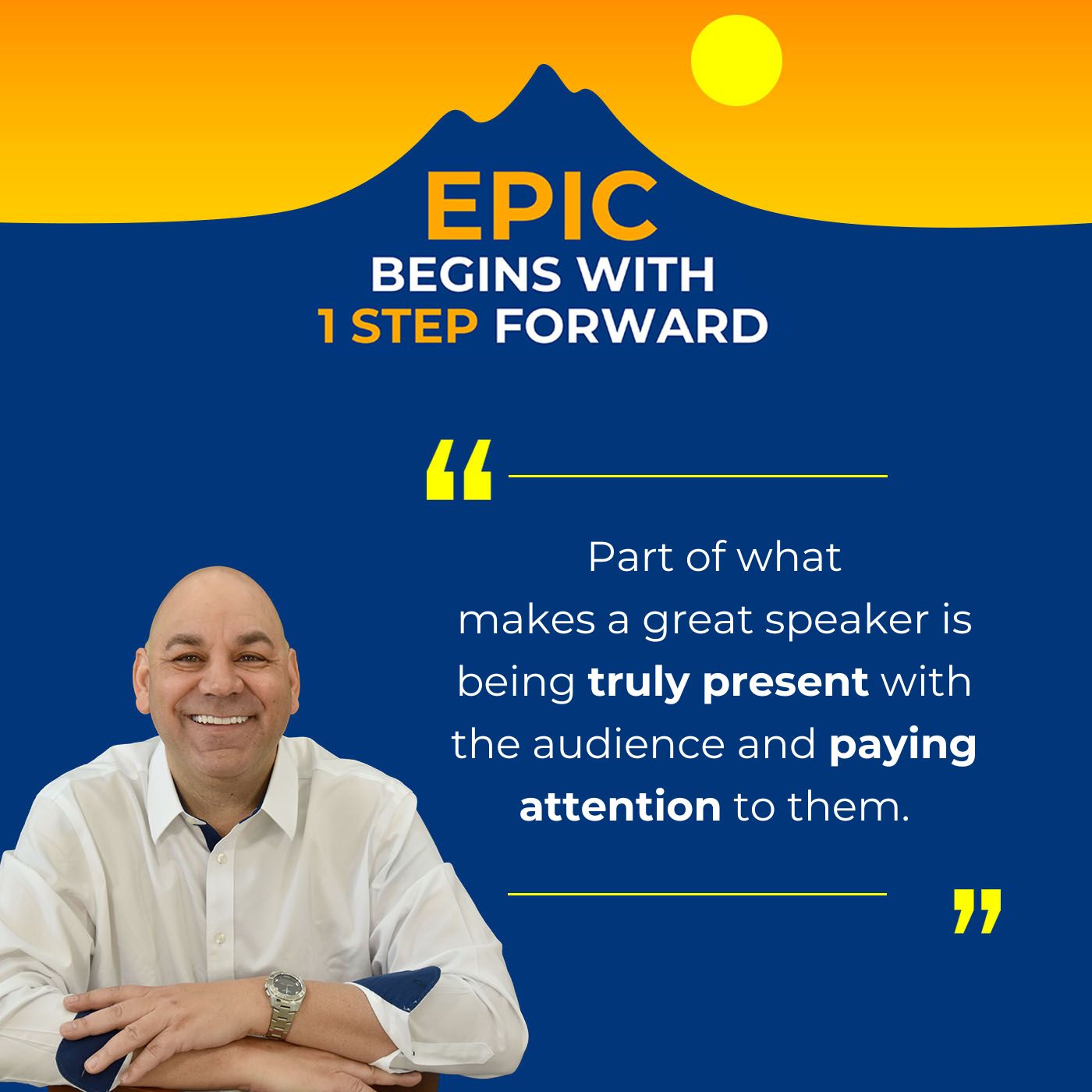
I would teach like three day classes and I had software engineers, I had highly technical people and I just remember, just true, where I know my material and it’s this out of body experience where I’m sitting here talking, but part of me has pulled back a little and I’m watching how it’s landing.How you’re like, “Is the audience engaged? I’m going to switch this up. This story I’m going to make a little longer because I have the audience so I can add this. No, I don’t have the audience. Let me make that shorter.” part of what I think makes a really good speaker is someone who’s looking at the audience. Now, I can say that during the pandemic, I did quite a few like virtual keynotes. Very honored to be asked to do that, incredibly hard to do.
Yeah, virtual was tougher than people thought.
Especially because like, “Just record your speech and then we’re going to play it.” Here’s the thing, like you, I have humor, there’s stuff that I say. You’re doing it, there’s no audience feedback. I’m looking at a camera like I’m looking at you. I don’t even have you, I can’t even see that you’re smiling or not smiling or whatever. If you have something that’s funny, and we all need a little I think humor in what we’re doing, you don’t know how long to hold like, “How long do I pause?”
You’re like “If I wait too long, people think there’s a problem with the audio and the video or something.” if I start talking and people are like, “Hold on. I just missed,” whatever” because we tend to use let me have a little joke and then let me make my point or or whatever. The virtual was hard. Zoom and all the other platforms are great. You don’t necessarily have to get on an airplane and spend your week traveling all the time. However, there is “Zoom face.” that slack-jawed whatever. If I’m talking, I may be flip around to see how is the audience looking and there’s so many people because they’re engaged but they’re just not that engaged.
It’s totally true. They’ve just opened their screen, they’re there, they’re present. Part of the problem with performing and presenting in the pandemic was exactly what you said. We didn’t get the feedback that we wanted that we’re used to that we’ve worked on our timing to get. It comes across like, “is this guy an amateur? His timing seems weird.” Everything was weird for these audiences. Thankfully, having speaking and juggling and magic all working together really helped during the pandemic and really helps with virtual. It was a strange time, without a doubt. I think that that’s going to resonate for years to come.
One of the challenges of performing and presenting during the pandemic was exactly that—we didn’t get the feedback we’re used to and rely on to shape our timing and delivery.
If you’re looking for audience engagement and I had to do this, I ran a couple workshops where part of the workshop is audience engagement, like I’m trying to get them to participate with me. Virtually, they’re not doing it. In person, they do it. I don’t know if it’s the social pressure of, “I’m in the room and other people.”
It was hard when you’re like, “I’ve got an hour for this,” and really, I need about fifteen minutes of interaction or conversation. I’m trying to get people to talk and share and feel comfortable and they’re not doing it and then you’re like, “What do I do?” Now luckily, when that happened to me, I had moderators. I learned this to say to the moderator. “I’m emailing you ten questions,” so that it goes “Yeah, we have a question from the audience.” I had one moderator’s really good goes, “I know this isn’t going well for Zander, so I’m going to put some questions out there to try and get people to feel comfortable to ask their questions and stuff.”
One of the things I love to ask my guests is in my book I have the concept of “not yet.” On our epic journeys we have these journeys that we’re on that the answer’s not yet. Greg is your book out? “Not yet.” If you say no, then it ends, but “not yet” is so good. There are those things in in our life that are not yet. I would love to go get my private pilot’s license. Am I working on it? “Not yet.” You know what I mean? For you Greg, what’s one or two of your “not yet”?
Greg’s “Not Yet” Projects
I would say a second book. I’m writing a book on a cultural anthropologist named Ernest Becker who wrote about our quest for meaning and the things I talk about in my keynote, being reminded that we matter and the importance of having meaning and self-esteem. The Becker book is I’ve got about maybe about 100 pages written and then tons of notes.
I’ll be writing his biography, that’ll happen sometime, but not yet. More keynotes and a revised promo video. My video is extraordinary, but the this event that I did, I want clips from that in it. The updated promo video is a not yet and that’s not as simple as just editing. A promo video takes a lot of work. I’m really looking forward to diving into that and seeing where it ends up. I think that those two things, updated promo video and then the new book, I think, are going to take priority at some point, but not yet.
I’m curious myself, you talk about people finding meaning in their life, in their work and stuff. Give me some highlights of what that means to you.
Yeah, for sure. We have limited time. It’s just a fact and not to sound morbid, we have limited time. Literally 100 years from now, you and I are not sitting here having this conversation. I would hope that in the time that we do have, we do meaningful things. Not just for ourselves, which is important, we do things that are meaningful for other people as well. That we matter is important. The fact that we matter means something to us and hopefully we make connections which are sincere. That we take part in actions and act responsibly so that we matter to other people and so that we’re meaningful to other people.
I think that it creates a self-esteem boost and I think psychologically it’s balancing for us. It makes us feel better about an unsure existence that we’re all living and at the end of the day, it just improves quality of life. Reminding being reminded that you matter and that what you do is meaningful and connecting with other people, it absolutely allows us to stay in psychological for lack of a better word equanimity or balance with all the influences at stake here.
I think my own experiences, I’m a relentlessly positive person. I’m like, “Let me find some good in this.” You know in my book I I talk about the 97-3 rule, which is I believe that most days 97% of your day is good and up to 3% isn’t as good. Now, yes, we all have days where we have just a really bad day and it’s more than 3%. On the whole, there’s lots of good going on.
Yet when we talk about our days we talk about that 3% all the time, “Here’s what didn’t go right.” Completely ignoring the 97 and I’m like I’m like “Why?” this all came because I’m a licensed professional clinical counselor. I had to do 3,000 hours of internship here in California before I could take the licensing exam and I worked in middle school and high school. A lot of my clients had academic issues. It’s trying to get them as teenagers do they want to hone in on all the things that you know “aren’t going right.” I’m like “No.” I think we all do that. There’s so much more. I’ll love doing this to my guest. Greg, in high school what was your least favorite subject?
I would say my least favorite subject in high school was probably English because I spoke well naturally, but I wasn’t quite convinced that all the rules around it were necessary.
If you got a 97 on an English test, how would you feel?
I would think that that would be pretty pretty extraordinary actually because it was my least favorite subject.
Let’s live in epic ways that reflect what’s in our hearts and minds and what we truly want. Let’s pursue what feels meaningful—whether that’s becoming a movie star or simply going to the grocery store and doing it well. Whatever it is, let’s bring real intentionality to it.
Absolutely. You’d be excited, you tell your friends, you tell your parents, would you be complaining about the three points that you didn’t get?
No way.
Absolutely. Again, I go back to all of our daily lives, like “Why are you ignoring all the things that are good?” you were talking about not being morbid but I you know I’ve said this before. We woke up this morning, that’s a really good positive start. I didn’t doubt that I would wake up.
It’s a huge plus. Given the nature of our lives, which is and I’ve always said this, in human beings are insecure frightened terrified creatures hurtling towards an uncertain end. That’s not supposed to sound negative, that’s supposed to sound inspiring. Let’s do some things, let’s live in epic ways that reflect what’s in our hearts and in our minds and what we truly want. Let’s go after the things that are meaningful to us whether that’s becoming a movie star or just you know going to the grocery store and doing it well. Whatever it might be, let’s really put intentionality in.
Knowing that the things that we want to do that seem big bold and audacious are not nearly as hard. Honestly, any of our epic journeys, that first step is not nearly as hard as you imagined it would be.
It’s essential. Everything relies on that first step.
I’ve run marathons, I can tell you that in the marathons they say, “A marathon starts with one step forward” and it does. It’s just left right repeat and it’s how it’s how we get through stuff. There’s stuff that we know is just going to be a long process, you’re starting to write the book that book. You understand that it’s going to take you time. It’s a marathon not a sprint.
Without a question about it. You got to start somewhere.
You’re like, “Alright, today, I’m working on this chapter, or even this part of the chapter.” The fact of the matter is you’ve made progress forward.
Consistency Is The Key To Progress
Yeah, you have and you have to continue going. Consistency is a key. I often ask my keynote clients, keynote audiences to remember one word. If you forget all the others that I said and have it be consistency, consistency, consistency. That’s really the thing.
You have to keep going—consistency is key. I often ask keynote audiences to remember just one word. If you forget everything else, let it be this: consistency, consistency, consistency.
Absolutely. Also, have some grace and gentleness with yourself. Sadly, the meanest person in each of our lives is ourselves. The things the things that we say in our head about ourselves and who we are and what we’re doing, if your best friend said one of those things, you’d be devastated and yet we doubt ourselves, wewe have a committee that’s telling us that we can’t, we shouldn’t.
I guess I just don’t listen to that committee too often because I keep doing things that I’m not supposed to be able to do and yet I do it. The fact that I have written and published three books and am writing a fourth one is amazing because I’m a talker not a typer. If you asked me in college if I’d write a book, I’d be like, “Absolutely not. I hate writing.” I wish through school I could have done oral exams, I would have killed it. I would have had the 4.0 because I knew the material. I just hated writing so I wanted to get it over as quickly as I could.
Yeah, I could totally see that. Absolutely. Without a doubt.
Greg, unbelievable conversation. I’m sure you and I could talk for another three hours and it would be great. You know trying to keep this manageable for the listeners. How can people find you? How can they get a hold of you?
People can go to GregBennick.com, or you can find me on LinkedIn, or Instagram if you’re so inspired, but any one of those ways, I’d be happy to hear from anyone anytime.
Great. Greg, I want to thank you so much for coming in, so much fun.
Thank you, I appreciate you. I’m glad we were able to coordinate this.
Absolutely. I want to remind everyone that if you’re ready to begin your epic journey, go to EpicBegins.com. If you have an epic story, go to EpicBegins.com and reach out to me and let me know because I am always looking to highlight epic stories. As always remember, epic choices lead to the epic life that you want.
Important Links
- Greg Bennick
- Reclaim the Moment: 7 Strategies to Build a Better Now
- Epic Begins With 1 Step Forward
- UNIX For Dummies
- Bird by Bird
- Greg Bennick on LinkedIn
- Greg Bennick on Instagram
- One Hundred For Haiti
About Greg Bennick
 Greg Bennick is a world-class speaker, social theorist, and best-selling author whose ideas have inspired tens of thousands of people to take new approaches to eliminating distraction, increasing productivity and focus, and aiming towards personal development. His book “Reclaim the Moment: 7 Strategies to Build a Better Now,” takes a close look at eliminating distractions so that we can be more productive, be better skilled as leaders, and increase our focus.
He engages with audiences in conversations that span borders, appearing on stages in 27 countries (and counting). He is the founder and executive director of an international nonprofit in Haiti (onehundredforhaiti.org), which since 2010 has listened to Haitian people to help transform an entire region’s relationship with water, education, food, and housing. You can read more about Greg at gregbennick.com and find him amidst your next session of endless scrolling on social media at @gregbennick on Instagram.