In this raw and powerful episode of Epic Begins With 1 Step Forward, Zander sits down with creative strategist and podcast expert Nick McGowan for a deeply honest conversation about identity, purpose, and transformation. Nick shares his journey from childhood struggles and emotional disconnect to building a successful career that ultimately left him feeling empty and lost. After hitting rock bottom and facing moments of severe depression, he began the difficult work of reconnecting with his true self—creativity. Together, they explore mental health, breaking free from societal expectations, and the courage it takes to choose a path that aligns with who you really are. This episode is a reminder that your lowest moments can become the foundation for your most meaningful life.
Free E-book – https://dl.bookfunnel.com/afk096okro
Apply to be a Guest on My TV show – https://www.epicchoicemedia.com
#EPICBeginswith1StepForward, #ZanderSprague #Transformation #Purpose #Identity
—
Watch the episode here
Listen to the podcast here
From Rock Bottom To Creative Purpose: Nick McGowan’s Journey Back To Himself
In this episode, boy howdy, do we have an interesting conversation coming. I am so honored to have Nick McGowan on. Nick, welcome. Tell us who you are and what you do.
Nick McGowan’s Work With Thought Leaders, Podcasting, And Self-Mastery
Zander, I appreciate having me on. I’m looking forward to this conversation. I’m Nick McGowan. I primarily work with thought leaders, authors, people who have a deep purpose and passion on their heart, specifically in the medium of podcasting, but more so in the medium of being able to speak about their actual purpose and what is on their heart to be able to do.
I’m a creative at heart, so I tend to lean toward a lot of creatives, musicians, artists, things of that sort, and have gone through an immense amount of stuff to put it softly over the course of time. Things that have drastically changed the way that I viewed things, being able to look at how systems work within everything that we do, even to the point of pulling myself back from the ledge multiple times in life and the lessons that I’ve learned from all that stuff. Again, I appreciate you having me.
Absolutely. As you know, I love to talk about all things epic and the epic journeys that we’ve been on and you alluded to at least one, if not more, epic journeys. Probably it sounds like some of them might have been what I call the epic unexpected, those things that happen in our life that change who we are and how we do things and then how we recover. Can you give me a little background of some of the things that you alluded to that put you on an epic journey?
Childhood Experiences And Trauma Shaped Nick As A Creative
Yeah, I think most things for pretty much everybody stems back to childhood. Be it childhood abuse, childhood trauma, childhood experiences, just things that shaped us in our early childhood that then led us down different paths. As a young kid, I was an art kid. I was one of those kids even in high school that if I didn’t want to be in a class, I would just raise my hand, be like, I got a project and they’d be like, “Alright, whatever,” and I’d go off to the art room and that was my jam.
One of the moments that really shaped me was the way that I was raised as a kid going back and forth between my mom and dad’s house. I’m a really emotional person. We talked about the enneagram briefly before I hopped on. I’m a 4-3. I’m really basically like the diva that can be outward-facing in certain ways and my parents were not like that. In fact, I’m a real feeler and emotion and they’re really thinkers. They would tell me, “Think, use your brain,” and as a creative, they didn’t really understand how to work with me or to help me with certain things and I had to learn how to do things on my own, but also how to see what was going on.
There was a thing that shaped me when I was I guess maybe 16 or 17 that I can really look back to being incredibly pivotal. Most people remember being in maybe 10th or 11th grade where you sit down with a counselor and they’re saying, “We’re going to get you into college, but let’s figure out what you need to do and all the stuff for the next year.”
Counselor’s Advice Led Nick Away From Creative Careers To Sales
The counselor that I sat down with looked at my stuff and she was like, “We can get you in art school, we can get you into music school, but you’re not going to make any money so what do you want to do?” I remember sitting there being like, “I don’t want to be here, so I’m going to leave.” She basically told me like, “You’re going to be a starving artist no matter what you do.”
I grew up in a situation where similar to Rich Dad Poor Dad, but I had a rich dad, poor mom. My mom didn’t make much money at a few different jobs. We lived in a tiny apartment. My dad and his wife and their kids, they had a big house, a pool, business. I was able to see how things are different and I remember going, “I don’t want to deal with that stuff. I want to go make money I guess.”
This lady told me that I won’t be able to do it in a creative realm. I guess I have to go somewhere else. That ultimately turned into a sales career and a few different businesses, but all tied into sales and marketing, the context of where life was. I got out of high school in 2002. The internet was starting to become a thing, marketing, digital marketing especially was becoming a thing. By 2013, I had a social media marketing company with my in-laws at the time and that was also another pivotal shaping moment. My father-in-law at the time was bipolar narcissistic who’s manic depressive and an abuser and it was pretty tough.
It was like, “I got your daughter here. I’ve got to deal with these things.” At one point, we had lived in Portland, Oregon. I’m originally from Philadelphia. My wife and I at the time moved out to Portland because the business was doing well on paper. Portland was great, but for most of that year, a little over a year that I was there, I basically just wanted to jump off the top of the building and there was a lot of stuff that I went through. I built a business that had like 30,000-foot walls around me that I couldn’t get out of. I had to get out of that, ended up moving to Florida. Her family was in Florida, so I worked with them for another couple months and at one point I was like, “I can’t. I’m done.”
I took a little bit of a break. Somewhat of a sabbatical, a couple of months, get my stuff together, get my head together, ended up in a corporate job. It was creative agency, primarily working in 3D modeling and graphic design for big companies. I worked on big interactive projects, but all of it was sales and all of it really ties back to my childhood because there was a strategy that was developed in my formative years that I’ve learned about within the past few years. It’s a winning strategy that we develop literally between 4 and maybe 7 or 8 years old that says this is how you win in life. This is how you stay safe or loved and this is what you can do.
I learned that I could make people laugh. I could be the one that they go, “I want him around to not abandon him, etc.” All of that is just turned into literally a sales career and at one point several years ago, I remember thinking, “I live on two golf courses in Florida and I make a bunch of money and I travel around and I hate it. I hate this. I don’t want to do any of this anymore,” and all the while creativity was still in the background. I’d been a musician for a long time, but also closed the doors on that for a little while.
Started His Podcast After A Divorce And Returned To His Creative Roots
I started my podcast in 2021 after getting a divorce and the creativity was always there. At this point over the past few years, I’ve gotten deeper and deeper into it, back to my roots in a sense of like what is actually driving me. That’s part of the work that I do now where I help people resonate with their audience, be it from a stage or podcasting or even working on an album with them and then being able to actually figure out the ways you can rank for your business or rank for your podcast specifically like search engine optimization. I’m staying away from the things that people just say like, “You need to do all this, you need to do all that,” isn’t actually helping. I guess I’ll throw the baby out with the bath water in a sense, I’m talking about social media.
Being able to actually reach the right audience for you and all of that has tied together because of the work that I’ve done internally, but also because of all those different pivotal moments where there have been times where I’ve legitimately looked up and went, “Are you kidding me? What are you doing now? What’s happening?”
Yeah and absolutely, Nick. I got to say a lot of what you’re saying, I get that. I spent 22 years in the corporate world. I had jobs I had no business doing. Honestly, got hired to work on a Unix help desk at Fidelity Investments and I did not know what Unix was when I was in the interview. When they asked me what Unix was, my honest straight-faced answer was two emasculated men from Rome because I knew what a eunuch was. I thought that was the plural. They hired me. Perhaps they thought it was a funny answer and stuff. For those in the audience who don’t know, Unix is an operating system, it is incredibly powerful but at least when I was doing it back in the early and mid-‘90s, it was command line.
You had to type out everything you wanted to do. Unix is actually the backbone of a lot of the internet and everything that we run because it is very powerful and bulletproof, but we don’t know that. We click on our little icon to open up Zoom or whatever. Behind the scenes is a whole lot of lines of code that say, “Go here, do this.” I feel you. Also, I got to ask you, a scary moment when you look at what you’re doing going, “I know I’m not happy with this and I know what floats my boat is creativity, but how am I going to pay the bills?” There’s that being really brave, being honest with ourselves, which can be hard to say I know that the epic journey I need to go on.
It’s not even like I’m choosing. You’re like, “I have to do this. This is what fills my bucket. Here’s where I get satisfaction.” I know I had a moment in 1999 where I’d been laid off from a job and I was doing a job that really I was technically qualified for but just wasn’t really the right job. I had a month, I went down to Mexico to study Spanish because I’ve always wanted to try and learn Spanish. I didn’t I learned some but not a lot, I’m certainly not fluent but I got nothing else going. This is the time for me to do it because when else can you take a month off and do it like your sabbatical. While I was down there, I thought about what a job I wanted. That’s really a hard question.
I asked myself this simple question, which had complex answers, which was what were the jobs I’ve had, what did I like about each of those jobs and what are the unifying aspects of those jobs? What it came down to was one, I like being in front of people. I like to perform in front of people. I seem to have a knack for understanding technology and teaching people.
I spent seventeen years doing technical instruction. I think I was pretty good at it, but then when I got laid off for the umpteenth time because unfortunately, education in the corporate world is seen as last hired first fired, which of course from a business perspective makes no sense. “We’ve got engineers they can teach it.” Not everyone can teach. I spent honestly half my time when I was in the office not out delivering training, explaining to the leadership that I was a zero-sum employee.
By that I mean we charged for training so if you took what you got from the training and that would be at that time, a 3-day course was about $3,000 per seat, I’d have about 10 people in a class, I’d deliver it like twice a month. Basically, if you took my salary, my benefits and any other cost associated with me, by about April or May depending on how many classes, I had brought in enough revenue to cover what it cost to have me as an employee. The rest of the time, so another nine months, I was a zero-sum employee meaning it did not cost the company money to actually have me there. Yet you get laid off.
Yeah, I’ve had a similar situation. I’d worked in the car business. When I was told you basically can’t be a creative that makes money. I went, “I don’t want to be a broke creative, so I guess I’ll go make money.” I saw how tough it was growing up without money, so I thought, “This is what I got to do and I can do the hard thing so let me go do it.”
Little did I know that I was literally just jumping into a system that isn’t actually set to really help people succeed and especially if you’re going against the grain. Not to say making money is against my grain because that’s not it, but doing it in certain ways that are not creative or don’t allow me to actually use the God-given talents that I have is certainly against the grain.
Making money is not against my nature, but doing it in ways that suppress my creativity or keep me from using my God-given talents absolutely is.
I ended up getting into a multi-level marketing company. I had no idea what the heck it was. Somebody told me I could make money when somebody turns on a light, I was like, “Count me in, let’s do this.” I did that for a couple years and I learned what things were and learned a lot of stuff, but I also learned a lot about personal development, personal growth. I connected with the guy who was leading everything. I went to a meeting. I don’t know I think I was like eighteen years old or something. Saw somebody pull up in a Mercedes, he had like a $5,000 suit on. I was like, “I want to know his name. I want to be friends with him.” He got me into personal development all that stuff.
That led me next into the car business. This sounds like it’s going downhill because it’s like the MLM to a car business, but it’s not. That ultimately led me into starting a consultant company with my friend who was the manager of this business development center. Basically, a call center. We had maybe 4 or 5 of us in this call center for 4 different locations and at that point we’re doing about 1,000 cars a month. We had people coming in from all over the country going how the heck are you doing this? What do you do? My buddy started a consulting company, brought me on board, etc.
The Consultant Company Failed Following The Economic Crash
Maybe two e years later, the crash happened. Training was the first thing that these companies were getting rid of because we’re going out and charging $10,000, $15,000 a pop for a week for me and one other guy to be out there and next thing you know, we went from 30 clients to like 2 or 3. A few months after, after trying to keep the baby alive with our credit cards, I’m back on my mom’s couch looking up at the sky again asking what the heck and what do I do from here? That continued me on that path of well maybe I have to work harder, maybe I have to grind harder, maybe I have to do these things. All the while I’m still playing music because I’m in my early twenties at that point.
I actually got into a couple different church bands and I played maybe about ten in various church bands. Some that were tiny little like maybe 50, 100 people that were there and the last one that I was at, I think we had 4,000 or 5,000 per weekend, so it was like a big rock show which was cool and like scratched the itch, helped with my faith, all that stuff. I was still trying to play the game. I was trying to play the game of like let me go out and make money and do the things. I ended up getting married because I thought that’s what you do. I didn’t have any kids but I thought that’s what you do.
All of this stuff has shaped the way that I now am able look back at things but also the work that has happened since then and because of all those stuff where I think a lot of people can look through things like you had asked a little earlier. Basically, how do you make those decisions and the tough calls to be able to do things that you want and also still make sure you can pay the bills and take care of the dumb stuff like we have to be involved in capitalism in certain ways. I’m not totally anti-capitalism but I am anti the hustle and grind culture crap of like everybody has to hustle and grind all of that.
I’m not anti-capitalism, but I am against the hustle-and-grind culture that tells everyone they always have to be hustling.
Well, yeah and here’s the thing, Nick. I’m a firm believer I’m fortunate to do what I do. I had to take a huge leap of faith and say, “I have no guarantees of how I’m going to make money but I believe in me, I believe in what I’m doing and putting out into the world and it’s going to work. It’s that perhaps trite saying when you do something you love it doesn’t feel like work all the time.
Yes, there are absolutely every day there are times parts of my job that are work. I would love to be able to have that big team of people that do all the things that I really am not that good at and I don’t like to do and I got to, you know basically I get to show up, do my podcast, do my TV show, get to be on stage and present and do the stuff that is really where my strengths are.
We can’t always do that, but we can all of us shape our life to say, “I’m clear on what I’m good at and I’m clear about what I’m not good at.” I’ve used the example of I could change the oil on my car, but I choose to go to a place that does oil changes because they know what they’re doing and they can do it faster than I can. Nothing wrong with that.
I think there’s context to this stuff though too. To say we can all make these decisions but even like with that oil change thing, I’m right there and I’ve thought that exact same thing. I could learn how to do it. I don’t want to do it. I know there are people that enjoy doing it and that’s their jam. Why not do that? At the same time, there are people that are at jobs like that that they hate it and they don’t want to do it, they want to do something else and we all go through that stuff. I think there are things that happen in life that we go well I’ve gotten to this point so I can’t go backward and I was a victim of that of my own self. I use the word victim as like pretty appropriate in this term because I was beating myself up about it where I was like I got so far ahead that I didn’t ever want to go backward.
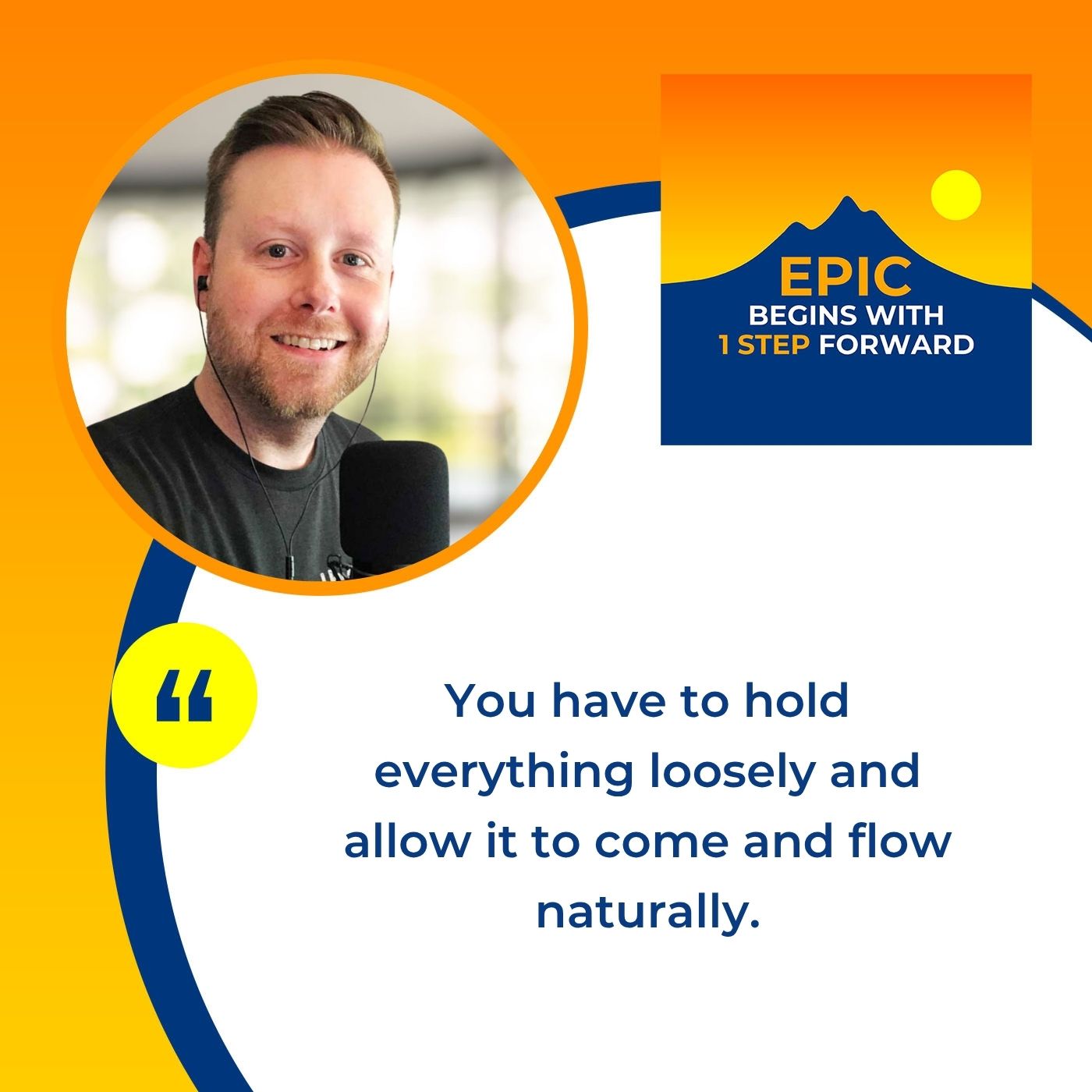
I remembered what it was like being told you can’t make any money, going out making a bunch of money and losing it all. Starting all over again and doing all that stuff and then making more money and going, “I want to hold it as much as I can.” At this point, I understand you have to hold basically everything very loosely and let it come and flow but that’s how it works with me.
Leaving Comfort And Security For Internal Work And Life Transition
I’m a responder in life I have to respond to things. I have to be around different situations and people etc. To be able to then respond and figure out at the same time like this makes sense to me, this aligns with me, I want to do more of that. There was a moment where I realized the things that I wanted, I thought I wanted comfort and security weren’t really actually helping me.
I was on two golf courses in Tampa, Florida and if anything happened to the place that I was living in, I could call somebody pay $75 and they’d come out and fix it and I remember thinking at one point like, “That’s pretty cool. Look, I’ve arrived,” and then realizing that’s not arrival. That’s not really what I want and this isn’t what I want to do. We sometimes have to take really drastic steps to be able to step outside of that and do something differently. Literally I went, within a two-month period, I was living on golf courses to then living in a fifth-wheel renovated camper in the foothills of a mountain and I remember staring up at night looking at the stars and thinking, “My soul has been craving this.”
I started to do a lot of deep internal work and then being able to understand like things aren’t the way they were before. I wasn’t making as much money as I was. I have to start this all over again, but I also needed to use my mind and put my mindset in action to be able to say, “How I’m actually going to go about this is different than I went before because what has gotten me to this point is not going to get me any further. I have to do things differently.” Life looks different at that point. Now granted, it’s really uneasy at times and uncomfortable but you can also find comfort in it. I was having a conversation with a good friend specifically about that.
There’s stuff that’s going on right now in this legit moment with me right now that are difficult times and a life transition and I’m very uncomfortable. I’m also really comfortable. It’s a weird situation. Some of that is also, I’ve been sick for the past week and a half so I think my brain’s a little wonky. We can find comfort in those little spaces, find rest in that and then also be able to figure out what works for us.
I’ve practitioners that I work with, people that help me with deep subconscious processing. I’ve mental health coach that I work with at least every other week. I have a small group, I have a few different people that I connect with and then also the stuff that I’ve worked on on my own to be able to regulate myself and to be able to get myself back to center to go, “Calm down. It’s all going to be okay, here’s what we’re going to do next.” We, as people, will sometimes go, “I need to know what’s going to happen in 5 or 10 years,” and I think that’s nonsense. We need to be where our butts are right now and just keep walking.
When I’m working with people about some epic journey, something that they’ve dreamed of. For me epic is those things that we say, “Someday, I’d like to write a book, run a marathon, travel somewhere, etc.” Instead of saying, “Someday,” I go, “I’m ready to do that. I’m going to figure out how I’m going to do this.” Some of the epic journeys are shorter, some are longer. Some people want to go back to school. I went to graduate school at 45 because I knew I needed to get my Master’s in Mental Health Counseling and get my mental health license because that was going to help me do what I wanted to do.
That was a seven-year journey. I knew that. I knew going in this is not just a like, “I’ll get this done.” It just takes time. With all of that, there are people who say like, “Why haven’t you, Nick? Why haven’t you done XYZ?” I don’t have all the answers. I don’t know how to do everything. I try and break stuff down. I guess the mental health provider says, “Let me put it in terms that people can understand.” I got a question for you, Nick. Do you have all the answers to all the questions that you’re going to get asked?
Somebody asked me, “What’s the answer to life,” and I responded 42, but he’d never seen The Hitchhiker’s Guide to the Galaxy. Don’t forget your towel.
That didn’t prevent you from getting up and starting and living your life. Of course you don’t have all the answers. Yes, we need a plan we need to have some structure but we don’t know exactly how it’s going to go and frankly, change happens because we start to take steps forward. We start to have some forward momentum.
Are there going to be detours, unexpected things? Absolutely. My whole Epic book came because I finished up my internship for my licensing in February of 2020. A month later, the pandemic had set in. All the plans I had were gone. I couldn’t do any of the things. I had a lot of time to think about stuff and I got thinking about these really cool things that I’d achieved in my life that I never thought I would do.
I’ll be honest. I got three published books I’m working on my fourth and if you asked me in college if I’d write a book, I’d be like, “Heck, no.” I’m not a writer. I really don’t like writing. I figured out how to get my ideas into a form that I can then turn into a book. That’s the key thing. There isn’t necessarily just one way to do something. Figure out what works for you.
For me, it’s talking so I dictate books and luckily now we have all kinds of technology where it used to be I’d have to dictate into a tape recorder, send it to someone who did transcription. Now, your Word document or your Google Doc will do it for you. There are programs that you can do and just talk and then it will go give you a transcript, then you have something to work with. It’s definitely good.
I think another thing and going to ask you is people forget, especially as adults, that we have choice. Just because you’ve gone down a path a certain distance. People think, “I’ve gone this far. I got to keep going.” No. You could just say, “This is no longer working for me,” be it a relationship, a job, a lifestyle choice.
We see all these things of people who have remarkable weight loss journeys. That all started because they decided that their choice on nutrition and the choice on their life was no longer working for them. They just decided to make a change and that change was not some profound change. It started with one step. I’m going to start to change how I eat. Change takes time. It’s hard. You were talking about how sometimes the discomfort. There’s comfort in that. There’s comfort because you’re like, “I’m creating change.” Yes, it’s uncomfortable but frankly if we just stay comfortable, stay in our safety, we never learn anything new.
Sometimes that can take a while for people to get through or to get to that point to go, “I’ve had enough.” Some of that, people are unsure of how to handle that like, “I’ve been in this job for ten years,” or, “I’ve been in this relationship for so long and I’ve put so much time and effort,” and a lot of those are just stories. If we remove the interpretation of it, remove the story and just look at what it is. You’ve done a thing for ten years. That’s it. You’ve learned things from it. That’s also it. You can make those other choices and decisions and it is, like you said, those small little choices where oftentimes, we look at stuff like on social media.
Somebody’s doing all these things and all this stuff and it’s like you miss all the years and all the nights and all the stuff that they’ve gone through and they’ve cried through or tried to figure out. You miss all that. You don’t actually have the context. At the same time, I believe none of that actually matters to us as individuals. It’s on us as individuals to do something within our own self and go, “What feels right for me to do?” We can get so far away from being able to hear our intuition that we don’t actually hear it when it’s screaming to us. I think our soul screams to us at times and says, “You really need to do this. This is what’s right for you. You’re going against the grain.”
We can just you know put dirt on it and just keep going back in the game and just keep going with it instead of saying, “Let me think about this a little right now. Let me talk to other people right now.” I think it’s really important no matter where people are to be able to have people they can talk to. It can also be really hard to find a mental health therapist or coach or practitioner. Sometimes it just takes forever to be able to find one. The system is messed up.
It’s important for people, no matter where they are, to have someone they can talk to.
However, there are also people that are out there or there are podcasts like yours and mine where we get into the stuff to be able to talk about it and I even bring this up with my guests that are on my show. I don’t care about thousands of people that listen to the episodes. In the sense that as long as one person says something to themselves to say, “Maybe I need to do something a little different.”
I love that there are so many people listen to the show and get so much out of it, but it is really for that one person to be able to go, “That dude was right or the guest that person that was on. That’s something there’s something there what do I do with it?” They then just start to actually germinate that and start to grow it and then see where your life goes.
Battling With Depression And Anxiety, Including Past Suicidal Ideation
One of the things I want to touch on real quick. I’ve battled with depression and anxiety for a long time. I do not want to be on medication and don’t go the psychologist route to be just fed anxiety meds. I’m mindful of the things that I do and how I eat at times and also there are times where I just eat crap because I want it and I want to do it.
Successfully Integrating Creative Talents Into Current Business, With An Office In A Recording Studio
I’ve also been suicidal at different times. I’ve tried to take myself out. I even overdosed on heroin when I was nineteen. I didn’t try to take myself out but in a way I did. I’ve realized over the course of time since then that I’m not going to take myself off this planet. Who cares if we have multiple lives or this is the only life that we have. This is where I’m at right now. What feels right for me to do and how do I also not go against other people and what they feel is right for them to do and stay in my own lane of just being what feels right for me to do?
A lot of that is creativity, which similar to you, I’ve learned I can talk to people. I can talk in front of people, I can talk with people, I can teach, I can train, I can do all that and that’s turned into various different things that have ultimately led to I’m literally on a show with you. I have another podcast interview for my own later, I have a client call later, and my office is in a multi-million dollar recording studio. If you had told me that several years ago, I’d have told you, “Screw off. Are you kidding me? I’m in, but really?”
I get you and just touching quickly as you know put on my license professional clinical counselor hat and say mental health is really important. It is an incredibly intimate relationship and I can tell you that if I start to work with someone, one of the things I say up front is if I am not the right person for you, you are not hurting my feelings. I do not want to work with someone if I’m not going to be helping them. The clients that I do have seem to get a great benefit. Everyone’s different. Different counselors counsel different ways. Interview someone. Pay for an hour of their time. See if you feel comfortable talking. Can I talk to this person? Oftentimes, you think you’re going into therapy for is not the thing that you actually need to work on.
Where you start and where you end up in therapy are often very different but incredibly rewarding. You’re right, the system is by no means perfect, but mental health is really important. Having someone to talk to is so important. It is not a lifelong thing. Most therapy is like six months long and my job is to help you wherever you are right now.
I tell people, “I help you get unstuck. You come to me because you’re stuck with something. Maybe it’s anxiety, maybe it’s work or a relationship, past trauma. Once we find you’re able to talk about it and close the circle on that, then you’re ready to go forward. You may need to come back, that’s fine, but it’s not like once you start here’s something I’m doing for the rest of my life.” Some people absolutely do and they need it and that’s great. Most people, it’s a temporary thing.
That’s also just one modality because I’ve talked to people that they go, “I’ve talked to people before.” I’m like, “That’s cool because I talk to people every day.” They’re like, “What do you mean?” If you’ve talked to somebody and you’ve had a therapist and that didn’t work for you or helped you to an extent, beautiful. There are so many different modalities out there and that’s one of the things that I really love. I try as many of the different modalities as I can.
I haven’t licked a frog’s butt and thrown up for six hours yet. Maybe at some point. I’ve done DBT, EMDR, all these different things. I go through all this stuff and I’ve realized that what helps me is to have somebody that I can talk with about certain things from an accountability perspective and mental health perspective, bi-weekly. I have another small group that I talk to that are about really tactical things and things that we’re going through as men. I also have a practitioner that I work with that we do deep subconscious processing to be able to get into the root and those are typically 3, 4 hour long sessions.
You nailed it too because I’m sitting here smirking as you said it. I’ll go in at times be like, “This is the thing I’m going to work on,” then twenty minutes later, there’s a different thing that pops up and it’s like, “Okay, cool.” Finding the modality that works for us is important, but we have to take those steps to do it. We can’t just sit there and go, “Nothing works for me. I haven’t tried anything.”
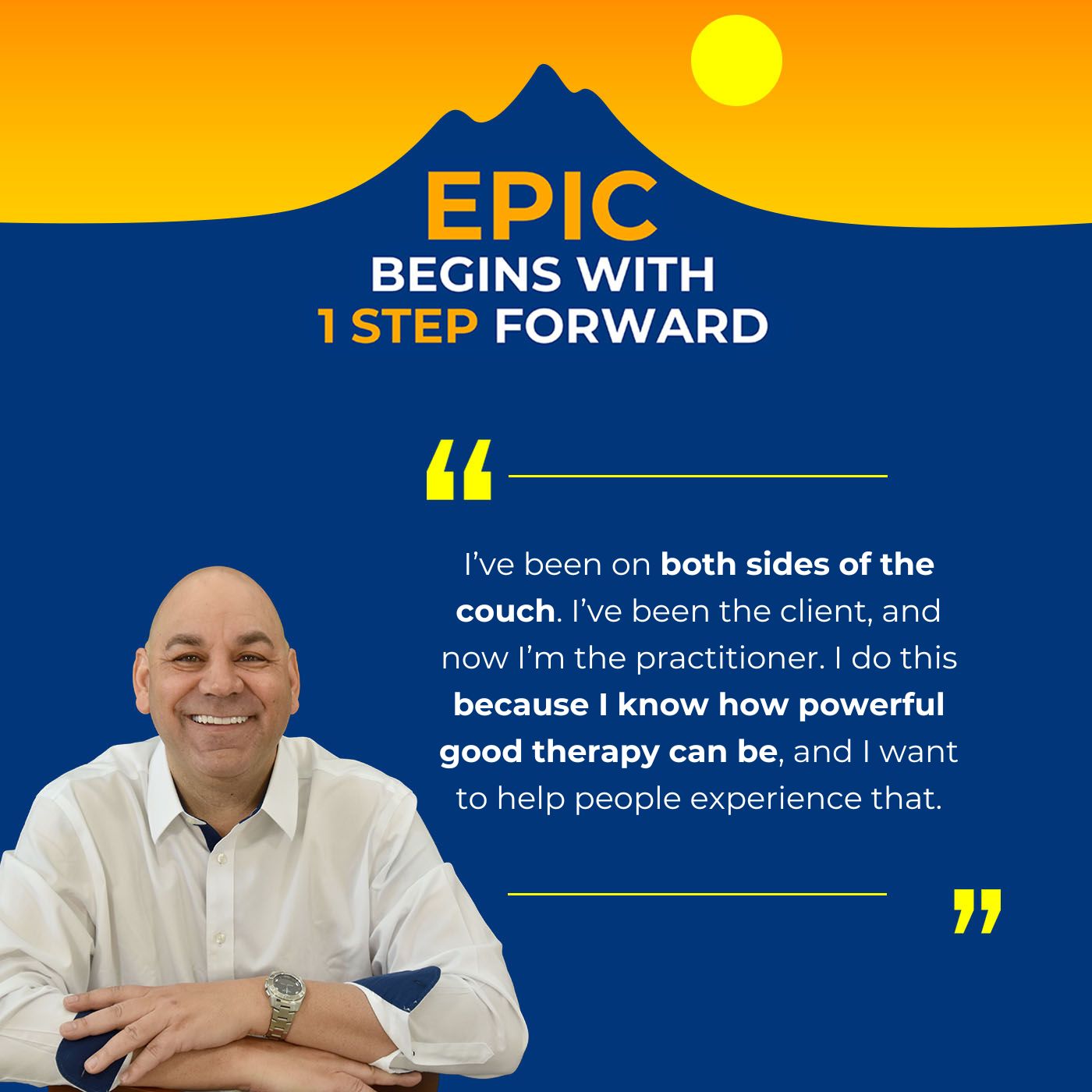
I’ve been on both sides of the couch as it were. I’ve been a client, I’m a practitioner. I do it because I want to help people because I know how powerful good therapy can be. You’re right, there are different modalities. Every therapist has those schools of thought that power how they do therapy. What I’m choosing may not work for you. That’s okay. When I say intimate, people get all squirrelly. I’m like, “It is.” I want you to talk about the things that scare you, the things that are bothering you. If you can’t trust me, if you don’t feel that it’s safe to talk to me about it, that’s a wasted hour of your time. It’s wasted hour of my time.
This has been fascinating I’m sure you and I could talk for literally hours about all of this. One of the things I love to ask my guests is in my book, I have this concept of not yet. Those things that we know we want to do but we just haven’t done. We haven’t given up on them but we haven’t done it. What’s 1 or 2 of your not yets?
The “Not Yet” Goal: Full-Time Music Engineer And Producer
This is pretty timely. As an audiophile and a musician for a long time, I’ve been recording music and producing music at different times like with different bands or solo artists etc. That’s a thing that I’ve wanted to do for a long time. I remember back in 2012, I had a few band members leave and I went, “I’m going to start this company again get married,” and here we are, many years later and I am literally at the cusp of doing more of the work that I want to do actively with this studio that I’m a part of working on that.
I thought about that. The not yet for me specifically is I want to be a full-time music engineer and producer and working on the creative side from mental health perspective with artists and I’m doing that but I’m taking those steps to be able to do it and it’s funny how twists and turns will get you to a point. Even with the office space that I’m in right now. I looked at 4 or 5 other office spaces a while ago and had a few people tell me, “I’ll send you a lease,” and then they reneged on it, pulled it back.
I found a recording studio that had some office spaces on the side and made friends with the owner and all of this has just worked out the way that it’s supposed to, but because of those steps that I’ve taken to be able to do it. The not yet is give me a few years and I’ll be doing engineering and production pretty much full-time, if not 100% full-time, but tying in all the work that I do from the podcast as the mindset and self-mastery and all the things that help really creatives and artists excel at what they do and get that message and that purpose out of them.
Absolutely. Nick, this has been fabulous. How can people get ahold of you?
The best way are my two websites. NickMcGowan.com will show you everything that I do, specifically in the world of helping podcasters and working with people to resonate with their audience. TheMindsetAndSelfMasteryShow.com is my website for the podcast. You can check out all the episodes, more info about me. There’s contact info on there. I’m barely on social media at this point. I do some on LinkedIn, so if there’s anywhere you want to reach out, reach out there. For the most part, just go to the websites. You can see everything I’m about.
Nick thank you so much for joining me today. What an epic conversation.
Thank you.
I want to remind everyone that if you’re ready to begin your epic journey, go to EpicBegins.com and as always remember epic choices lead to the epic life that you want.
Important Links
- Nick McGowan
- Rich Dad Poor Dad
- The Hitchhiker’s Guide to the Galaxy
- Epic Begins With 1 Step Forward
- The Mindset and Self-Mastery Show
- NIck McGowan on LinkedIn
About Nick McGowan
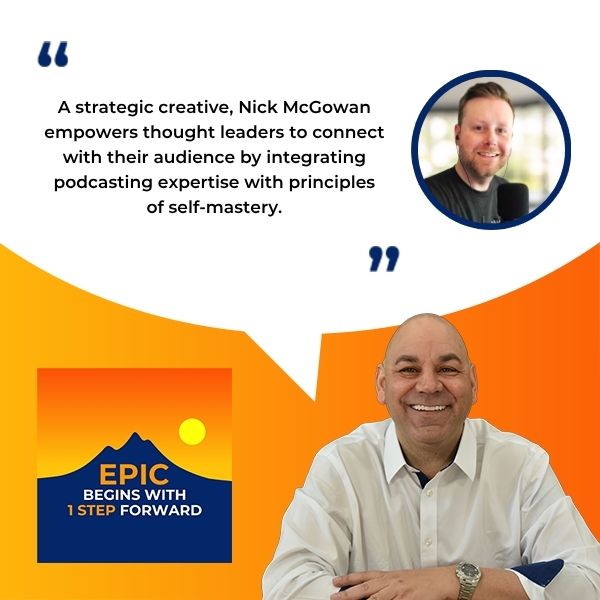
 Nick McGowan is a mindset and self-mastery mentor, podcast host, and strategist who helps creatives and thought leaders turn meaningful conversations into transformative movements.
With more than two decades of experience across marketing, media, SaaS, music, and personal development, Nick brings a rare blend of inner mindset and self-mastery work, along with practical strategy, to people who feel called to use their voice to share something that matters.
As the host of The Mindset and Self-Mastery Show, Nick has spent years exploring the stories, breakthroughs, and challenges that shape who we become. His work centers on one core belief: when people master their mindset, communicate genuinely, and trust their voice, they unlock the courage to share their message in a way that truly resonates.
Through his work with podcasters, creatives, and mission-driven leaders, Nick helps launch and grow podcasts that maintain the soul of their message while building a strong strategic foundation for their work. From strengthening discoverability through SEO to guiding podcast tours that prioritize meaningful conversations over mass outreach, he equips leaders with the tools and mindset required to expand their impact.
Nick’s passion lies in helping people move past hesitation, refine their message, and step into the conversations they’re here to have, because the right message, shared in the right room, has the power to transform.
Nick McGowan is a mindset and self-mastery mentor, podcast host, and strategist who helps creatives and thought leaders turn meaningful conversations into transformative movements.