In this inspiring episode of Epic Begins With 1 Step Forward, Zander Sprague sits down with entrepreneur, author, and business strategist Adam Strong, whose journey began with an unlikely business—collecting and selling lost golf balls at just 11 years old. Despite growing up with financial hardship, bullying, alopecia, and asthma, Adam developed the resilience that later helped him compete alongside elite athletes, including future Olympic champion Mo Farah. Today, he helps founders scale their businesses and increase company value while preparing for successful exits. Together, they explore why self-discipline matters more than motivation, how failure becomes your greatest teacher, and why every entrepreneur must embrace continuous learning and growth. This episode is a powerful reminder that extraordinary success is built one intentional choice, one lesson, and one step at a time.
Free E-book – https://dl.bookfunnel.com/afk096okro
Apply to be a Guest on My TV show – https://www.epicchoicemedia.com
#EPICBeginswith1StepForward, #ZanderSprague, #ScaleUpAndExit, #EntrepreneurialMindset, #Accountability
—
Watch the episode here
Listen to the podcast here
Bullied, Asthmatic, And Unstoppable: Adam Strong’s Epic Journey
From Golf Balls To Business Strategy
I have an international guest with me, Adam Strong, all the way from the United Kingdom. Adam, welcome, and tell us who you are and what you do.
Thank you very much, Zander. I really appreciate you introducing me. Guys, my name is Adam Strong. As you can tell, I’m not an American, Canadian, or Australian. I’m from Britain. What do I specialize in? I specialize in working with founders and business owners who wish to scale up and exit over the next two to three years. I help increase company valuations and give them the framework to be able to do that.
That is really cool. Now I always like to get people. We’re all on these epic journeys, and yet they did not just begin magically when we were adults. In doing some research, I learned that your entrepreneurial path began collecting golf balls.
You are correct.
Talk a little about collecting the golf balls and how you got to where you are.
That’s a good question. I started up my first company when I was eleven years old. That was my real first taste of entrepreneurship, which was completely accidental, in all honesty. When I grew up, my mom was single at the time. We lived off the state and did not particularly have a large amount of money. I do not know what happened, but I was just walking, just minding my own business, and I do not know if you ever believe in this, but this message from the universe. Do you know what I am saying?
I started seeing all these golf balls, not knowing that there was a golf course nearby, of course, but then the next day I decided, “I’m going to go start collecting these golf balls, just out of a hobby type of thing.” As I walked further and further along, I found the entry into the fairway. I had this big bucket of golf balls, used to jump into the water and forage through the bushes and all that kind of nonsense. The golf course at the time, which was an eighteen-holer, used to attract a lot of old folk, people in their ‘70s, retired old folk type of thing.
They probably had a handicap of about plus fifteen, not that I know much about golf, but they were very highly competitive. One really particular great story that really stuck out to me, one of my first encounters was two old men running down the fairway, waving their clubs, trying to warn me that I might get hit by a golf ball. That is where the conversation started. “What are you doing here?” “I find lost golf balls.” They told me that they had pretty much exhausted their supply of golf balls. They were like, “You’re looking to sell your golf balls?”
I am like, “They really thought about that. Sure.” That is when I started to learn more about sales and negotiation. Also, the importance of brand as well. I’m not a golfer for you guys, have no experience in golf and never had any interest in golf, but I did quickly learn about the importance of good-condition golf balls, what the different price points were, and also the importance of negotiating and sales because, effectively, golf balls are damn expensive. I do not know about you.
As a golfer, I could say, and someone who has been generous in my donations to the tall weeds, the woods.
I did not realize this. I’m like, “Holy s***.” It’s like $10, $15, $20 for a ball on my damn. I was charging like $3, $4, $5. They were trying to negotiate with me. I am like, “You can take this golf ball, and you can go buy this golf ball in the golf shop if you like. It is going to cost you four times more. We have a deal. That was my opening line, and that is where it all started.
That is a good start. I have to say, for many entrepreneurs, it was not intentional and was just there. All of a sudden you realize that “I have a business that I did not intend to have.” That’s really cool. Now, one thing I have got to say I am interested in is that you were an athlete at one point. I’m not saying you’re not still an athlete here, Adam, but you seem to have achieved a certain level of success because you were training with Olympians. Talk a little about that. That’s really cool.
Overcoming Adversity Through Elite Athletics
Listen, eleven years old was a bit of a special age for me. I went through an early midlife crisis, if you want to call it that. As you do, my childhood was quite scarred. I lost my hair through alopecia when I was ten years old due to stress and worry. I was bullied from a very young age. I was low in confidence, that kind of stuff. I suppose getting into entrepreneurship was one of the stepping stones, actually, but around that time I got into elite athletics when I was an asthmatic. People would look back at this and think, “You were asthmatic. What the hell? Why would you go running?”
That was crazy. I did not really have a lot of friends around me, and because I was bullied a lot, I used running more importantly as a way to escape. Because I did not have a father figure around me, my mom really did not support me that much when I was younger either. I had the confidence to just turn up at the athletics track and say, “I’m interested in joining your club. Do you have any spaces?” She is like, “Sure. What are you interested in?” I am like, “I’m interested in distance running.” She was like, “Cool. Let me go and introduce you to the coach.” I was like, “One snack. I haven’t told you here. I’m asthmatic.”
She’s like, “Do not worry. We figured that out.” I am like, “Okay.” What happened? Within the first six months, it was a real struggle for me being asthmatic, especially training during the winter season. It’s tough because it can get down to like minus 5, minus 10 Celsius, which is really cold. That is where it all started for me. I had zero experience. For the first six months, I could barely run a hundred meters. It was a real struggle for me. I could have just thrown the towel in and just decided, “This is enough for me. I’m taking enough beans as it is.” I actually stuck at it. I stuck at it and decided, what have I got to lose?
Within 6 to 12 months, I actually met my training partner who is now the current world and Olympic world champion, Mo Farah, in 5,000 and 10,000 meters. He was obviously not by then, but he is now. What was really interesting about him is that he came from Africa, Somalia, more specifically, barely spoke a word of English, and went through it because he was a different kid like me. We used running as a way to escape, but we used it as a healthy competition as well. Where that really excelled within six months, I was really turning things around, and then eventually got to the national level, got to elite status, started studying and training with the Olympians, Mo being one of them.
That’s really cool. I used to do distance running. I did half marathons, marathons, one 50K ultra, which was certainly fun, many years ago. I know my listeners like, “No, he is going to talk about marathoning again. Talk about it a lot.” I will try not to talk about it, but yeah, I can totally get that. There is something about distance running. It is a challenge. When you begin and set a goal, I want to go run a 5000 meter or a half marathon or even a 10k. You’re like, it seems impossible.
You’re like, “I have no idea how I am going to do this, but I’m still going. I’m still going to go on this epic journey because I’m interested to figure it out.” I tell people all the time, you know, I enjoyed running. I enjoyed that identity of saying, “I’m doing this thing that lots of people do, but it is like one percent of the world’s population completed a marathon.” I am like, “That’s really cool. I’m part of that.” It’s hard, those training days. It applies to business. I call them the grindy runs, those runs when you cannot find your pace. You cannot find your breath. It is like you’re running through molasses. You show up the next day and go, “It’s a new day. Let’s go out and do it again.”
Listen, I learned a lot of mindset shifts in my early days, and obviously through the springboard of entrepreneurship, you mix that with entrepreneurship. It’s a very interesting chemistry experiment. I can tell you that for sure. What’s really interesting just off the back of that is there are huge correlations between elite sport and how that can spiral into entrepreneurship. It’s actually really useful. I would say that I was very much ahead of my time when it came to building a business, because I had already mastered the mindset that was required to run a business.
There are huge correlations between elite sport and how that can spiral into entrepreneurship.
Definitely. Sport gives you so much clarity. One of the things I just got started, endurance running when I was 38, and honestly, I did it as a way because I was working in the corporate world. I knew I needed exercise, even though I could get a free gym where I worked. The stress of trying to get to the gym at lunch in between meetings to reduce my stress. It’s like I was doing it to reduce my stress, but I was more stressed trying to get the exercise to reduce my stress.
A colleague of mine is like, “Why don’t you run? No matter where you are, if you have to travel, you can go out for a run.” Although that is technically true. I do have to say it is sometimes challenging and scary to go into a city that you have never been in and go, “I’m going to go for a 4 or 5 mile run around a city. I do not know where I am. I barely know the address of the hotel I am at. I am going to get lost.” That’s also fun. All of what you learn, I rediscovered that I like structure. Structure makes me feel comfortable, and it’s helpful for lots of people as a mental health professional.
I talked about structure all the time because from a psychological standpoint, if we understand what we need to do, it’s so much easier to execute. When you were a runner, if the coach said, “Look, you have got to go out and run whatever distance.” “I can go do that.” When you were done, you were done with your training for the day. It was not all day. You were like, “Here’s what I need to do. Once I do it, I’m done. Now I get to go on to the next thing.”
That’s cool. I know now you help business leaders. You have written your three-time bestselling author. Congratulations on that. That’s awesome. One of the things I wanted to dig into with you is that you talk about accountability, and I think that’s an interesting subject these days of people owning what they have done. As a business leader, I made a decision. Maybe it did not work out, but you’re the one who has got to get up and say, “That wasn’t a good choice. I’m really sorry.” How do you help leaders with accountability?
Mastering Self-Discipline And Accountability
Accountability and ownership are very similar things. How do I help them? It entirely depends on, number one, what is it they actually want to achieve in the first place. When we think about accountability, I spin it on its head. The main recipe for why I was very successful in the running realm is because of self-discipline. They are two completely different things, by the way. Accountability and self-discipline are two very different things, because ultimately a lot of entrepreneurs that run a business need to have self-discipline because generally most do not have the mentorship.
They do not have the support structures in place. It can be quite lonely at times. I know, granted, put my hand up. I feel like, I guess in a nutshell, from a self-discipline perspective is like I’m not a big believer in motivation. I do not believe in motivation. I believe that if you need to be motivated to do something, it’s like you’re forcing someone to do something. Does that make sense? If you want to do it because you have a passion for doing it, that’s completely different. You still have to have the self-discipline to go out and put the reps in, like running, like going to the gym or whatever it is.
You have to put the reps in. Otherwise, you cannot move those micro steps forward. That’s where improvement happens. If you apply this to business, I know a lot of businesses out there that have stagnated. They plateaued for many years. There are a number of reasons for that. Normally it’s because of the founder or the person that’s running the ship. Number one, they are, I suppose, taking inventory as in, they’re not taking responsibility and accepting that actually, “This is not working.”
Maybe I need to go in a different direction. Maybe I need to try something new. You do not accept it. That’s the first thing. Secondly, when it comes to ownership from a self-discipline perspective, you also have to accept that if something does not work, that’s okay. Making mistakes is a part of life. I’ll be honest with you. I made more mistakes. I’ve done more fuck ups and screw-ups than most people. I would not change it for the world because the way that I see it is that I have just discovered a way that this particular way or strategy, whatever it is, does not work this way, and that’s okay.
I could not agree more. I talk about how failure is part of our journey. We are not perfect. I find it from a psychological standpoint where day to day, we’re not particularly burdened by the fact that, for example, we do not have all the answers to all the questions we may get, yet we still get up, and we still go on with our day. Yet when you are thinking of starting to run a business, or you’re running a business, oftentimes, “I cannot do that. I do not have all the answers yet. I’m doing research.”
Look, research is good. Knowledge is power. However, one step forward is always going to get you closer to your goal. Look, maybe that’s not the right step. You’re right. You learn, “This is not how to do this thing.” I also think, sadly, ego gets in the way. I do not want to admit that I made a bad decision, but the people who are successful say, just like you did, “I messed up a lot.”
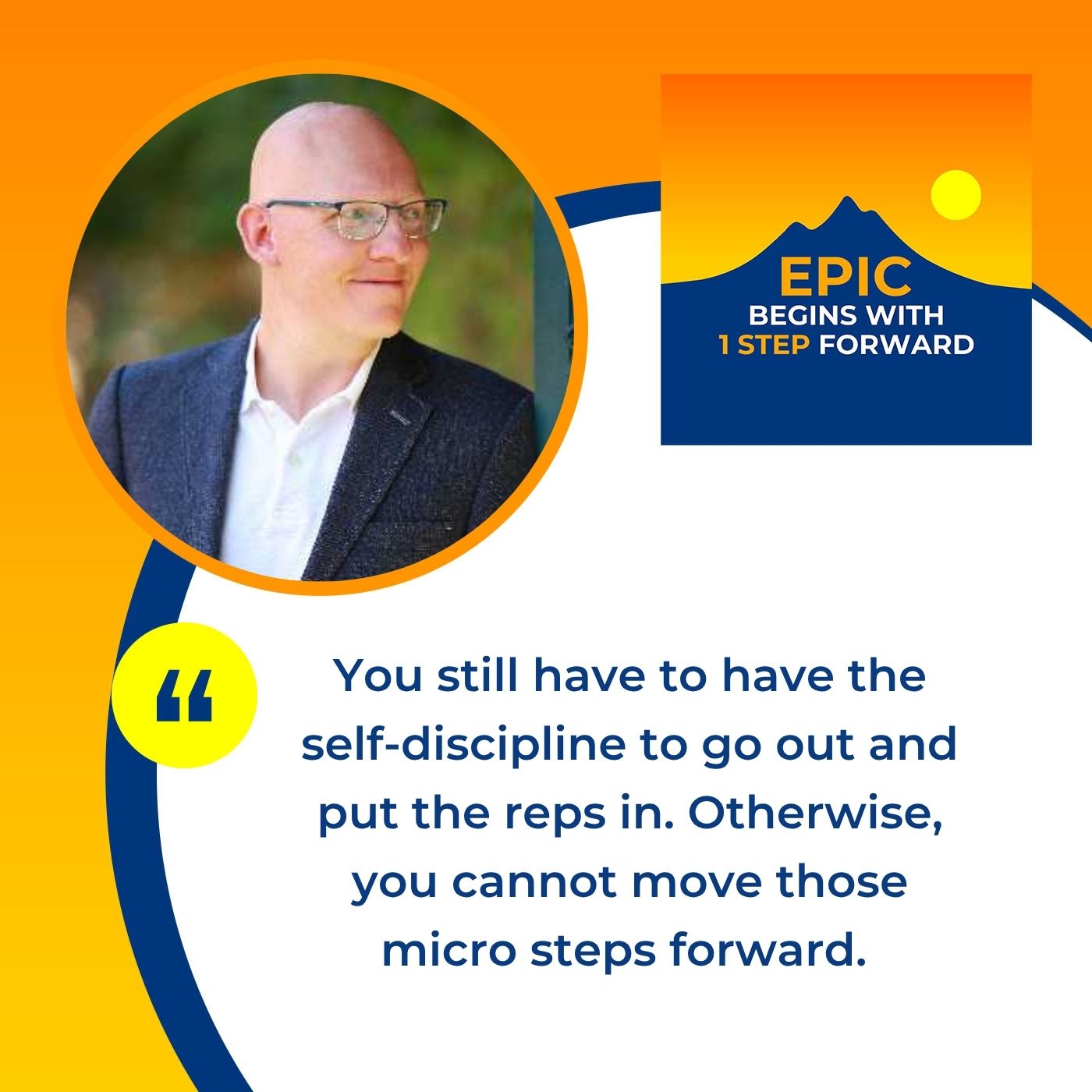
You still have to have the self-discipline to go out and put the reps in. Otherwise, you cannot move those micro steps forward.
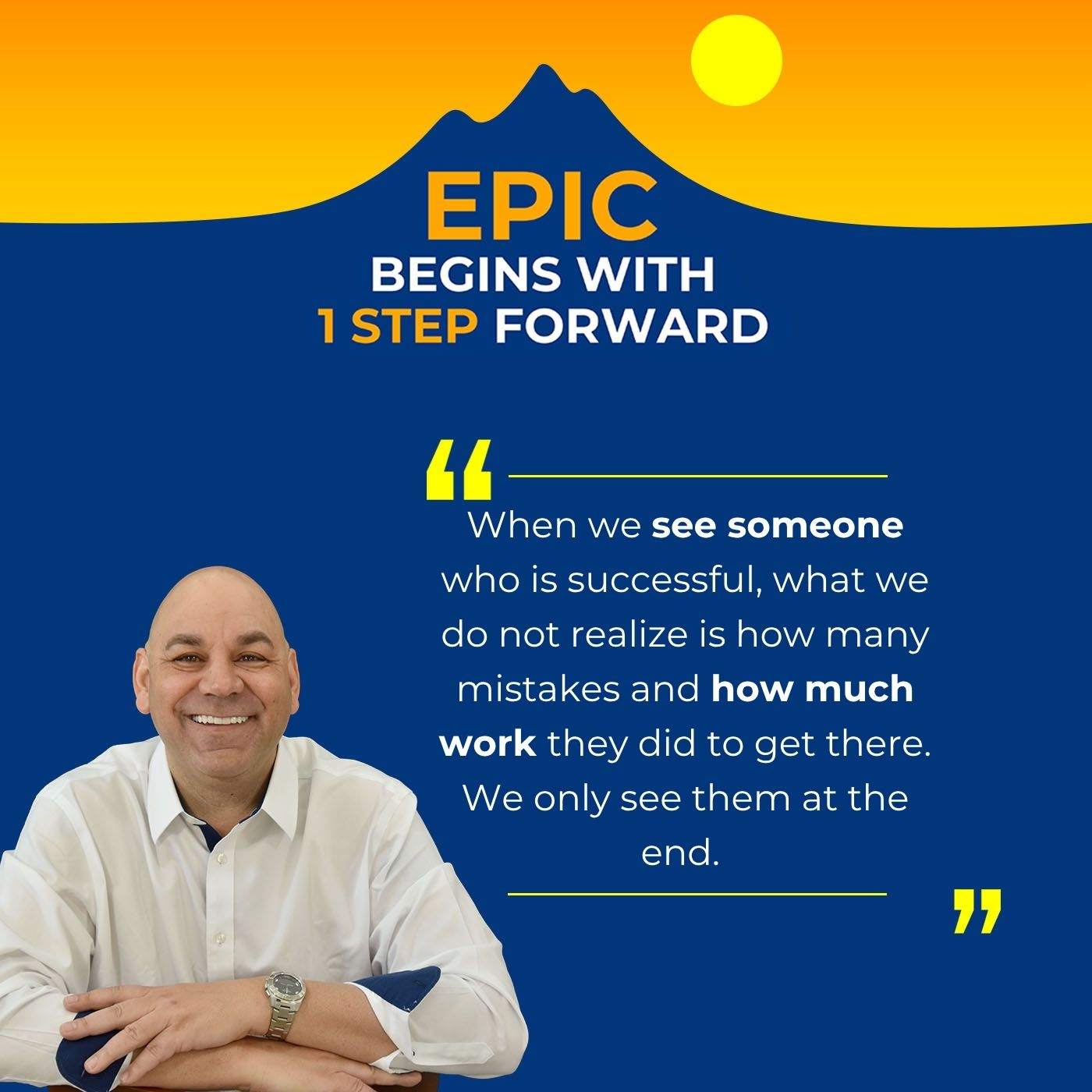
We look at people. There’s that famous quote about Thomas Edison. “Tried a thousand different ways to make a light bulb.” That’s true. People make mistakes. When we see someone who is successful, what we do not realize is how many mistakes, how much work they did to get there. We only see them at the end. Your friend Mo, I am going to guess he has had hundreds, not thousands, of bad training sessions.
Absolutely. 100%. It is the same with running a business. There are going to be good days and bad days. You have to accept that. When you do have those bad days, you have got to have the tenacity and the resilience to say, “Do you know what? That was a bad day, but today is going to be a good day because I choose to make it a good day. I choose to do things differently. I choose to learn. I choose to grow.” I hope that answers your question.
Great answer. I love these kinds of discussions because I think they’re really important. It is when we are on these epic journeys that I think each and every one we are. Most times we’re on multiple epic journeys simultaneously, and they’re not short-lived. A lot of these are really long-term things, and we do not know where it’s going to go. That’s okay.
As long as you’re taking steps forward, as you said, take inventory. How’s it going? Let me be honest. Let me get some honest feedback about what’s going on. Let me ask people who I know might not agree with me a hundred percent. You do not need lots of detractors, but 1 or 2 who go, “Adam, you want to know what I do not know that this is working for you. Here is why.” I know as an entrepreneur, I have been generous to try out lots of different software, and they do not work out for me.
Making mistakes is a part of life.
It’s not that they’re bad. They are just not the right tool for me. Former runners, you try different types of running shoes to find the brand that you like and the one that works. I do have to say that one of the things that drove me up the wall was that you would find a pair of running shoes that worked. It’s just right. The next year they improved it. It did not fit right. The thing that you really loved about it, they took away. You’re like, “No, do not change it.”
Do not change the recipe.
Embracing Failure And Defining Future Goals
I had a running coach. He said, “If you find a pair of shoes that you like and they work for you, buy as many pairs as you can, because they will change them.” You will be happy that you spent a lot of money upfront because then you’re like, “This is worn out. Now, I can do it.” That’s true for you as an entrepreneur. If you find a tool that works for you, use it. Interesting. One of the things I love to ask my guests about is in my book, I talk about not yet, the concept of not yet. There are so many things in our life that are not yet as an entrepreneur. I’m launching my business. Do I have my first customer? Not yet. Have I made X dollars that I set a goal for? Not yet. For you, what are 1 or 2 of your not yet? It does not have to just be in business. It could be personal.
I’ve always wanted to do this. I can mix this up, actually. I think on the personal front, my not yet is that I really want to do something completely bonkers, whether it be, I do not know, climb Mount Everest base camp or do some mega adventure race or whatever it is. To me, I’m a big believer. My mind says I can do anything. I can move on. My body wants to do it. It is a completely different thing, of course. That’s a whole new conversation, of course.
That’s a whole other episode.
That’s a whole new episode altogether. On the personal front, that’s my what-not. From a business perspective, I would say my not yet. Here are a couple of things. Let’s just think, you’ll know that I’ve got a podcast which I’ve turned into a media company. I have not yet officially hit a certain revenue target for example with it yet. That to me is okay, but I’m moving towards it, which is very good. Learning from some of the other successful podcasters, whether it is John Lee Dumas, Steven Bartlett, or whatever it might be. Reverse-engineering what they do and learning from those guys is absolutely pivotal. Hopefully, I will not be too far behind them.
Whether it is John Lee Dumas, Steven Bartlett, or whoever it might be, reverse-engineering what they do and learning from them is absolutely pivotal.
Look, I think goals are always so important. Let’s understand what our destination is. Also understand that when you get there, you’re really excited, but very soon it goes away because, “I’ve achieved this.” The question is now, what? I know when I finished my first marathon, I was so excited. About a half hour later, I’m like, “Now what?” Not that I wasn’t very grateful that I had trained hard and achieved my goal, but for me it did not end there. It’s like, “I achieved this.” In business, you go, “I will have made it when I hit this revenue goal, whatever X goal.” When you get there, you’re like, “That’s great,” but it’s not like you’re like, “I hit a million dollars.” That’s it, and you exit.
There’s far more to it.
Connecting With Adam Strong
It’s so interesting that you talked about, not necessarily the motivation, but I think there is some motivation to say, “I am competitive. I want to hit this goal.” Your own self-motivation. Look, as entrepreneurs, I know there are lots of jobs I have to do that I really do not like. I wish I could offload because I want to spend my time talking and stuff, but that’s not always the way life works out where you could just say, “All the stuff I do not want to do.” I will get other people who are experts in marketing or outbound sales or whatever. That’s cool. How can people find you, Adam, if they want to read your book, or they want to hire you to come speak?
I’m only really on two social media channels, which are LinkedIn and YouTube. Those are the two places that I really hang out. Alternatively, you can go out and check the podcast out, which is called The Business Strategist. You’re very welcome to take a look at that. Actually, 45% of our audience is in the United States. Hi to my fellow Americans.
That’s awesome. I want to thank you so much for coming on. What a fascinating conversation. What an Epic life you’ve led so far.
I appreciate it.
I want to remind everyone that if you’re ready to begin your Epic journey, go to EpicBegins.com. As always, remember, epic choices lead to the epic life that you want.
Important Links
- Adam Strong
- Adam Strong on LinkedIn
- Adam Strong – Scale and Exit on YouTube
- The Business Strategist Podcast
About Adam Strong
 Adam is known as the ‘Business Strategist’, Best Selling Author, Entrepreneur, International Speaker and podcast host. He currently works with experienced business owners and entrepreneurs in the professional services industry to help them scale up and exit from their business. Adam is a Former Elite Athlete that trained with Olympic and World Champion Sir Mo Farah for 3 years.
He takes the same skill-set that he learned as an elite athlete to teach his clients on how to increase profitability by building purpose led, results orientated and impactful businesses. He is the best selling author of three books ‘Move it or lose it’, ’Fit body fit business’ and ‘Play the game’. Adam is the currently the host of ‘The Business Strategist’ a globally ranked podcast in the top 1.5% that shares tips and insights with business disruptors, thought leaders and experts. Adam is hugely passionate about helping his clients in growing and scaling their businesses in a fast and strategic way.
Tying that with helping people he believes is a great catalyst to creating results and success in life. He has been featured the front cover of Influential People Magazine, Steer Magazine and Global Man magazine, BBC radio, the Huffington post, in People Management magazine, Forbes, CIO, Edge, HR Director and DiversityQ. He has interviewed over a thousand influencers and thought leaders such as Jack Canfield, Marshall Goldsmith, Dr John Demartini, Chester Elton, Evan Carmichael & Olympic athletes such Neil Fachie, Jonathan Horton and Kate Strong. He has shared the stage with celebrities such as John Travolta, Vanilla Ice, Calvin Klein, 50 cent and Dr Nido Qubein.